


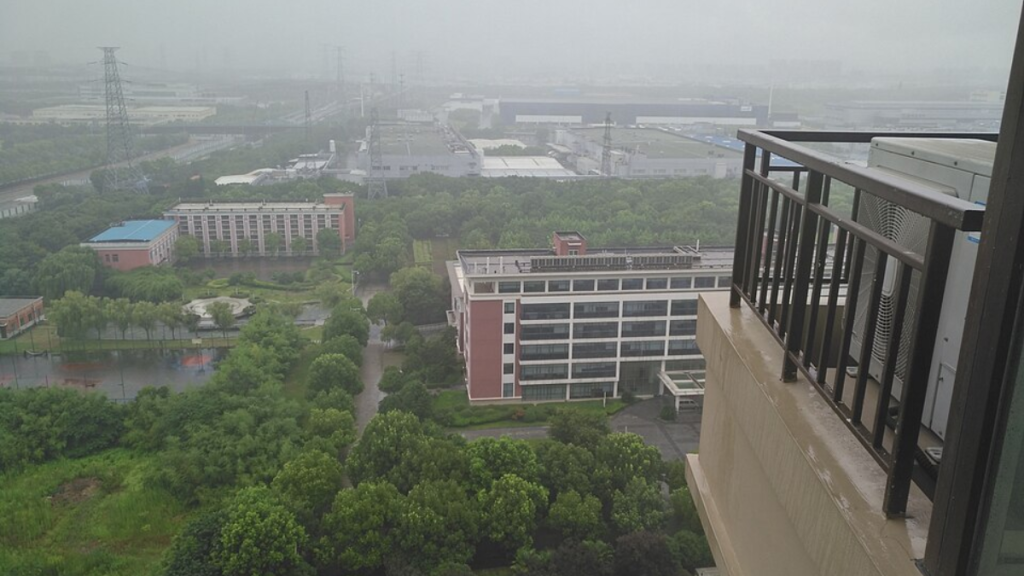
New Delhi: Typhoon Dolphin has left a trail of disruption across East Asia, with flooding, transport shutdowns and mass evacuations reported after the powerful storm struck China on Monday. More than one million people were moved to safer locations in eastern China as authorities prepared for prolonged rainfall that could trigger further flooding and landslides.
Shanghai faced some of the most severe rainfall, with one central weather station measuring nearly 313mm in the 24 hours until 7am on Monday. The figure was the highest 24-hour rainfall recorded at the station in more than 150 years, while another station in the city measured close to 400mm.
The downpour inundated several parts of Shanghai, with videos on Chinese social media showing flooded roads around the Wukang Mansion. The phrase “Shanghai turns into the sea” also trended on Weibo as footage of the flooding spread online.
The storm’s impact prompted extensive evacuations in Zhejiang, Fujian and Shanghai. Wenzhou in Zhejiang moved more than 900,000 people from vulnerable locations and established over 1,500 emergency shelters, while nearly 98,900 people were relocated from high-risk areas in Fujian.
Shanghai’s evacuation figure also rose sharply, reaching 215,600 by Sunday evening from an earlier estimate of 30,300.
Dolphin weakened to a tropical storm by early Monday after moving inland, but its weakening did not bring an immediate end to the threat. Heavy rainfall was expected to continue across eastern and central parts of China, with Shandong, Henan, Hubei, Anhui, Jiangsu, Zhejiang and Shanghai among the areas facing further downpours.
Chinese authorities retained an orange heavy-rain alert and warned that continued rainfall could lead to widespread flooding and landslides through Wednesday. Some locations were forecast to receive between 200mm and 400mm of additional rain.
The storm also disrupted air and ground transport. More than 1,300 flights were cancelled at Shanghai’s two airports, while several public transport and local train services were suspended. Ningbo International Airport was expected to restart operations from midday Monday, although further delays and cancellations remained possible. Hangzhou also resumed subway services after some train operations were halted on Sunday.
Dolphin’s wider regional effects were evident even in places where it did not directly make landfall. Hong Kong recorded its highest temperature ever on Sunday, reaching 36.9 Degree Celsius, with officials expecting the extreme heat to continue into Tuesday.
Taiwan suspended ferry services and cancelled more than 180 flights as strong winds and heavy rain associated with the storm affected the island.
Prior to arriving in China, Dolphin struck southern Okinawa prefecture of Japan, injuring six people and leaving over 50,000 buildings without electricity. In the Philippines, the typhoon remained off-shore, adding to the rains brought about by the monsoon season, resulting in floods in northern Luzon, particularly those near Manila.
The storm has once again highlighted the wider risks associated with increasingly extreme weather. Scientists say global warming is making extreme weather events more likely, including the development of more powerful typhoons.