


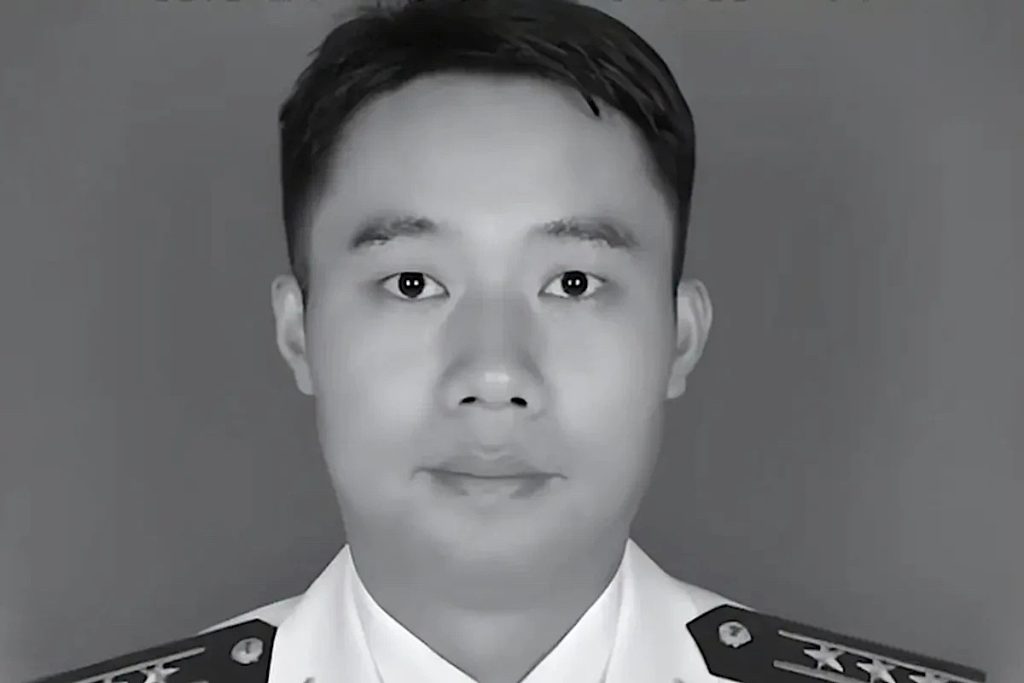
New Delhi: Two pilots of the People’s Liberation Army – Navy (PLA-N) – one of them a senior tactical commander – died during flight training exercises on Friday. The deaths were disclosed by local Chinese government bodies and regional media, not by Beijing’s defence establishment, which has said nothing on the matter more than a month on.
The disclosures came through a series of unconnected local channels rather than any central military statement – a pattern typical of how the PLA handles fatalities in its ranks. It remains unclear whether the two pilots died in the same incident, while flying the same aircraft, or in entirely separate accidents.
The senior of the two, Senior Colonel Fang Ming, 38, was a tactical commander with the Southern Theatre Command’s naval aviation unit, according to a report by the state-run Hefei Daily last week, on July 3. Fang, who hailed from Lujiang county in the eastern province of Anhui, had enlisted in 2006.
The Lujiang county government posted a video on Monday stating that he died during flight training on Friday. A memorial service held for him on July 3 was attended by more than 200 people, including personnel from his unit.
The political work department of China’s Southern Theatre Command’s naval aviation unit formally recognized Fang as a martyr. He held a third-class merit from 2018 and a second-class merit for combat-readiness and training from 2022.
A former colleague described him in the memorial video as someone who had always volunteered to take the lead. This held true, he said, whether in daily training or on operational missions.
The second pilot, First Lieutenant Shi Shaoyong, 25, belonged to Unit 91911 – also under the Southern Theatre Command’s naval aviation division. The unit has previously been reported to operate helicopters.
According to the Linyi News, Shi had enlisted in September 2019 and held the rank of a class IV pilot. He had already been awarded a third-class merit.
He had volunteered to serve on the South China Sea front line after completing his training. A tombstone inscription shared by the Yishui county government in Shandong – his home region – said he died during a night flight training mission, also on June 10.
He too was posthumously recognized as a martyr. Beyond these local-level disclosures, there has been no acknowledgement from China’s ministry of national defence or state media of the accident, nor any confirmation of the aircraft type involved.
A pattern of opacity
Beijing’s silence is consistent with the PLA’s long-standing reluctance to confirm training accidents or combat casualties. These typically emerge – if at all – through provincial or county-level channels, obituaries, or social media, rather than formal military announcements.
Indian readers will recall a comparable instance from the 2020 Galwan valley clash. China took roughly seven months to publicly confirm any casualties on its side, eventually naming four dead in February 2021, against India’s acknowledgement of 20 losses within days of the clash.
That episode remains a reference point for how differently the two militaries handle transparency around fatalities. The Southern Theatre Command, under which both pilots served, oversees Guangdong, Guangxi, Hunan, Yunnan and Hainan provinces along with the South Sea Fleet.
It also carries responsibility for China’s claims and patrols across the contested South China Sea. This is a theatre where Beijing’s disputes with Vietnam, the Philippines and other South-East Asian states remain unresolved, with freedom-of-navigation implications for Indo-Pacific stakeholders including India.
The accident also comes at a time when the PLA has been intensifying flight training tempo across services. This is part of Beijing’s push to modernize its forces and integrate newer platforms and tactics – a drive that has, on occasion, coincided with a rise in reported training mishaps.
For a force this opaque about its own losses, two rare local disclosures surfacing within days of each other is itself a notable departure. It stops well short, though, of any admission from Beijing itself.