


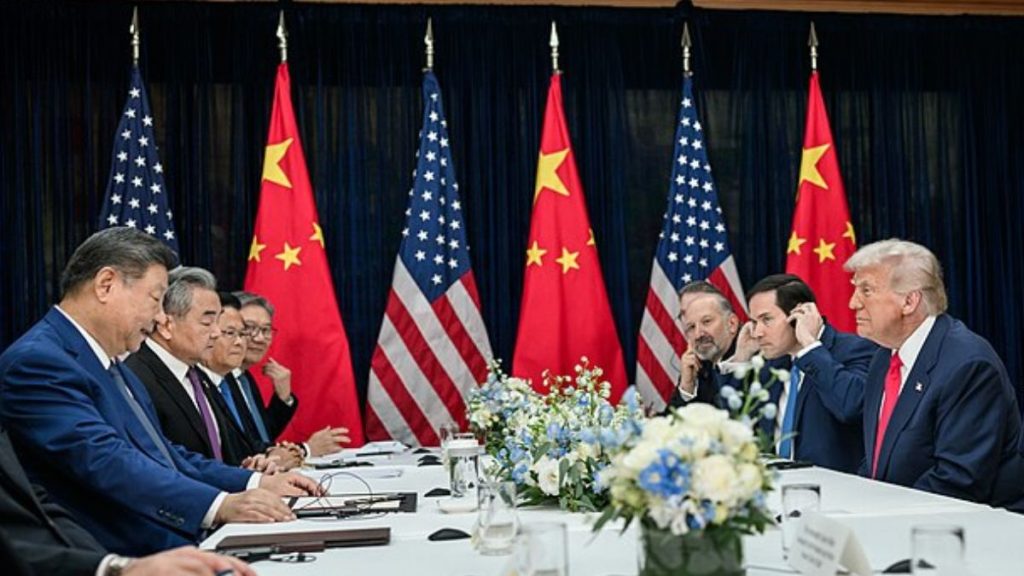
US President Donald Trump is scheduled to visit China on May 14 and 15, 2026. Trump’s trip could test the bilateral ties with China, as he holds summit talks with Chinese President Xi Jinping on various fronts, including military, trade, and Taiwan.
The visit, like most other presidential engagements with Beijing, is a modest step toward achieving greater stability and predictability in what is described as the world’s most important bilateral relationship.
This Trump’s visit brings with it oversized expectations. That is because the US-China relationship is at present the most complex and challenging on many fronts.
China is more confident of its ability to stand up to Trump on many key issues, such as sanctions, technology controls, critical materials, Iran, and, in particular, Taiwan.
But its eagerness in having the Xi-Trump summit meeting betrays uneasiness, particularly on matters that have strained their ties in recent years.
Both Trump and Xi have a common goal this time. They want to show off their skills in managing each other and coming out on top.
Both countries may announce a return trip by Xi to the US sometime later this year, particularly when Xi is expected to attend the G-20 meet in Miami.
Trump would want to show the world that his ties with Xi can deliver tangible economic and security benefits to the US.
He is expected to seek Beijing’s support for his efforts to end the Iran war and the reopening of the blockaded Strait of Hormuz.
He would also aim to secure Chinese commitments to significantly buy US goods and services, particularly emphasising purchases from American companies in sectors such as agriculture.
Following the failed previous commitments under the 2020 Phase One Trade Deal, Trump could announce a ‘Board of Trade’ with senior officials from both the US and China overseeing implementation.
The US may ask China to expand its supply of rare earth materials, as agreed between Trump and Xi in Busan in 2025, and to block fentanyl precursor exports.
Trump and Xi may also hold discussions on Artificial Intelligence, particularly the risks and safety hazards, and Beijing’s support and cooperation in finding a solution to the Russian-Ukrainian war.
Xi’s top priority during his talks with Trump would be to achieve greater stability and predictability on tariffs.
China is particularly welcoming of Trump’s visit to Beijing, the first in nine years, as this would lend it legitimacy and enhance global recognition for standing up to the US President.
Beijing has pushed for the establishment of a ‘Board of Investment’ to match the ‘Board of Trade’ and would like an agreement on the need to reduce barriers to investment in the US, something that is more than feasible at present.
Xi will once again emphasise concerns about US engagement with Taiwan and seek explicit agreement to restrict arms sales as a quid pro quo for a more stable relationship.
He may even push for a change in the long-standing American language on Taiwan, to portray that as a win on the island nation’s status.
Meanwhile, China’s Foreign Minister Wang Yi on Thursday (May 7) urged the US to maintain “stability” and warned that Taiwan posed the biggest threat to the relationship.
Wang’s comments just ahead of Trump’s Beijing visit came during a call with his US counterpart and Secretary of State Marco Rubio.
Wang said Beijing and Washington should “safeguard the hard-won stability”.
A US State Department official confirmed the phone call between Wang and Rubio and said it was to arrange Trump’s trip.