


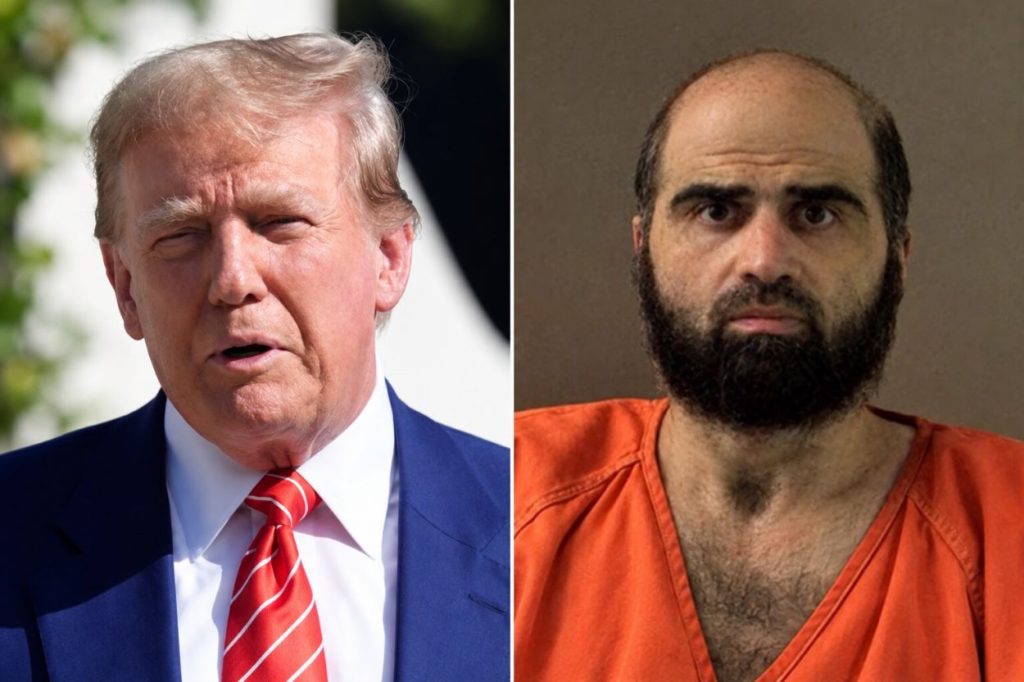
New Delhi: The US president, Donald Trump, is reconsidering whether to allow the Pentagon to livestream the firing-squad execution of Fort Hood mass shooter Nidal Malik Hasan. The proposed broadcast has drawn objections from Republican lawmakers, religious leaders and the United Nations, although Trump continues to support carrying out the death sentence.
Axios reported on Monday that Trump had privately expressed reservations about the livestream. His public comments have also left the broadcast unresolved, with the president saying he would make the final decision.
The uncertainty concerns public viewing of the execution, rather than a withdrawal of presidential approval for Hasan’s death sentence. According to the US Army’s official announcement, Hasan is scheduled to be executed at Fort Hood, Texas, at 1pm Central Standard Time on December 3 – 12.30am IST on December 4.
Trump approved the sentence on October 2 and the acting secretary of the Army, Adam Telle, subsequently selected the execution date. Military regulations require that date to fall between 60 and 150 days after presidential approval, which is necessary before a military death sentence can be implemented.
The US defence secretary, Pete Hegseth, has advocated allowing the public to watch, arguing that the punishment should demonstrate the consequences of such crimes. As RNA Media previously reported, Pentagon officials confirmed the livestream proposal but initially provided no details about how viewers would access it.
Trump’s subsequent statements have made clear that the Pentagon’s announcement does not settle the question. On October 10, he said he remained undecided and would ultimately determine whether the execution was shown publicly.
The US vice-president, JD Vance, has also questioned whether the broadcast will proceed, while supporting Hasan’s execution. “If it’s ultimately livestreamed, I’m not going to be watching it,” he told reporters on October 9.
Supporters of public viewing argue that it would send a warning to potential attackers, but critics contend that the footage could instead serve extremist propaganda. The US homeland security secretary, Markwayne Mullin, rejected that security concern during a television interview on Sunday, saying he saw no additional threat arising from the broadcast.
Mullin defended the proposal as a demonstration that attacks on the United States would bring punishment, adding that watching would be optional. His position contrasts with objections from within the Republican Party that publicizing the execution could turn punishment into entertainment or give extremists material for recruitment.
The international criticism goes beyond questions of security or taste. In a statement to AFP, the Office of the UN High Commissioner for Human Rights said a livestream would be equivalent to a public execution and would breach the absolute prohibition of torture, an intervention covered in RNA Media’s earlier report.
Hasan, a former US Army major and psychiatrist, killed 13 people and wounded 32 others at Fort Hood’s soldier readiness processing centre on November 5, 2009. The dead included 12 serving soldiers and a retired soldier working as a civilian, while troops at the facility were preparing for overseas deployments.
He represented himself at his court martial, acknowledged being the gunman and portrayed the attack as retaliation for US military operations in Iraq and Afghanistan. Convicted of premeditated murder and attempted premeditated murder in August 2013, he was sentenced to death and subsequently held at Fort Leavenworth, Kansas.
If carried out, his execution would be the US military’s first since 1961 and its first by firing squad since 1945. Broadcasting it to an unrestricted internet audience would also differ substantially from the private closed-circuit viewing offered to survivors and victims’ relatives during Oklahoma City bomber Timothy McVeigh’s execution in 2001.
There are also unresolved legal questions about the broadcast: experts told the Associated Press that army execution rules do not expressly address livestreaming. They suggested that Hasan himself would have the clearest standing to challenge it, while attempts by others to stop the transmission could face substantial obstacles.
The execution date itself is not beyond legal challenge, despite completion of the military appeals process cited by the Army. The Death Penalty Information Center says Hasan can still pursue review in civilian federal courts, potentially delaying the punishment independently of Trump’s decision on public viewing.