


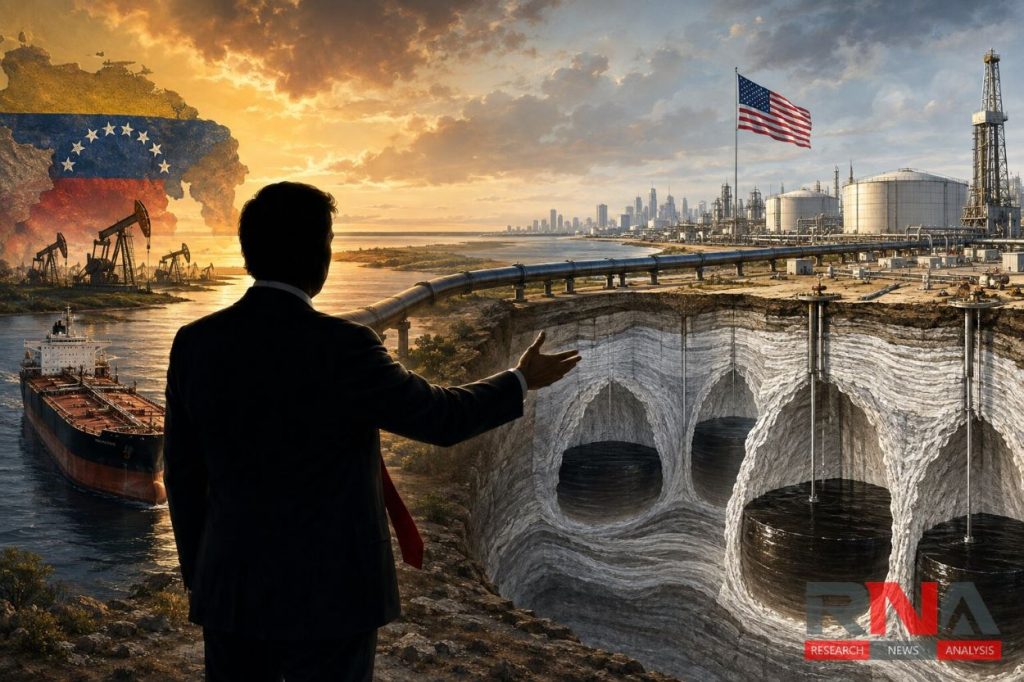
New Delhi: The US president, Donald Trump, has said crude secured through Washington’s new energy agreement with Venezuela will be used to replenish his country’s strategic petroleum reserve, which has fallen to its lowest level in more than four decades. The announcement links the rebuilding of America’s emergency stockpile to a wider attempt to revive Venezuela’s badly weakened oil industry and secure a long-term source of crude for US refineries.
Trump said in a social-media post on August 30 that the process of “topping out” the reserve would begin “very shortly”, describing the oil as a “gift from Venezuela to the people of the United States”. He accused his predecessor, Joe Biden, of having virtually emptied the stockpile, although official data show that releases continued under both administrations as Washington responded to successive global supply disruptions.
The reserve contained approximately 294.1 million barrels on August 20, according to the US energy department, against an authorized storage capacity of 714 million barrels. That means the emergency stockpile was about 41 per cent full – severely depleted by historical standards, but not literally empty.
Biden authorized the release of 180 million barrels in 2022 to ease market disruption and rising fuel prices after Russia invaded Ukraine, the largest emergency sale in the reserve’s history. The Trump administration subsequently drew down more oil during the conflict with Iran, including through a coordinated international programme intended to stabilize supplies, according to the Energy Information Administration.
Trump’s plan follows an agreement announced on August 28 under which Washington says American interests will obtain majority control over more than 65 billion barrels of proven Venezuelan reserves through partnerships with private companies. That volume represents roughly one-fifth of Venezuela’s proven reserves, although the administration has not explained the ownership structure, the participating companies or precisely how US control will operate.
The interim president of Venezuela, Delcy Rodriguez, said the arrangement would remain in force for 25 years and cover 17 existing oilfields, with another eight undeveloped blocks expected to be opened later. Caracas intends to raise national production from about 1.25 million barrels per day to 1.5 million barrels per day, while maintaining Venezuelan sovereignty over the resources, Reuters reported.
Rodríguez estimated that the agreement could generate about $209 billion in revenue for Venezuela, assuming an average price of $65 a barrel, with approximately $19 from every barrel sold flowing to the state. Trump has not clarified whether his description of the oil as a “gift” means that crude destined for the strategic reserve will be supplied without payment or obtained through a separate commercial mechanism.
Nor has Washington specified how many barrels would be transferred, when deliveries would begin or whether the crude would be placed directly in the reserve. The absence of operational details makes an immediate replenishment doubtful, despite Trump’s assertion that the process would start soon.
Venezuela possesses the world’s largest proven oil reserves, but decades of underinvestment, poor maintenance, sanctions and political interference have left its production and export infrastructure far below capacity. Restoring pipelines, electricity supplies, storage terminals, wells and upgrading facilities will require substantial investment and could take years before materially larger volumes reach the market.
Most Venezuelan crude is heavy and sour, requiring specialized processing, but several sophisticated refineries along the US Gulf Coast were designed to handle precisely that type of oil. The strategic reserve already stores both sweet and sour grades in underground salt caverns in Texas and Louisiana, although Washington could also consider swaps under which Venezuelan crude goes to refiners and more suitable barrels are deposited in the reserve.
The agreement therefore carries greater strategic significance than its immediate effect on American petrol prices. It could strengthen US access to heavy crude, reduce supply vulnerability during the continuing Iran conflict and bring Venezuela’s energy industry more firmly into Washington’s economic orbit, but any market impact will depend on investment, legal certainty and sustained production growth.
Questions also remain about whether the arrangement complies with Venezuelan law, under which the state retains control over the core oil industry. Analysts have further warned that political uncertainty, limited export capacity and the deteriorated power grid could discourage the scale of private investment needed to convert Venezuela’s enormous underground reserves into dependable supplies.
For now, Trump’s announcement establishes the strategic reserve as one intended beneficiary of the Venezuela agreement but does not amount to a detailed replenishment programme. Until Washington discloses volumes, prices, delivery schedules and the legal structure of the transaction, the proposal remains a politically significant commitment rather than an assured near-term solution to America’s depleted emergency oil stocks.