


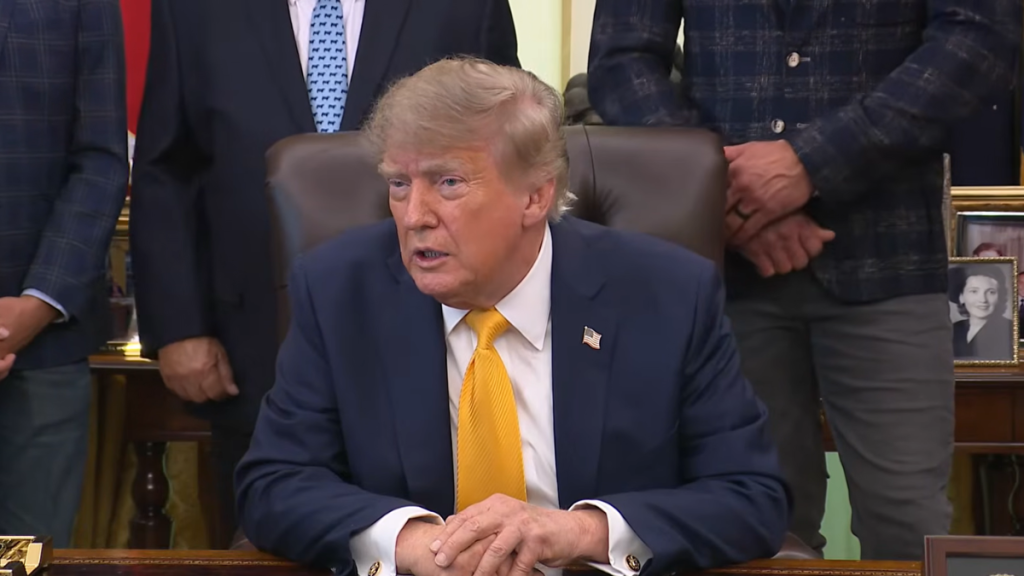
New Delhi: A possible new US strike on Iran came into focus on Friday after the US president, Donald Trump, indicated that Washington could target the underground facility at Pickaxe Mountain. Addressing reporters, Trump said the US was closely watching movements around the site and could act very soon if it detected any activity there.
“We may hit Pickaxe very soon,” Trump said. Highlighting the US’s surveillance capabilities, he added, “We’re leading in space. We know everybody that’s moving at Pickaxe, we know everybody that’s moving everywhere, all over Iran.”
The remarks came days after the US military carried out another series of strikes on Iranian military positions, including air-defence systems and radar installations. Trump defended the strike, saying its objective was to prevent Tehran from acquiring a nuclear weapon.
“We’re in five months now. And you know what we did in five months? They’re not going to have a nuclear weapon, that’s what we did,” Trump said. He added, “Iran will not have a nuclear weapon because if they did, you probably wouldn’t be standing here very long.”
What is Iran’s Pickaxe Mountain?
Pickaxe Mountain, also known as Kuh-e Kolang, is a deeply buried facility located just south of Iran’s Natanz nuclear complex. The site has four apparent tunnel entrances and is believed to contain extensive underground infrastructure, although its exact purpose has never been publicly established.
The facility has attracted attention because of its proximity to Natanz and concerns over whether Iran could use the underground complex to preserve sensitive nuclear equipment. The Wall Street Journal reported in July, citing Israeli and US officials, that Israeli intelligence believes Iran moved thousands of uranium-enrichment centrifuges into tunnels beneath Pickaxe Mountain after the June 2025 attack.
The International Atomic Energy Agency (IAEA) has not been allowed to inspect Pickaxe Mountain, leaving uncertainty over what is currently going on inside the tunnels. The IAEA director general, Rafael Grossi, said in an interview with FRONTLINE earlier this year that Iran had indicated its intention to conduct nuclear activity.
Why does the US want to target it?
The concern for Washington centres on the possibility that Iran could use the deeply buried facility to retain or restore parts of its nuclear programme after strikes on more exposed locations. Unverified reports have also suggested that centrifuges or nuclear material could have been moved to the site, although there is no public confirmation of what is currently underground.
Its construction makes the facility particularly significant in any military calculation. Unlike exposed nuclear infrastructure, deeply buried tunnels could potentially withstand attacks that damage facilities above ground, making the site a possible location for rebuilding sensitive capabilities.
Trump has raised the possibility of striking Pickaxe Mountain several times before Friday’s remarks. His latest warning comes as US intelligence monitors activity around the site following the recent conflict.
Satellite imagery shows movement near the site
The Pickaxe Mountain facility came into focus after fresh satellite imagery analysed by CNN in collaboration with the Institute for Science and International Security showed activity around the site. According to an earlier report by RNA Media, trucks and other vehicles were seen near the facility, including around its tunnel entrances and access routes.
The reported activity has added to scrutiny over Iran’s nuclear programme following the recent conflict. While the satellite images cannot confirm whether nuclear equipment is being moved or operated inside the facility, activity around the entrances has raised questions about possible work at the deeply buried site.