


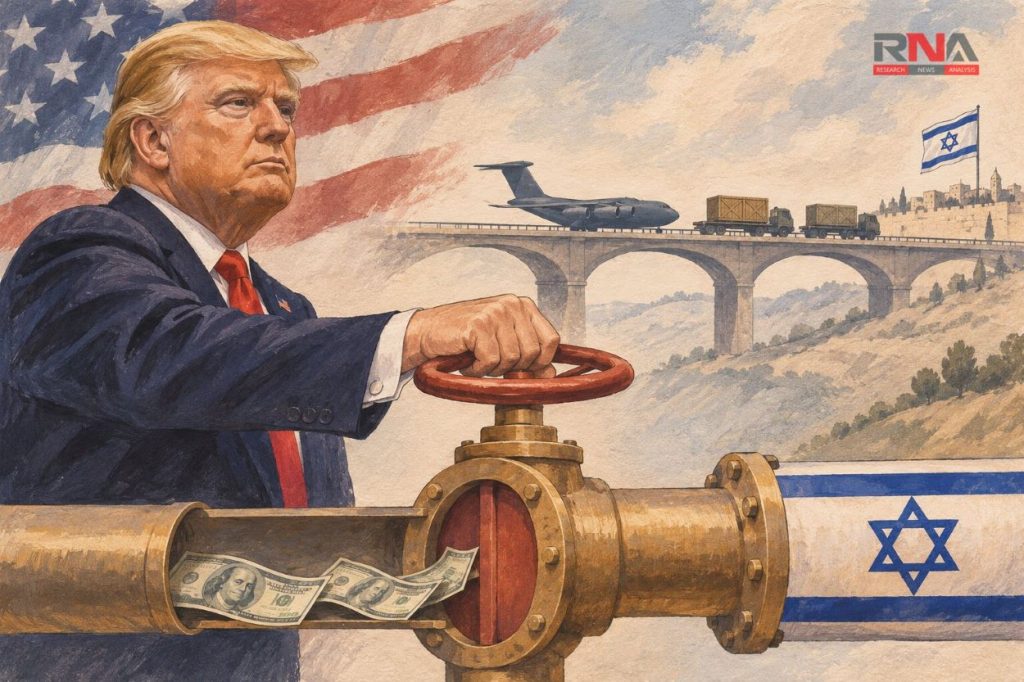
New Delhi: The US president, Donald Trump, said on Tuesday that Washington would stop providing what he described as $4 billion in annual funding to Israel after the end of the year. The announcement raises questions over an existing military assistance arrangement running through 2028, although Trump indicated that Israel could continue buying American weapons.
Speaking on Fox News’ “Fox & Friends” programme as Americans voted in the midterm elections, Trump said the Israeli prime minister, Benjamin Netanyahu, had agreed to the change. He linked the decision partly to domestic political criticism, describing the annual payment as an “easy target” for the left.
Netanyahu’s office did not immediately comment, according to Reuters. The precise funding streams covered by Trump’s remarks remained unclear.
The existing aid agreement
The established annual package is $3.8 billion, comprising $3.3 billion in Foreign Military Financing grants and $500 million for cooperative missile defence programmes. These allocations form part of a 10-year security assistance arrangement covering the 2019–2028 US financial years.
Signed during the administration of the former US president, Barack Obama, in 2016, the memorandum of understanding envisaged $38 billion in military support over that period. A cutoff after December this year would therefore precede the scheduled conclusion of the current framework.
However, the memorandum is a political commitment rather than a legally binding treaty, and the funding it envisages remains subject to congressional approval. The Congressional Research Service’s assessment of possible changes to aid makes clear that Congress retains authority over the appropriations needed to implement such arrangements.
That distinction leaves a significant implementation question: how the administration’s proposed deadline would interact with congressional funding decisions and existing commitments. Trump’s announcement alone does not establish how individual assistance programmes or previously financed purchases would be handled.
A faster timetable than Israel previously proposed
Netanyahu had already advocated reducing Israel’s dependence on American military grants, but earlier accounts described a gradual transition. Following his Washington meetings in July, an Israeli official told Times of Israel that he had reiterated a desire to move away from US aid over approximately a decade.
Under the approach outlined at that time, Israel envisaged progressively eliminating the $3.3 billion in annual financing grants while retaining some American support for ballistic missile defence. The official also described discussions about a joint fund for weapons research and development, pointing towards a restructuring of defence cooperation rather than its termination.
The year-end deadline now announced by Trump is substantially earlier than that previously described transition. Without an Israeli explanation of the latest announcement, it remains uncertain how the two approaches would be reconciled.
What ending grants would mean
American military assistance largely finances Israeli purchases of weapons and services from US defence contractors. Ending those grants would change who pays for equipment, while continued access to American weapons would remain a separate question governed by arms-sale decisions and applicable controls.
The Congressional Research Service has cautioned that Israel’s predominantly American-made fighter fleet and its missile defence architecture would sustain dependence on US supply chains even if grants were phased out. It also notes that major weapons purchases can involve financing commitments extending well into the period covered by a future aid agreement.
Growing political scrutiny
The announcement follows increasingly visible divisions in Washington over military support for Israel. On July 15, the House of Representatives rejected an amendment seeking to cut off aid by 314 votes to 104, with 103 Democrats and one Republican supporting the proposal.
That congressional vote demonstrated that a substantial majority still opposed ending assistance, even as dissent had expanded sharply among Democrats. Disagreements have also concerned the purposes for which support should be provided, with some lawmakers advocating restrictions and others favouring funding specifically for defensive weapons.
For now, the central unresolved issue is the extent of the proposed cutoff: whether it would cover financing grants, missile defence cooperation or other programmes. Its practical significance will depend on the detailed arrangements Washington and Israel adopt, the treatment of existing purchases and the funding decisions Congress makes.