


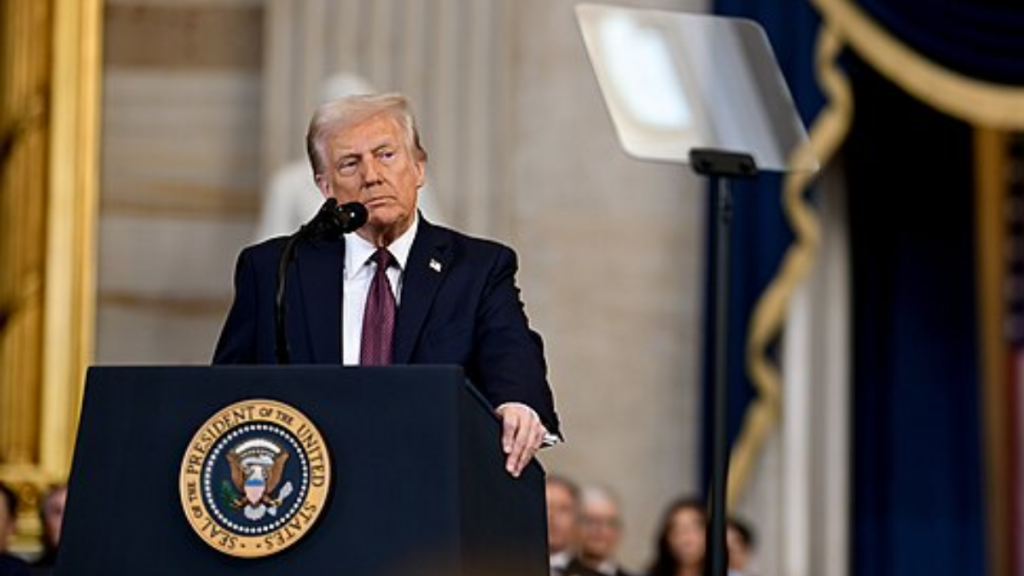
US President Donald Trump has warned that the month-long ceasefire between the US and Iran was on a “massive life support,” triggering concerns that the fragile halt in the military operations may come apart sooner than expected.
Trump, in a media interaction in his Oval Office in the White House on Monday (May 11, 2026), said the ceasefire was “unbelievably weak,” though it remained in place as of now.
“I would say the ceasefire is on massive life support…when the doctor walks in and says, ‘Sir, your loved one has approximately a 1 percent chance of living’,” Trump said.
The US president said Iran’s leaders were “very dishonourable people”, adding: “Look, I’ve had to deal with them four or five times – they change their mind.” “That piece of garbage they sent us – I didn’t even finish reading it,” he said.
Trump also accused Iran of going back on an agreement to allow the US to remove its supply of enriched uranium. He insisted that Iran would “never have a nuclear weapon.”
Soon after, Iranian Parliamentary Speaker and key negotiator in the peace talks, Mohammad Ghalibaf, posted on X that Iranian armed forces were “ready to respond and to teach a lesson for any aggression.”
Last week, Iran had responded to the US offer of talks on a 14-point agenda, placing its own demand and counter-agenda, seeking to put off talks on its nuclear programme. Trump had rejected the Iranian counteroffer, calling it “totally unacceptable” and a “piece of garbage.”
Iranian Foreign Ministry spokesperson Esmail Baghaei, responding to Trump’s comments on Iran’s counteroffer, said his nation’s proposals were “responsible” and “generous.” Baghaei said Iran would act “in any way necessary to secure our interests.”
In a separate X post, Ghalibaf said there was “no alternative but to accept the rights of the Iranian people as laid out in the 14-point proposal.” He said, “The longer they (the US) drag their feet, the more American taxpayers will pay for it.”
Iran’s counteroffer included an immediate end to the war on all fronts, a pointer to the Israeli attacks on Lebanon-based Hezbollah, a military group supported by Tehran.
The counteroffer also involved lifting the US Navy blockade of Iranian ports and guarantees of no further attacks on Iran, apart from the removal of all sanctions on Tehran, the release of all its frozen assets abroad, reparations for war damages, and acknowledging its sovereignty over the Strait of Hormuz.
On the sticking point over enriched uranium, Iran had said it would not accept any suggestion on stopping its nuclear programme or removing the enriched uranium from its territory.
But Israeli Prime Minister Benjamin Netanyahu said that Iran’s stockpile of enriched uranium must be “taken out” before the war can be considered over. “There are still enrichment sites that have to be dismantled,” Netanyahu said in an interview.
Iranian President Masoud Pezeshkian, speaking to his nation’s police officials on Monday (May 11), said Tehran aimed to consolidate on the victories in the latest West Asian war through “dignified and powerful diplomacy.”
He emphasised that the Iranian objective is securing national interest, not surrendering during negotiations with the US.
Outlining several possible paths forward for Iran, Pezeshkian noted that it involved “entering dignified negotiations to secure national interests, remaining in a situation of neither war nor peace, or continuing military confrontation.”
The “rational and logical option” consistent with Iran’s national interests is to complete the military victory in the diplomatic arena from a position of dignity and strength, he said.
“If there is any talk of dialogue or negotiation, it does not mean surrender or backing down,” he said in separate remarks on Sunday (May 10). “Rather, the goal is to secure the rights of the Iranian nation and powerfully defend national interests.”
The US-Iran peace negotiations have stalled after their first meeting in Islamabad in mid-April. Though the ceasefire, announced on April 8, still holds, it is currently frayed in view of the hardline positions taken by both the US and Iran on the talks agenda.