


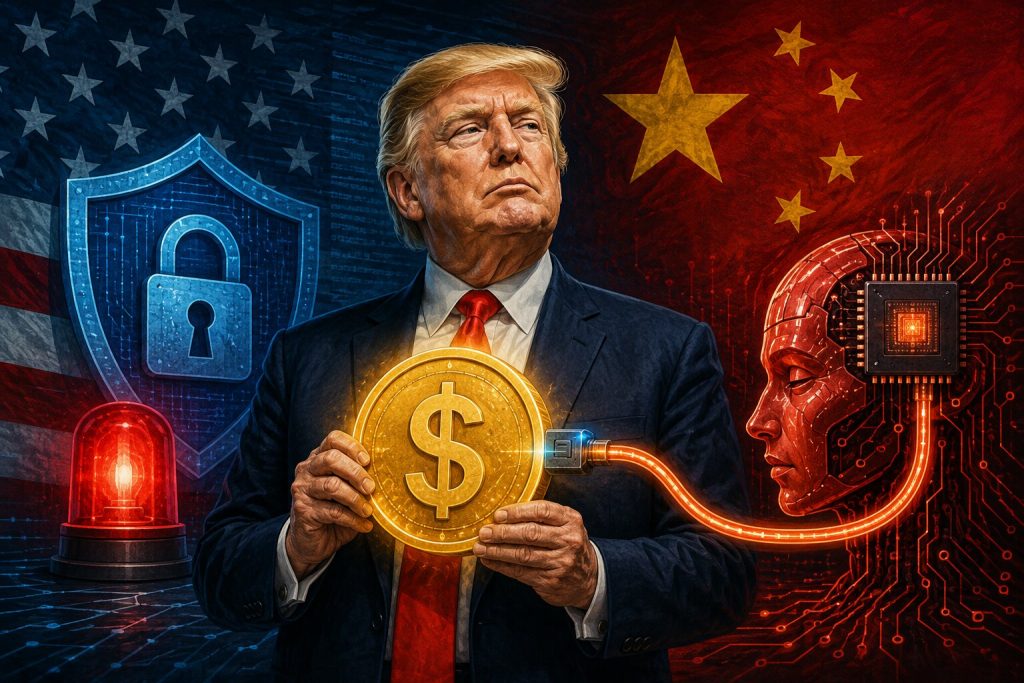
New Delhi: A cryptocurrency venture backed by the US president, Donald Trump, is working with a Hong Kong platform that provides access to artificial intelligence models developed by Chinese companies his administration has identified as national-security concerns. The legally permissible arrangement has exposed an awkward divide between Washington’s campaign to contain Chinese technology and the Trump family’s expanding commercial interests in digital finance.
World Liberty Financial is collaborating with WorldClaw, an AI platform that allows customers to use numerous American and Chinese models through a single interface. WorldClaw accepts World Liberty’s USD1 stablecoin as payment and also allows customers to obtain certain service packages by locking the company’s WLFI tokens.
A Reuters examination found that 43 of the 90 models then available through WorldClaw had been developed by Chinese companies, including Alibaba, Baidu, Z.ai, DeepSeek and Moonshot AI. The platform also offered models from leading American developers, such as OpenAI and Anthropic.
Alibaba and Baidu have been placed on the Pentagon’s Section 1260H list of companies considered to be connected with China’s military or its military-civil fusion programme. The Pentagon’s June 2026 assessment alleged that both companies had affiliations with Chinese state institutions supporting the country’s defence industrial base.
Z.ai, previously known as Zhipu AI, faces more consequential restrictions after being added to the US commerce department’s “entity list” in January 2025. The department said the company was helping advance China’s military modernization through advanced AI research, resulting in a presumption that applications to export controlled American technology to it would be rejected.
However, neither designation imposes a general prohibition on individuals or companies using AI models produced by the listed firms. The Pentagon’s classification principally restricts defence-related procurement, while the entity list regulates the export, re-export or transfer of American-controlled goods, software and technology to the designated organization.
The Trump family owns 38 per cent of World Liberty and earns revenue from the sale and use of its digital tokens, according to Reuters. USD1 is backed by assets such as US treasury securities, allowing its issuer to earn income from the reserves held against tokens in circulation.
WorldClaw’s adoption of USD1 therefore helps expand the stablecoin’s use and potentially increases the financial returns available to World Liberty and its owners. The precise financial arrangement between the two companies, including how much revenue the partnership has generated for the Trump family, has not been disclosed.
The president’s sons, Donald Trump Jr and Eric Trump, who co-founded World Liberty, have promoted WorldClaw on X. Ryan Fang, World Liberty’s head of growth, has also advised the Hong Kong company on USD1 adoption, partnerships and expanding international access to AI services.
WorldClaw maintains that it is independently owned and operated, while its terms state that World Liberty neither manages nor controls its services. World Liberty has similarly argued that offering models from several countries is a standard industry practice and that their availability does not constitute an endorsement of their developers.
The White House rejected suggestions of impropriety, saying there was no conflict of interest and that Trump acted only in the interests of the American public. There is also no public evidence that the president personally arranged the WorldClaw collaboration or selected the Chinese models offered by the platform.
Nevertheless, the commercial relationship has attracted scrutiny because the administration is simultaneously urging allies to adopt American AI systems and reduce their dependence on Chinese technology. Trump’s family has a financial interest in a service whose commercial appeal partly rests on inexpensive Chinese models that Washington itself regards with suspicion.
Why the Trump business is doing it – and how serious is the risk?
The immediate explanation is commercial rather than ideological: World Liberty wants USD1 and WLFI to be used as widely as possible, while WorldClaw wants to offer customers a large selection of competitively priced AI models. Each payment made in USD1 increases the stablecoin’s utility, circulation and reserve base, from which its issuer can earn income.
Chinese models have become difficult for global aggregators to ignore because they combine improving performance with relatively low operating costs. The Stanford AI Index 2026 found that the performance gap between leading American and Chinese models had effectively closed, with the strongest US model ahead by only 2.7 per cent as of March 2026.
WorldClaw’s own website advertises access to more than 300 models and offers some Chinese systems at substantially lower prices than prominent American alternatives. For a platform seeking users across cost-sensitive markets, particularly in Asia, Africa and Latin America, excluding Chinese models would weaken its commercial proposition.
This does not automatically make the arrangement a national-security threat. A model’s origin, the infrastructure on which it runs, the information supplied to it and the permissions it receives are separate factors that must all be assessed before determining the level of risk.
An open-weight Chinese model installed on a company’s own secured servers need not transmit prompts or documents to its original developer. The danger is potentially greater when a user accesses the same model through a remote application programming interface, because prompts, files and outputs may pass through infrastructure controlled by the platform, an intermediary or the model provider.
WorldClaw’s privacy policy says users’ prompts may be transmitted to third-party AI providers and acknowledges that the company does not control how those providers store, use or process the material. This creates a genuine concern if customers submit commercially sensitive information, government documents, source code, personal data or material connected with critical infrastructure.
The risk rises further with AI agents, which can be authorized to read emails, open files, make payments, access online accounts or execute software. A compromised or improperly secured model in such an arrangement could expose information, generate unsafe code or manipulate an agent into taking actions that the user did not intend.
Concerns about censorship and information manipulation are also supported by evidence, although they should not be confused with proof of espionage. An evaluation by the US Center for AI Standards and Innovation found security weaknesses and censorship in DeepSeek models that could create risks for developers, consumers and national security.
Chinese AI systems operating from China must comply with domestic rules requiring generated content to conform to official political and social standards. This can produce selective answers or distorted treatment of Taiwan, Xinjiang, the 1989 Tiananmen crackdown and other issues considered sensitive by the Communist Party of China.
Yet it would be misleading to conclude that every Chinese model is inherently compromised or that American models are free of privacy, security and political-bias problems. The prudent approach is to assess individual models, hosting arrangements, data-retention practices, software dependencies and access permissions instead of treating nationality as a substitute for technical evaluation.
The broader strategic concern for Washington is that AI influence will be determined not only by which country builds the most advanced system, but also by whose models, payment networks and technical standards become embedded in other economies. The Trump administration’s AI export policy explicitly seeks worldwide adoption of an American technology stack comprising chips, infrastructure, models, applications and standards.
Low-cost Chinese open-weight models complicate that objective because they can spread even when Washington limits Beijing’s access to advanced semiconductors. Export controls may slow the training of future Chinese systems, but they cannot easily prevent existing models from being downloaded, modified, hosted abroad or sold through multinational platforms.
The WorldClaw episode consequently highlights three overlapping issues: a genuine but context-dependent security risk, an incomplete American regulatory system and a potential clash between public policy and presidential-family business interests. The controversy is not that World Liberty appears to have broken an existing law, but that it can profit from technology linked to companies the administration presents as strategic threats.
For India, the lesson is to avoid both unquestioning adoption and blanket exclusion based solely on a model’s country of origin. Government departments, defence companies and critical-infrastructure operators should establish clear rules on model provenance, prompt routing, data storage, local hosting and agent permissions before allowing foreign AI systems to handle sensitive work.