


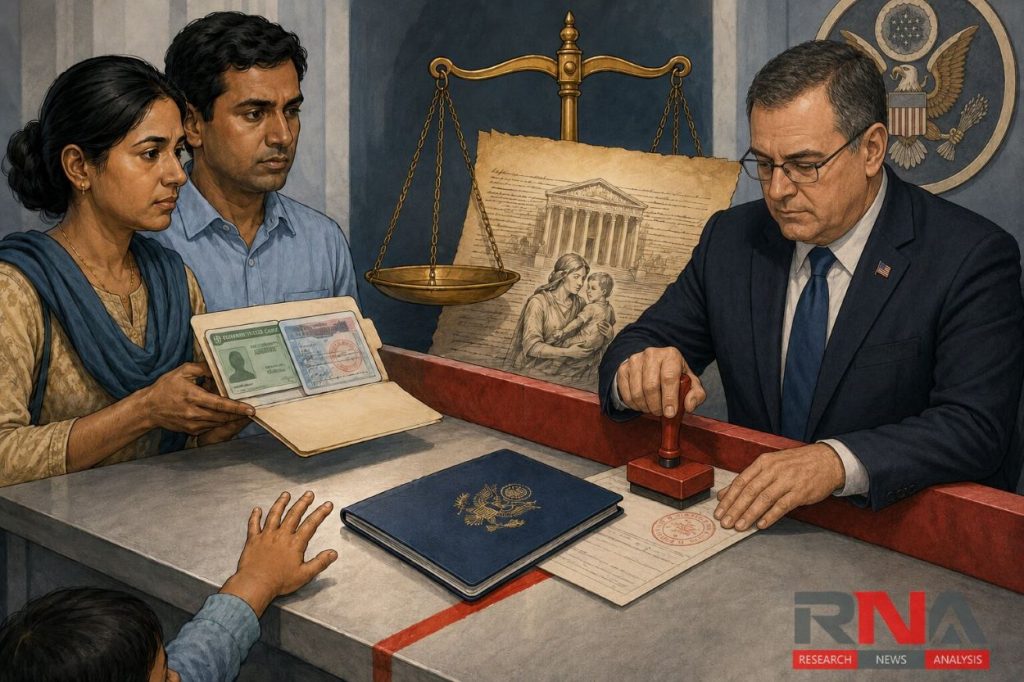
Washington: Parents applying for US passports for their children could soon be required to document their own citizenship or immigration status under draft guidance prepared by the state department. The proposed checks would support the renewed attempt by the president, Donald Trump, to restrict birthright citizenship following the Supreme Court’s rejection of his administration’s broader policy.
The internal proposal, reviewed by Reuters, offers the first detailed indication of how the department could implement Trump’s August 6 executive order targeting “birth tourism” and expanding the categories excluded from automatic citizenship. The White House referred questions about the plan to the state department, which said the passport adjudication system must reflect the administration’s interpretation of American citizenship.
If finalized, the guidance would require every parent or legal guardian applying for a child’s passport to submit proof of citizenship or lawful immigration status. Acceptable documents could include a valid US passport, an American birth certificate, an I-94 arrival and departure record or a permanent resident card, commonly called a green card.
Passport officials would use the information to determine whether a child falls within the categories covered by Executive Order 14418. Because the proposed requirement would apply to all parents and guardians, its immediate administrative reach could be considerably wider than the group whose citizenship the order seeks to challenge.
Under the existing process, a US-born applicant must submit evidence of citizenship, generally a qualifying birth certificate, while the parents establish their identity and relationship to the child. Parents are asked on the application form whether they are US citizens, but they are not normally required to provide separate documentary proof of their own status, according to current state department instructions.
The proposal would therefore turn a child’s passport application into an additional examination of the parents’ immigration records. Families unable to locate current or historical documents could face delays, requests for further evidence or closer scrutiny before a passport is issued.
Indian professionals living in the US on H-1B, L-1 and other temporary visas could be among those affected by the additional paperwork when seeking passports for their American-born children. However, temporary immigration status by itself is not identified in the narrower August order as a reason to deny citizenship, distinguishing it from Trump’s more sweeping 2025 directive.
The latest order focuses primarily on children born after their parents allegedly travelled to the US through fraud or a commercial arrangement designed to secure citizenship. It also seeks to exclude children of certain foreign-government employees and people classified as “alien enemies”, potentially extending the historically recognized exceptions involving accredited diplomats and members of an enemy occupying force.
Trump’s original executive order, signed on January 20, 2025, directed federal agencies not to recognize the citizenship of US-born children when neither parent was an American citizen nor a lawful permanent resident. That policy would have covered the children of undocumented migrants as well as people lawfully present on temporary work, study and visitor visas.
The Supreme Court rejected that attempt by a 6–3 majority on June 30, 2026, holding that it violated the citizenship clause of the 14th Amendment. The court’s official docket records that the justices affirmed the judgment against the administration, preserving the constitutional guarantee for people born in the US and subject to its jurisdiction.
The new order is already facing legal challenges from immigrant-rights organizations representing children whose citizenship could be questioned. Lawyers have asked two federal judges to stop its implementation while courts examine whether the administration can create additional exceptions to the 14th Amendment through executive action.
On August 28, the US district judge, Deborah Boardman, declined to issue an immediate temporary restraining order because the existing complaint did not specifically challenge the 2026 directive. She nevertheless allowed the plaintiffs to amend their case and questioned whether the president possessed the authority to establish new birthright-citizenship exceptions, describing the approach as unprecedented, Reuters reported.
Justice department lawyers have argued that intervention would be premature because agencies have not publicly finalized their implementation instructions. The leaked state department proposal could weaken that argument by showing that federal officials are already designing procedures capable of changing how passport applications for US-born children are assessed.
The central legal question is whether the government may treat alleged parental misconduct or immigration circumstances as grounds for withholding citizenship from a child born on American soil. Until the draft rules are formally issued and the courts rule on the August order, existing passport requirements and judicial protections for birthright citizenship remain in force.