


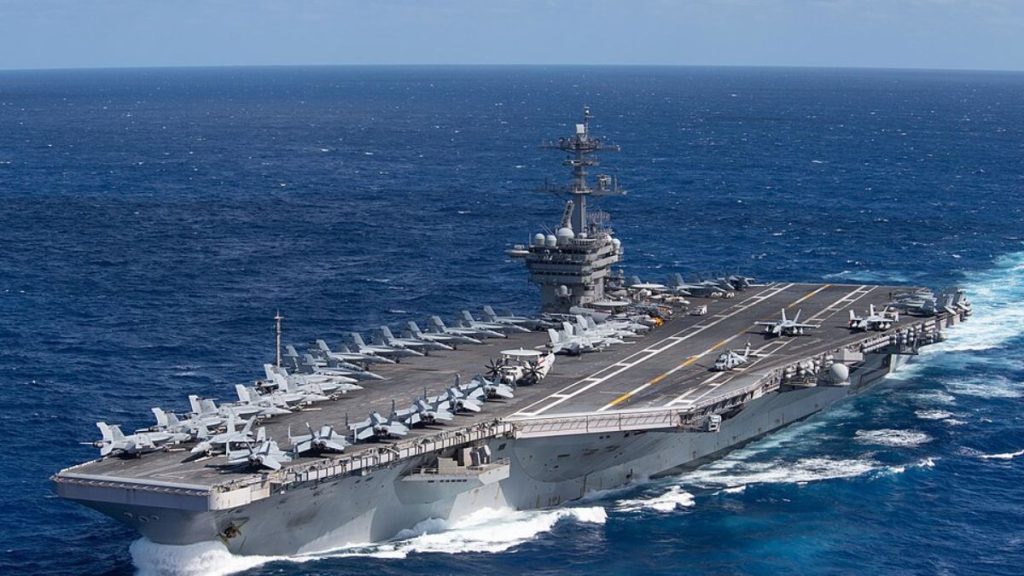
New Delhi: The United States is sending roughly 9,000 additional sailors and marines and another aircraft carrier formation towards West Asia, potentially creating a three-carrier concentration in the Gulf as the US president, Donald Trump, weighs renewed strikes on Iran. The buildup could temporarily push the US naval presence in the region above 20,000 personnel and hundreds of aircraft, although Washington has announced no fresh military operation.
More than 7,000 sailors and about 2,000 marines are deploying with the USS Theodore Roosevelt carrier strike group and the USS Makin Island amphibious readiness group. The latter includes the USS John P Murtha and USS Anchorage, adding amphibious forces and marine aviation to an already substantial US naval presence.
A US official, speaking to the Associated Press on condition of anonymity because of the sensitivity of military operations, said the deployments could briefly put three American carriers in the region by the end of October. USS George HW Bush and USS George Washington are currently operating there, while USS Theodore Roosevelt is heading towards the region.
Theodore Roosevelt is expected ultimately to relieve George Washington, meaning any three-carrier presence could reflect an overlap during rotation rather than a permanent addition. George Washington, normally Pacific-based, had earlier been moved to West Asia to relieve USS Abraham Lincoln after an extended deployment in which Lincoln’s crew spent more than 260 consecutive days at sea.
The US Navy last had three carrier strike groups simultaneously in the region in April, the first such concentration there since 2003.
Trump told Time magazine that it was “possible” he could intensify bombing in Iran after the November 3 midterm elections but declined to disclose his military strategy. Pressed on what Washington might do next, he said: “I can’t tell you that because look, you know, you’re asking, where are you going to bomb?”
Trump said he rejected Iran’s latest ceasefire proposal because “things that I wouldn’t have approved a year ago I wouldn’t have today”. Tehran’s offer included reopening the Strait of Hormuz, but Trump said the overall proposal was “not good enough”.
Trump also raised a possible Iranian connection to the Flydubai cockpit attack when questioned at the White House, saying that based on what he was hearing the answer appeared to be “yes”, but that officials were still investigating. He offered no evidence, and no Iranian connection has been established. Trump warned that if such a link were proved, Iran would be “hit very hard”.
Iran’s seven-day trust building proposal envisages reopening the Strait of Hormuz and restoring normal maritime passage if agreed conditions are met. Qatar continues to shuttle messages between Washington and Tehran, with sequencing of the proposed steps remaining the principal disagreement.
The strait remains central to both the military confrontation and negotiations because of its importance to global energy shipping. As RNA Media reported earlier, Tehran has claimed control over both approaches to Hormuz, while Washington has disputed Iran’s grip on the strategic waterway.
The immediate developments to watch are the arrival of the Theodore Roosevelt and Makin Island groups, the duration of any three-carrier overlap, Qatar mediated negotiations and security conditions around Hormuz. Any decision to renew US strikes remains with Washington and has not been announced.