


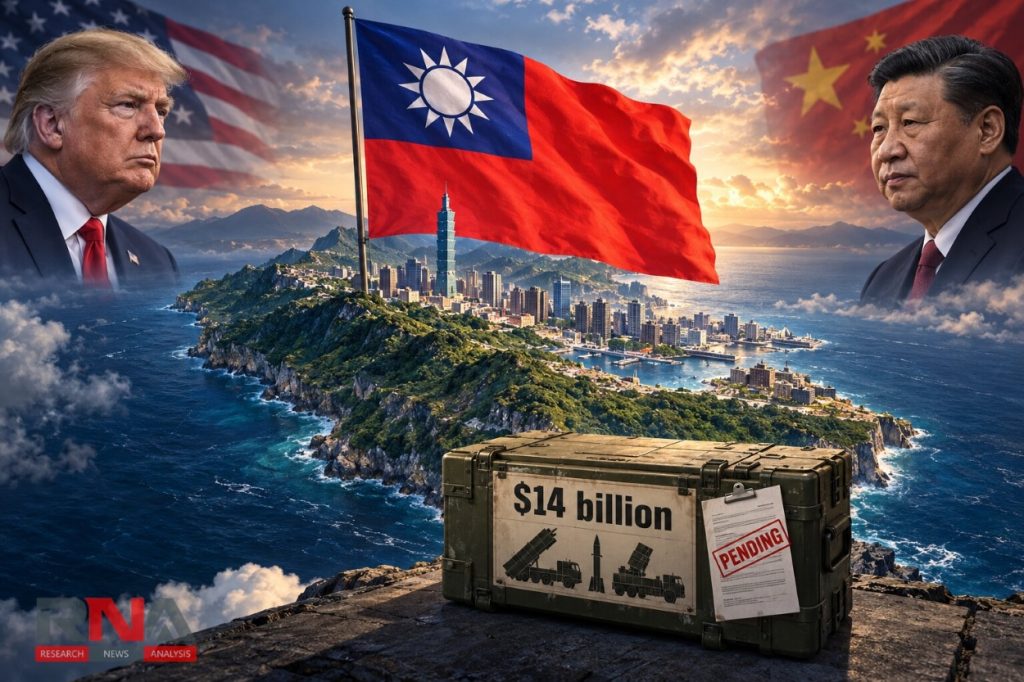
New Delhi: Taiwan’s defence minister, Wellington Koo, said on Tuesday that Taipei had received no information suggesting Washington would divide a proposed $14 billion arms package into smaller deals. His remarks left the timing of the sale unresolved, while reaffirming that the US commitment to Taiwan’s self-defence remained unchanged.
Speaking in parliament, Koo said Taiwan respected the American review process and remained in coordination with Washington, according to Reuters. His comments followed earlier suggestions from officials in Taipei that smaller approvals could help advance the package without provoking as strong a reaction from Beijing.
The US president, Donald Trump, has withheld approval while seeking to preserve relations and a fragile trade truce with the president of China, Xi Jinping. After their meeting in Beijing in May, Trump described the pending sale as a “very good negotiating chip”, bringing Taiwan’s defence requirements into the wider negotiations between Washington and Beijing.
Koo’s statement did not confirm that the package would proceed intact or rule out separate approvals later. It established that Taipei had not been informed of such an arrangement, rather than announcing a decision on how the sale would be handled.
The uncertainty concerns a new package, rather than a blanket suspension of existing military sales. In remarks reported by AP, on September 29. Koo said Taiwan had received no notification of changes to existing procurement programmes or defence cooperation, although the proposed $14 billion deal remained stalled.
Trump had approved a separate package worth about $11 billion in December 2025, underscoring the distinction between earlier authorizations and the proposal awaiting his decision. China, which claims Taiwan as its territory, has repeatedly demanded an end to American weapons sales to the democratically governed island.
Previously contracted equipment has meanwhile continued to arrive: Taiwan received the first two of 66 new F-16V Block 70 fighter jets on Friday, following delays to the order placed in 2019. The aircraft landed at Chihhang Air Base in Taitung after travelling through Hawaii and Guam, providing a tangible addition to Taiwan’s air defence capabilities despite uncertainty over future approvals.
The delay has also drawn scrutiny from within Trump’s Republican Party. The chairman of the US Senate armed services committee, Roger Wicker, said in a September 30 statement that decisions on Taiwan’s defence needs should rest on an assessment of military necessity and that resources authorized by Congress for training, security assistance and arms sales must be used as intended.
Wicker also invoked the Reagan-era Six Assurances, which include a commitment that Washington would not consult Beijing beforehand about arms sales to Taiwan. Those assurances form part of the established framework for US relations with Taipei and explain why linking weapons approvals to negotiations with China has attracted congressional concern.
The underlying legal framework is the Taiwan Relations Act, enacted in 1979 after Washington switched diplomatic recognition from Taipei to Beijing. It requires the US to make defence equipment and services available in quantities sufficient for Taiwan to maintain its ability to defend itself, with the nature and quantity determined by the president and Congress on the basis of Taiwan’s needs.
That obligation is distinct from an automatic promise of American military intervention in a conflict. The act provides for the president and Congress to determine an appropriate response through constitutional processes, making arms supplies an important component of US support without prescribing how Washington must act in every crisis.
Alongside the arms discussions, Taiwan’s foreign minister, Lin Chia-lung, and its former president, Tsai Ing-wen, are visiting the US this week, with Tsai making her first visit since leaving office in 2024. The US state department defended engagement with Taiwan by citing its democracy and technological strengths, while China’s embassy in Washington reiterated Beijing’s opposition to official US-Taiwan contacts.