


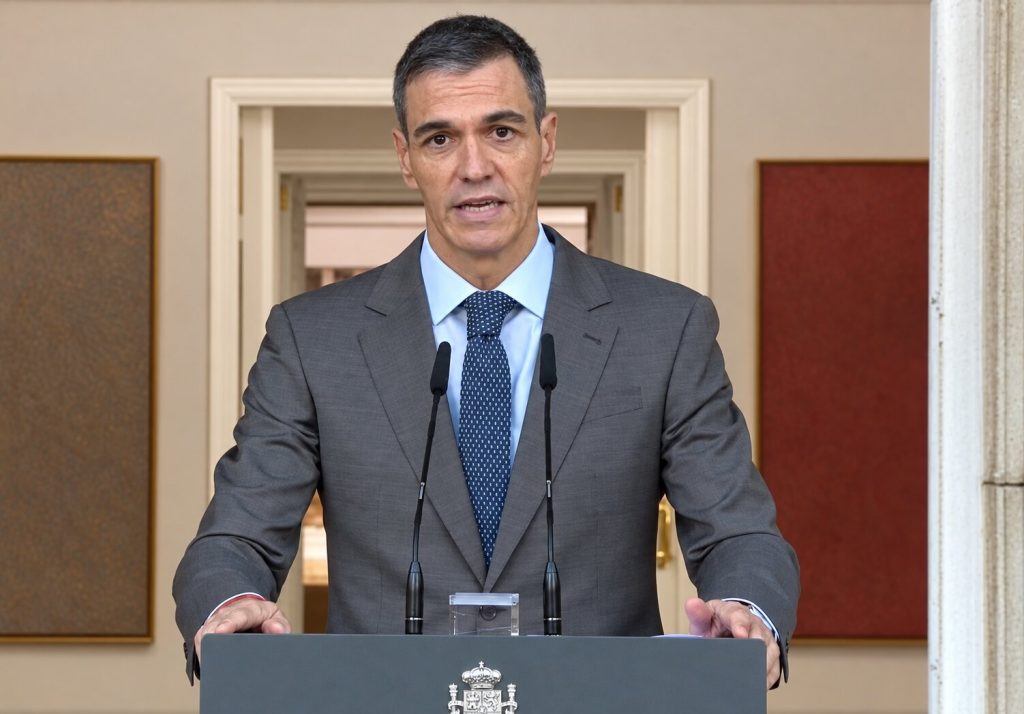
New Delhi: Spain’s prime minister, Pedro Sanchez, announced on Monday that an early general election would be held on November 29, after his minority government failed to secure parliamentary backing for emergency housing measures. The decision brings forward a vote expected in 2027 and turns mounting anger over rents, evictions and affordable housing into a contest over the country’s political direction.
In a televised address from Madrid’s Moncloa Palace, Sanchez said his government needed a larger progressive majority to carry out reforms that the existing parliament had repeatedly obstructed. He acknowledged shortcomings in its record, including unresolved problems in housing and public services, while arguing that renewed electoral support was necessary to address them.
The immediate trigger was the lower house’s rejection of two housing decrees on October 2 following unsuccessful negotiations to assemble a majority. Junts per Catalunya, the Catalan separatist party whose support has helped sustain Sanchez’s administration, voted against the measures alongside the conservative People’s Party (PP) and the far-right Vox.
The proposals sought stronger protection for tenants through measures including automatic renewal of rental contracts and restrictions on evicting vulnerable residents. Their defeat exposed the central weakness of the governing arrangement: a coalition able to remain in office but dependent on smaller parties to translate its programme into legislation.
The government and its opponents offered competing explanations for the setback, with Sanchez portraying parliamentary resistance as an obstacle to social reform. Opponents, including Junts, argued that the proposed intervention in the rental market would aggravate the housing shortage rather than resolve it.
Public anger had intensified after the eviction of Maricarmen Abascal, an 87-year-old woman, from the Madrid flat where she had lived for more than seven decades. Housing campaigners said an investment company that acquired the property sought to raise her rent by 275 per cent, making her case a symbol of the insecurity facing longstanding tenants.
The backlash subsequently prompted an agreement allowing Abascal to return at a low rent, but the wider protest movement continued. Demonstrations spread to more than 50 cities, including Barcelona, Valencia, Seville and Málaga, while activists established protest camps in central Madrid to demand broader changes.
Tens of thousands marched on October 3, 2026, a day after parliament rejected the government’s proposals. The mobilization brought together an immediate demand for tenant protection and a longer-running grievance over the widening gap between housing costs and what households can afford.
The pressures extend beyond individual eviction cases, with housing supply failing to keep pace with demand. According to property website Idealista, cited by CNA, average rents have almost doubled over the past decade, while asking prices for homes have increased by about 90 per cent.
Sanchez’s government has also struggled to secure agreement on national spending, leaving Spain operating under its 2023 budget for several years. That prolonged impasse provides the background to his argument that the existing parliamentary balance cannot deliver the changes he wants to pursue.
In office since 2018, Sanchez has governed with the left-wing Sumar as his junior coalition partner since 2023, relying on additional parties for parliamentary support. The election announcement therefore seeks to change the arithmetic underpinning his administration, as well as secure public endorsement of its policies.
The gamble carries considerable risk because recent polls have placed the PP ahead of Sanchez’s Socialists. A SocioMetrica survey reported by the National put the PP at 33.9 per cent, the Socialists at 25.7 per cent and Vox at 18 per cent, although these vote shares alone do not establish the eventual distribution of parliamentary seats.
The PP’s leader, Alberto Núñez Feijóo, has indicated that his party could govern with Vox, offering a potential route to replacing the current administration. Sanchez, meanwhile, used his election address to frame the choice around social protections, environmental policy and the risk of a shift towards the far right.
Housing will compete for attention with legal proceedings involving people close to the Socialists and criticism of the government’s response to this summer’s migration crisis in Ceuta, Spain’s North African enclave. The PP and Vox have accused the administration of responding too slowly, while Sanchez has defended the government and security forces’ handling of the situation.
The campaign will also test whether Spain’s strong economic performance can translate into support for the governing parties when many voters remain dissatisfied with their living conditions. For Sanchez, the immediate electoral challenge is to persuade those demanding affordable homes that a stronger mandate would produce results after the existing parliament rejected his response.