


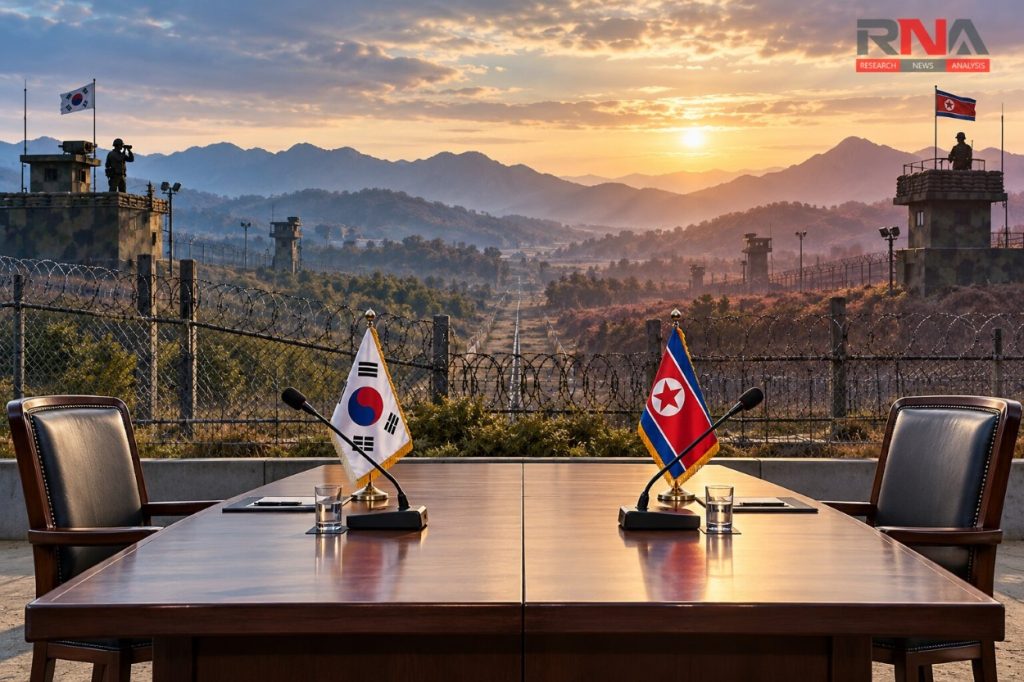
New Delhi: South Korea renewed its offer of military talks with North Korea on Friday, seeking agreement on the precise location of their land boundary and measures to prevent accidental clashes. The initiative follows landmine explosions that injured South Korean soldiers in September and increasingly confrontational exchanges over military activity along the heavily fortified frontier.
The deputy defence minister for policy, Kim Hong-cheol, said Seoul wanted discussions to clarify the military demarcation line, restore military communication channels and reduce the danger of unintended confrontations. Announcing the proposal for military dialogue, he said the two sides should “mutually confirm the precise location” of the boundary.
Seoul also expressed willingness to hold three-way discussions involving the US-led United Nations Command. Whether Pyongyang would accept remained unclear, with the North Korean leader, Kim Jong-un, having largely halted dialogue and cooperation with the South in recent years.
The immediate backdrop is the September 21 mine explosions, which the media reported injured three South Korean soldiers. Seoul’s military concluded that North Korean mines had been planted south of the demarcation line, an allegation Pyongyang rejected along with demands for an apology and the removal of remaining mines.
South Korea says North Korean troops have crossed the line while constructing roads, installing fences and laying mines near the frontier. A previous proposal for talks in November 2025 failed to draw a response, according to Reuters.
The South Korean military has reported 50 crossings this year during North Korean fortification work, prompting warning shots and broadcasts. Pyongyang disputes Seoul’s account and portrays those responses as provocations against soldiers working on its side of the boundary.
The disagreement concerns the exact position of sections of a military boundary established more than seven decades ago. Some original markers have disappeared over time, complicating efforts to identify the line on the ground, although the South Korean defence minister, Kang Shin-chul, has said the September explosions occurred outside any disputed area.
The 1953 armistice arrangements established the military demarcation line and a demilitarized zone separating the opposing forces. Under the agreement, each side was required to withdraw two kilometres from the line, creating a buffer four kilometres wide; the boundary itself and the surrounding buffer are therefore distinct.
The original demarcation was recorded on nine maps at a scale of 1:50,000 and marked by 1,292 numbered signs along a roughly 250-kilometre route, according to an analysis published by 38 North. That history helps explain why confirming the boundary’s position remains a practical military concern, particularly when construction brings troops close to contested sections.
The latest invitation comes as Pyongyang threatens to intensify pressure along the frontier. Kim’s sister, Kim Yo-jong, said anti-South Korean loudspeakers would be ready along the border within days and warned of retaliation if South Korean warning shots harmed North Korean personnel or territory.
The threatened broadcasts would reverse an earlier easing of psychological warfare between the neighbours. The South Korean president, Lee Jae Myung, suspended Seoul’s propaganda broadcasts in June 2025, and the military dismantled its fixed loudspeakers that August as part of efforts to improve relations.
For Seoul, the proposed discussions address an immediate operational danger: soldiers on opposing sides acting on different understandings of where the boundary lies. Kim Hong-cheol warned that leaving those differences unresolved would increase the risk of accidental clashes, making boundary verification and renewed military contact central to the latest offer.