


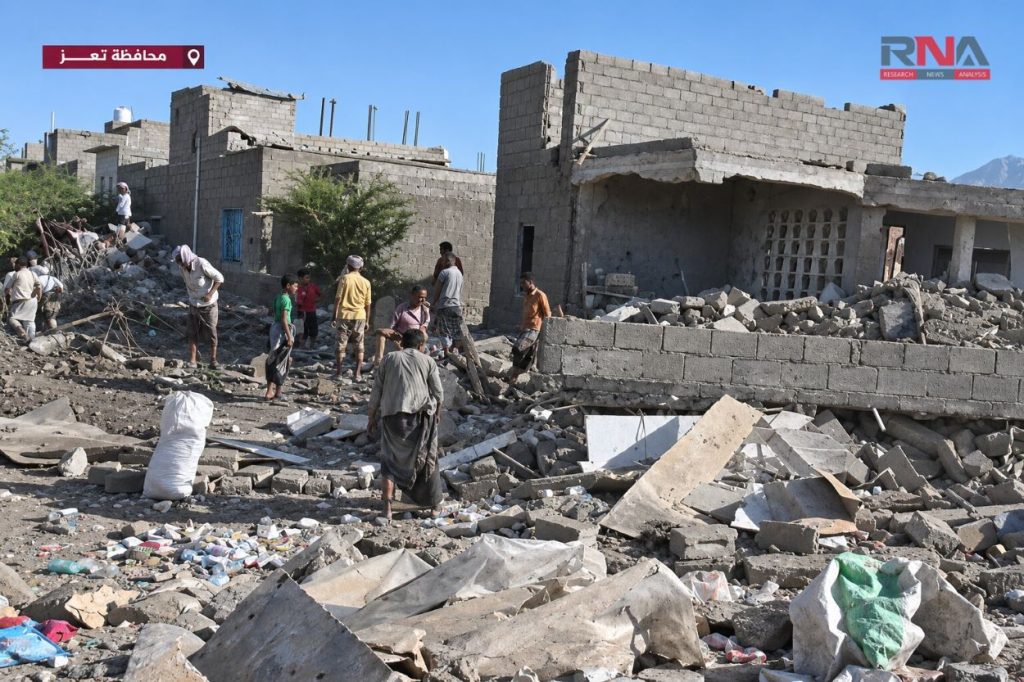
New Delhi: At least 33 people, including women and children, have reportedly been killed in Saudi-led airstrikes near Yemen’s capital, Sanaa, as fighting between the kingdom and the Iran-aligned Houthi movement intensifies. In a sharp escalation of the conflict, Saudi Arabia said on Sunday that its air defences had intercepted five missiles launched towards Riyadh and other parts of the kingdom, including its strategically important oil-producing Eastern Province.
The reported deaths occurred on Saturday when aircraft allegedly struck al-Shariyah village in the Bani Hushaish district, east of Sanaa, according to Yemen’s Houthi-controlled health ministry. The attacks came as Saudi-backed Yemeni government forces continued an offensive to recapture territory held by the Houthis, with both sides increasingly targeting locations beyond the immediate battlefield.
Ane es al-Asbahi, a spokesperson for the Houthi-run health ministry, said eight women and 13 children were among those killed, while at least 39 people sustained injuries. He alleged that the strikes hit residential buildings, roads and emergency responders, including paramedics and civil defence personnel, although the casualty figures and circumstances could not be independently verified.
The BBC reported the attack as one of the latest deadly incidents in Yemen’s renewed conflict, which has intensified since the breakdown of a United Nations-brokered truce earlier this year. Saudi authorities subsequently said they were investigating the reported strikes, leaving responsibility for the civilian casualties unresolved.
The Houthi military spokesperson, Yahya Saree, claimed Saudi-led forces had conducted 105 air and missile attacks across Sanaa and seven other governorates within 24 hours. He also alleged that the coalition had carried out 4,369 strikes since the latest escalation began, figures that remain unverified by independent observers.
The latest deaths follow another deadly incident on November 6, when an attack on a market in Taiz province reportedly killed 30 people. The Houthis blamed Saudi airstrikes, but Yemeni government forces accused the group of launching a ballistic missile at the market, illustrating the conflicting accounts surrounding civilian casualties in the war.
Saudi Arabia intercepts Houthi missiles, Aramco building suffers damage
Saudi Arabia’s air defences intercepted three ballistic missiles and two cruise missiles on Sunday, according to Saudi and international media reports. Two ballistic missiles were directed towards Riyadh, another towards the Eastern Province, and two cruise missiles were intercepted over the capital and southern regions.
Major General Turki al-Maliki, spokesperson for the Saudi-led coalition, confirmed the interceptions as emergency warnings were issued across several cities. Residents reported loud explosions over Riyadh, prompting civil defence authorities to activate precautionary alerts before announcing that the immediate danger had passed.
In a significant development, an administrative building belonging to Saudi Aramco in Riyadh’s King Abdullah Financial District sustained minor damage from falling missile debris. The Saudi energy ministry said there were no casualties, although the incident demonstrated how intercepted missiles could still threaten important infrastructure.
The Eastern Province is particularly sensitive because it houses much of Saudi Arabia’s petroleum infrastructure, including major processing facilities and export operations. On October 13, a ballistic missile struck Saudi Aramco’s headquarters in Dhahran, damaging an office tower and reinforcing concerns over the vulnerability of critical energy installations.
The Houthis have intensified their missile and drone campaign against Saudi airports, oil facilities and military positions since hostilities resumed in July. Saudi forces had already intercepted at least 15 missiles and drones during November, reflecting the frequency of attacks against the kingdom, Arab News reported.
The renewed confrontation follows the collapse of the 2022 UN-brokered truce and a major territorial offensive by Yemeni government forces in October. Their operation, called Dawn of Yemen, seeks to recover Houthi-held territory, including Sanaa, after the rebel movement expanded its control along Yemen’s Red Sea coast in September.
The conflict has also become entangled with the wider regional war that began with American and Israeli attacks on Iran in February. Tehran’s longstanding relationship with the Houthis has added a regional security dimension to the fighting, although Houthi battlefield decisions and Iranian involvement should not automatically be treated as identical.
For India, the escalation carries implications beyond Yemen because instability around Saudi Arabia’s energy infrastructure and the southern Red Sea can affect oil markets, commercial shipping and maritime insurance costs. More than 1,600 people have been killed and nearly 300,000 displaced since the ceasefire collapsed, underscoring the conflict’s mounting humanitarian consequences, according to Al Jazeera.
The immediate concern is whether intensified coalition operations in Yemen will provoke further Houthi attacks against Saudi cities and energy installations. With neither side showing signs of abandoning its military campaign, the latest exchanges raise the possibility of a prolonged confrontation with consequences for regional stability and international trade.