


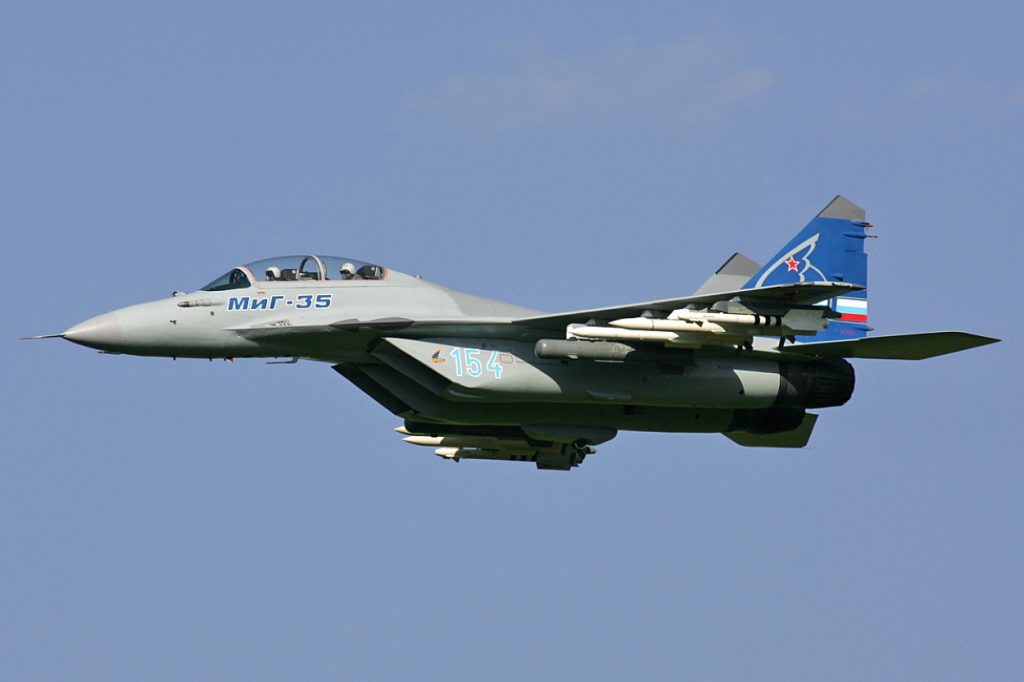
New Delhi: Russia is reportedly using its small fleet of MiG-35 fighters to intercept Ukrainian long-range drones, assigning one of its least numerous combat aircraft to air defence deep inside its territory. The reports suggest an operational role for a fighter that has remained in limited service, although the scale of its deployment and its interception record have not been independently established.
The claim originated with Soniashnyk, a Ukrainian aviation-linked Telegram channel, which said on October 21 that Russian MiG-29s and MiG-35s had been responding to large air raids well behind the front for some time. Ukrainian defence publications subsequently carried the account, which included a cockpit photograph associated with the purported operations.
Those reports require a distinction between evidence of an aircraft’s presence and confirmation of its combat results. The publicly available material does not establish how many MiG-35s have participated, where they are based, which weapons they have used or how many drones they have destroyed.
A Military Watch Magazine’s report on Monday presented the aircraft’s purported employment as a comparatively inexpensive option for defending Russian airspace. However, its account draws on the same Ukrainian reporting, rather than providing separate confirmation of the missions or their cost.
A small fleet with an unusual assignment
According to Militarnyi’s account, open-source information indicated that Russia had four single-seat MiG-35S aircraft and two two-seat MiG-35UBs undergoing trial operation in October. Deliveries began in 2019, but the programme has not developed into large-scale production.
The distinction matters because the reported missions involve a small evaluation fleet, rather than a fighter deployed across numerous operational squadrons. Even if all six aircraft were available, their numbers would limit the contribution they could make to defending Russia’s extensive territory.
The current reports are not the first claims of MiG-35 involvement in the war. On November 22, 2023, the chief designer of United Aircraft Corporation (UAC), Sergei Korotkov, said the aircraft was participating in operations, while acknowledging that further test flights remained before the defence ministry made a final procurement decision.
That statement did not provide a detailed account of missions, weapons employed or independently verifiable results. The October reporting is more specific in identifying a domestic air-defence role, but it still leaves the aircraft’s actual performance unclear.
What the MiG-35 brings
The MiG-35 is a modernized development of the MiG-29 family, drawing on the MiG-29M/M2 and carrier-capable MiG-29K/KUB designs. UAC markets it as a “4++ generation” multirole fighter, intended to engage aircraft as well as ground and maritime targets.
The manufacturer dates its international unveiling to January 27, 2017, and says Russia’s defence ministry signed a supply contract at the Army-2018 forum. Its published description lists upgraded RD-33MK engines, improved optical targeting equipment and longer component service lives among the aircraft’s features.
Russia’s state arms exporter, Rosoboronexport, lists a maximum external payload of 6,500 kilograms across nine weapon stations and a maximum speed of 2,100 kilometres an hour in its MiG-35 brochure. A separate equipment description identifies air patrol and interception among its missions, with short- and medium-range air-to-air missiles and an internal gun among its weapons.
These specifications describe the platform’s advertised capabilities, rather than a verified configuration for the aircraft reportedly flying against Ukrainian drones. Neither the weapon load nor the sensor performance during those missions has been established by the available reporting.
The limits of the ‘low-cost’ claim
Reduced operating expenditure is a central part of the MiG-35’s sales proposition: both UAC and Rosoboronexport advertise improvements in maintenance and running costs. Their published material, however, does not establish the cost of a successful drone interception or substantiate a fleet-wide comparison showing that it is Russia’s cheapest fighter to operate.
Military Watch argues that the aircraft’s smaller size, manoeuvrability and gun armament could make it useful against drones, while acknowledging the difficulty of detecting small, low-flying targets. It also notes that using guided missiles against inexpensive unmanned aircraft can produce an unfavourable cost exchange.
The economic case therefore remains conditional: lower aircraft operating costs alone would not demonstrate that a particular interception was inexpensive. A meaningful assessment would also require information about weapons expenditure, sortie duration, maintenance demands and the value of the installation being protected.
The reported deployment likewise does not, by itself, demonstrate that Russia has exhausted its other air-defence options. It could indicate the use of additional available aircraft, operational evaluation or an effort to distribute interception duties, but the public evidence does not distinguish between those explanations.
Drone strikes keep pressure on Russian defences
The reports come as long-range attacks continue to threaten facilities inside Russia. In a November 1 dispatch, Reuters quoted the governor of Nizhny Novgorod region, Gleb Nikitin, as saying an overnight Ukrainian drone attack had seriously damaged an industrial installation, while Russia’s defence ministry claimed 235 Ukrainian drones had been intercepted over Russian regions.
That latest episode provides context for the reported fighter missions, but no evidence that MiG-35s participated in those particular interceptions. For now, the aircraft’s apparent emergence as a drone interceptor is a development to watch, with its effectiveness and claimed cost advantage still awaiting substantiation.