


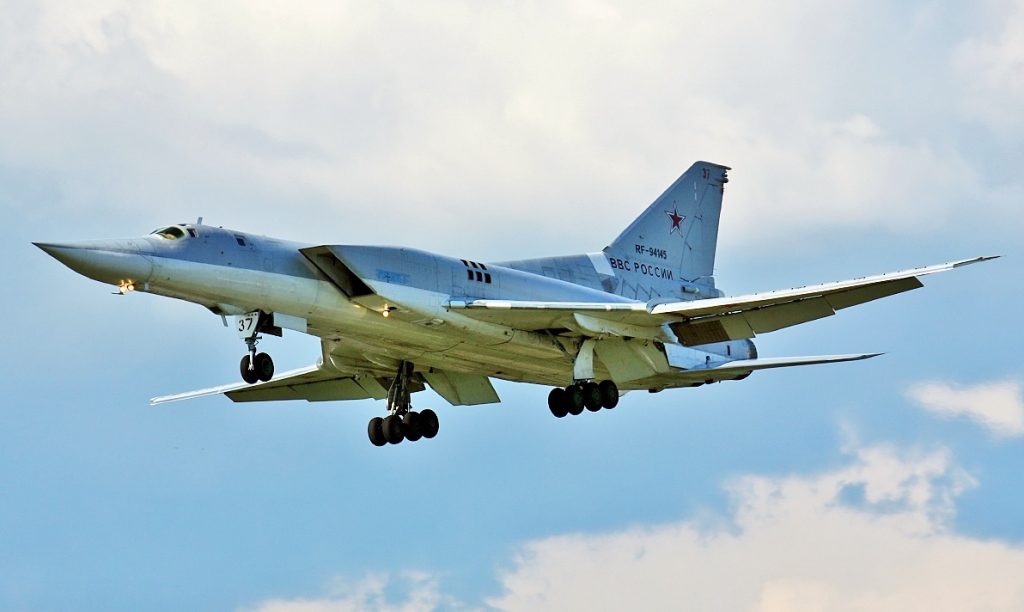
New Delhi: A Russian Air Force Tu-22M3 Backfire supersonic strategic bomber crashed in Siberia’s Irkutsk region on Monday during a scheduled training flight, with dramatic footage showing the aircraft nosediving into a densely wooded area before a thick column of black smoke rose from the impact site. All four crew members ejected from the stricken aircraft, but one pilot died upon landing.
Coincidentally, this happened the same day when a United States B-52 Stratofortress long-range strategic bomber crashed shortly after take-off at Edwards Air Force Base in California’s Mojave Desert, as RNA Media reported earlier.
The Russian defence ministry confirmed the crash, stating the aircraft went down near the village of Kamenka and the town of Svirsk, approximately 50 kilometres northwest of the Belaya Air Base, the suspected point of departure. The bomber was on its landing approach when it came down. Engine failure has been cited as the preliminary cause.
The aircraft was flying without a combat load, and officials said there was no damage on the ground.
The remaining three crew members were taken to hospital with injuries that were not considered life-threatening. Unverified video circulating on social media showed the aircraft descending steeply before impact. Witnesses in the area reported seeing several parachutes shortly before the bomber struck the wooded terrain along the banks of the Angara River. Irkutsk Governor Igor Kobzev confirmed that fire crews had been dispatched to the crash site.
The Tu-22M3 – designated “Backfire” by Nato – is a Soviet-era supersonic long-range bomber that serial production of which ended in 1993. The aircraft is capable of carrying a wide array of weapons, including the Kh-22 air-launched cruise missile, which can be fitted with either a conventional or nuclear warhead, and the Kh-47M2 Kinzhal air-launched hypersonic missile. That capability places the bomber in a category demanding the most exacting standards in handling, even during peacetime operations.
The Tu-22M3 is not typically counted alongside the Tu-95MS and Tu-160 as a strategic bomber under the New START arms control framework, but Russia has relied on it heavily for conventional strike missions throughout the war in Ukraine, including attacks on residential buildings and infrastructure that have caused significant civilian casualties. It has also previously seen combat deployment in Syria.
The Belaya Air Base, home to the 200th Guards and 444th Heavy Bomber Aviation Regiments and a hub for both Tu-22M3 and Tu-95 operations, has come under mounting pressure over the past year. It has been one of the several remote facilities targeted by long-range Ukrainian drone operations.
International analysts estimate Russia’s active Tu-22M3 fleet at fewer than 60 operational airframes, making each loss a costly and, crucially, irreplaceable one – serial production of the type ended more than three decades ago, and no replacement programme is currently in place.
Monday’s crash marks the third reported Tu-22M3 accident in the Irkutsk region in less than two years. In August 2024, a Tu-22M3 came down in the Cheremkhovsky district during a routine flight. Defence analysts have pointed to a pattern of technical malfunctions tied to aging airframes and an increasingly demanding operational tempo, particularly as Russia sustains its long-range bombing campaign against Ukraine.