


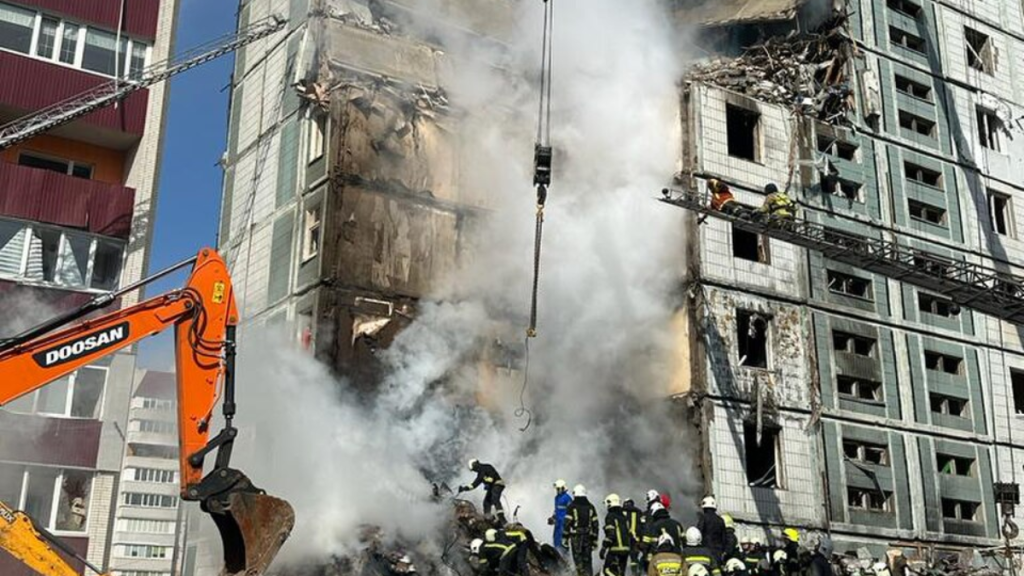
New Delhi: Russia’s latest missile strikes on Kyiv have once again exposed the growing pressure on Ukraine’s air-defence network. As Moscow increasingly deploys high-speed ballistic missiles alongside drones and cruise missiles, Kyiv is struggling to protect its cities with a limited number of advanced Patriot systems and a shrinking stock of interceptor missiles.
The challenge has become even more serious as Ukraine faces shortages of advanced interceptor missiles while Russia continues combining ballistic missiles with drones and cruise missiles to overwhelm air-defence systems.
Why ballistic missiles are harder to intercept
Unlike cruise missiles, which fly through the atmosphere along relatively predictable routes, ballistic missiles are launched high into the sky before descending almost vertically toward their targets at several times the speed of sound.
This steep, high-speed trajectory dramatically reduces the time available for radar systems to detect the threat, calculate its flight path and launch an interceptor. In many cases, air-defence crews have only a few minutes, or even seconds, to react. Because of these characteristics, ballistic missiles are considered among the most difficult aerial threats to defeat.
Which missiles is Russia using?
Russia has increasingly relied on several types of high-speed missiles during the war.
The ground-launched Iskander-M remains Moscow’s primary short-range ballistic missile. Russia has also used the air-launched Kinzhal, while modified S-300 and S-400 air-defence missiles have been repurposed for ground attacks.
Another weapon, the Zircon, is officially classified as a hypersonic cruise missile, but its extreme speed makes intercepting it similarly challenging.
Why Patriot remains Ukraine’s strongest shield
Among all the air-defence systems supplied to Ukraine, the US-made Patriot remains the only operational system capable of reliably engaging several of Russia’s most advanced ballistic missiles.
Its PAC-3 interceptor uses a “hit-to-kill” approach, destroying incoming missiles through direct impact instead of relying solely on an explosive blast. The system continuously tracks the target, predicts its trajectory and launches an interceptor within a very short engagement window.
However, even Patriot batteries cannot provide complete protection. How well they work depends on how they are deployed, the radar coverage, and whether interceptor missiles are available.
Too few systems, too many threats
Ukraine does not possess enough Patriot batteries to protect every major city and strategic installation.
Russia has increasingly adopted saturation tactics by launching ballistic missiles alongside cruise missiles, attack drones and decoy targets in the same wave. Such attacks are designed to stretch Ukraine’s air-defence network and force commanders to use valuable interceptors against multiple simultaneous threats.
This has made missile defence as much a problem of inventory as technology.
Ukraine’s interceptor shortage also reflects a broader international challenge. Demand for Patriot and THAAD interceptors has increased significantly due to multiple regional conflicts, while manufacturing capacity remains limited. Although production is expanding in the United States and Europe, building advanced interceptors takes time, making it difficult to replace stocks quickly.
Discussions over future Patriot deliveries and possible licensed production have continued, but any expansion in manufacturing would take years before it could meaningfully strengthen Ukraine’s air-defence capability.
Ukraine’s strategy is evolving
Recognising that intercepting every incoming missile is unrealistic, Ukraine is placing greater emphasis on striking missile launchers, logistics hubs and military infrastructure before launches take place.
Kyiv is also pursuing indigenous missile-defence projects and has joined European partners in efforts to develop a lower-cost air-defence system that could eventually reduce dependence on Western-supplied Patriots.
Until additional systems become available, however, Ukraine is expected to continue balancing limited interceptor stocks against an evolving Russian missile campaign that increasingly relies on speed, precision and coordinated attacks.