


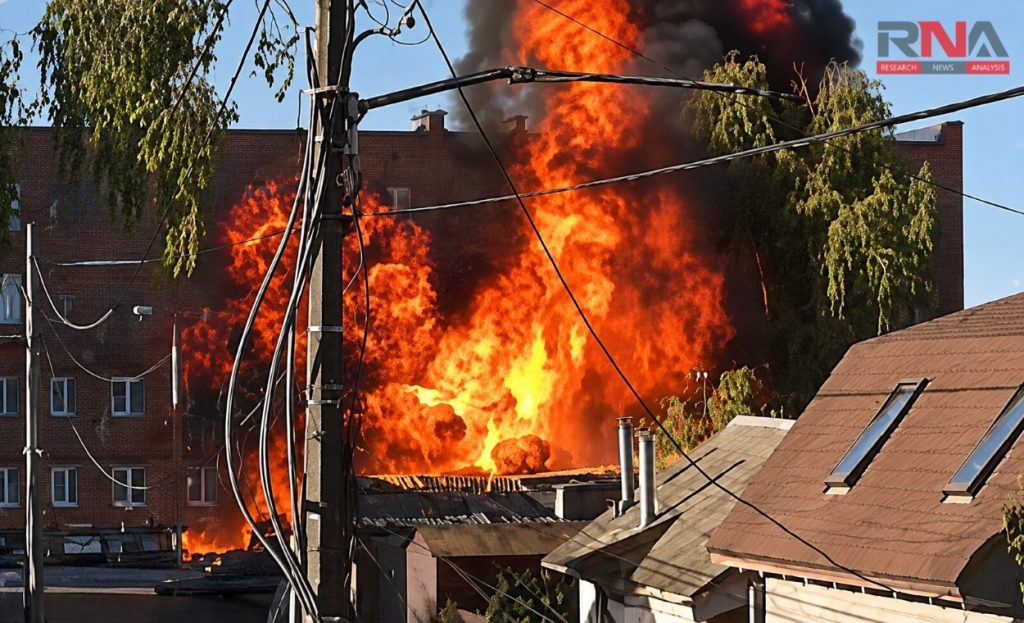
New Delhi: A Russian drone struck a school in Kyiv on Thursday as Moscow continued an aerial offensive increasingly reliant on faster drones that challenge Ukraine’s defences. Pupils and staff escaped injury after taking shelter, although the attack damaged the building and started a fire.
Ukraine, meanwhile, continued striking Russian oil infrastructure despite pressure from the US president, Donald Trump, over rising diesel prices. The competing campaigns are putting civilian services, military supplies and energy markets under growing strain as Ukraine prepares for winter.
More than 100 pupils and approximately 60 school employees were sheltering when the drone hit the school in Kyiv’s Solomianskyi district, according to police accounts reported by Hromadske. The impact damaged the facade at third-floor level, underscoring the importance of shelters during attacks that now interrupt the capital’s daytime activities as well as its nights.
The mayor, Vitalii Klitschko, said the drone’s warhead had not detonated, and Associated Press photographs showed police removing the unexploded device. The building nevertheless sustained substantial visible damage, including shattered windows and a hole in its brick frontage.
Ukraine’s air force said Russia launched 107 drones overnight and into the morning, including 63 powered by jet engines. It reported shooting down or suppressing 87, with impacts recorded at 11 locations and debris falling at four others, although the operation was still continuing when its morning assessment was issued.
The attacks also disrupted movement across the Dnipro River, with Kyiv’s Southern Bridge struck and metro traffic temporarily suspended. Reuters reported that the bridge had not suffered major damage, while the city’s Institute of Nuclear Research said a separate drone strike late on September 30 had left radiation levels normal.
Elsewhere, a morning drone attack killed a 50-year-old man in the Vesnianske community in Mykolaiv region and destroyed a tractor, according to local reports. An attack on Odesa damaged infrastructure and wounded one person, while a warehouse fire in Kyiv also left a man injured.
Russia’s jet-powered Shahed-type drones fly higher and faster than propeller-driven versions, reducing interception time. AP reported that Ukraine’s fastest existing interceptor drones typically reach 300–400km/h, leaving them struggling against the newer threat.
Manufacturers are developing faster propulsion and autonomous guidance, but scaling production and training crews could take months. Miniature turbojet engines are a bottleneck, while F-16 fighters can intercept the drones but face maintenance constraints that limit availability.
The shift was already evident on Monday, when the Ukrainian president, Volodymyr Zelenskyy, said 90 of more than 120 drones used in that day’s attacks were jet-powered. He reported nine deaths and more than 80 injuries across the country, including casualties in a strike on the National Academy of Sciences in Kyiv.
The renewed assault on electricity infrastructure adds another concern before temperatures fall. Ukrainian officials described the September 30 bombardment, which killed seven people and injured 24, as one of the largest attacks on the power grid since the previous heating season, reinforcing Kyiv’s requests for additional Western air-defence systems.
Ukraine maintains anti-refinery campaign
Zelenskyy said on Wednesday that Ukrainian forces had struck an oil facility in Russia’s Samara region, alongside a Russian vessel in the Black Sea. He also reported attacks on a drone launch and storage installation in Oryol region and a military supply depot in Bryansk region, presenting the operations as efforts to weaken Russia’s ability to sustain the war.
Trump had urged Zelenskyy during a private telephone conversation to stop targeting Russian refineries because of the pressure on diesel supplies. Citing people familiar with the call, it linked the intervention to concern over rising American fuel costs, which have become politically sensitive before November’s midterm elections.
Ukraine’s military said on September 21 that its long-range campaign had disabled 45 per cent of Russia’s refining capacity, an assessment requiring independent verification. Separately, Reuters industry sources reported that the Moscow Oil Refinery halted production after the September 20 attack, with repairs to damaged crude-distillation units expected to take weeks.
Moscow has extended restrictions on producers’ exports of diesel, marine fuel and gasoil until October 31. According to Russian media, the government said the decision was intended to stabilize domestic supplies, including during heightened demand from the harvest, adding another restriction to an already strained international fuel market.
Trump said on Wednesday that he was still considering an American diesel export ban, while acknowledging possible adverse effects on petrol prices. Reuters reported that US diesel had reached a record $6.53 a gallon a week earlier and attributed the surge to both supply losses from the Iran war and refining disruptions, including Ukrainian strikes in Russia.