


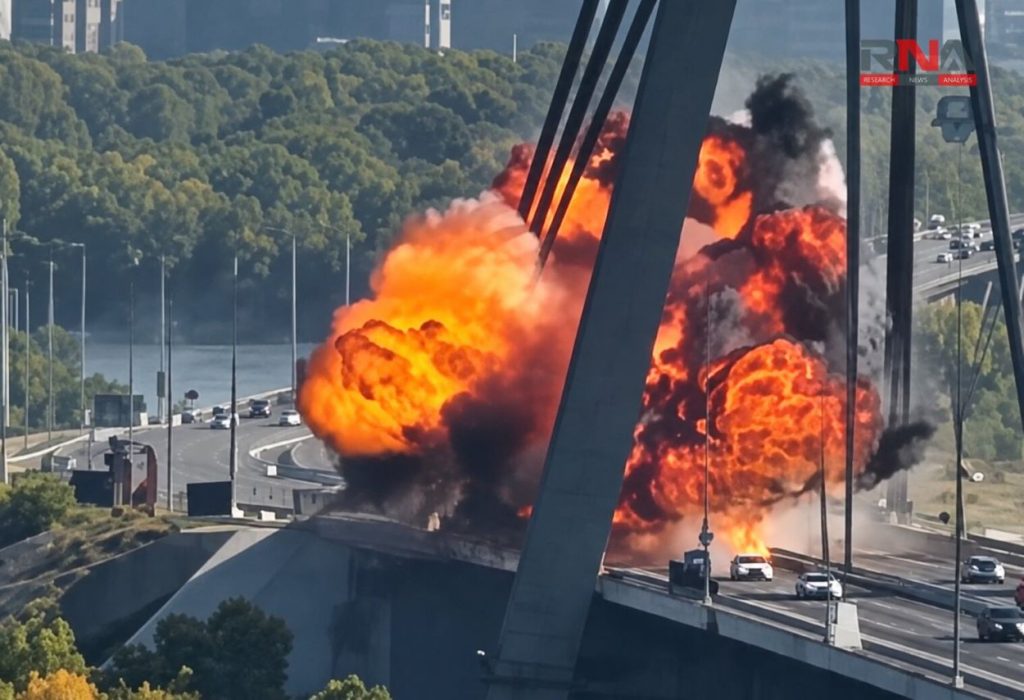
New Delhi: A Russian drone struck a major bridge in Kyiv on Sunday, injuring two people as the German chancellor, Friedrich Merz, visited the Ukrainian capital to reaffirm Berlin’s support. The attack coincided with his announcement of €1.35 billion in military and energy assistance as Ukraine faces intensifying aerial strikes ahead of winter.
Video showed the drone hitting the Northern Bridge while vehicles were crossing, sending flames and black smoke above the roadway. The mayor of Kyiv, Vitali Klitschko, confirmed the injuries as the crossing came under attack for the second consecutive day, according to CNN’s report.
The repeated strikes threaten links between the two halves of a capital divided by the Dnipro River, with many government institutions and businesses on the right bank and extensive residential neighbourhoods on the left. Ukrainian officials said the attacks were intended to divide the city, while the infrastructure minister announced plans for alternative crossings should the bombardment continue.
Russia’s defence ministry has claimed that the bridge is used to transport Ukrainian troops and military supplies. Moscow had also warned foreign nationals and diplomatic personnel against travelling to or remaining in Ukraine before Merz’s visit.
Merz and the president of Ukraine, Volodymyr Zelenskyy, visited the damaged National Academy of Sciences building, where a Russian strike had killed two people the previous week. Calling on the president of Russia, Vladimir Putin, to end the war, Merz said negotiations remained possible but attacks on Ukraine’s civilian population had to stop.
The German assistance package comprises €1 billion in military support and €350 million for Ukraine’s battered energy sector. Defence cooperation includes jointly produced interceptor drones, missiles with ranges exceeding 1,000 kilometres and satellite technology to assist Ukrainian targeting.
The emphasis on interception reflects the growing challenge posed by Russia’s fast, jet-powered attack drones. Merz said recent technical advances would accelerate production of systems designed to counter them, while German broadcaster ARD reported that government sources envisaged more than 15,000 interceptor drones.
Accompanied by the economy and energy minister, Katherina Reiche, and business representatives, Merz presented the industrial partnership as beneficial to both countries. German manufacturers would gain from Ukraine’s combat experience, he said, while joint ventures would strengthen weapons production and drone defence.
Zelenskyy said the two countries had signed 15 agreements worth more than €8.5 billion, principally covering security cooperation, weapons production and procurement. Separately, he said Russia had deployed 900 jet-powered drones during the week and that Ukraine had intercepted only about half, according to the Associated Press.
The agreements build on discussions in Berlin on April 14, when Zelenskyy proposed a bilateral arrangement encompassing drones, missiles and defence software. Those talks also covered air defence, energy reconstruction and expanding Europe’s capacity to manufacture essential military equipment, establishing the groundwork for deeper industrial cooperation.
The diplomatic visit brought no indication of an immediate easing of hostilities, with Russia announcing plans to intensify strikes on military facilities, defence industries and associated infrastructure. Its defence ministry described the escalation as a response to Ukrainian attacks, after Zelenskyy pledged more strikes on Russian refineries in retaliation for Moscow’s aerial campaign; both countries deny deliberately targeting civilians.
Alongside the military announcements, Zelenskyy said Washington had proposed technical-level talks involving Ukraine, Russia and the United States before the end of October, potentially in the United Arab Emirates. Kyiv was ready to participate, he said, but was awaiting Moscow’s response.