


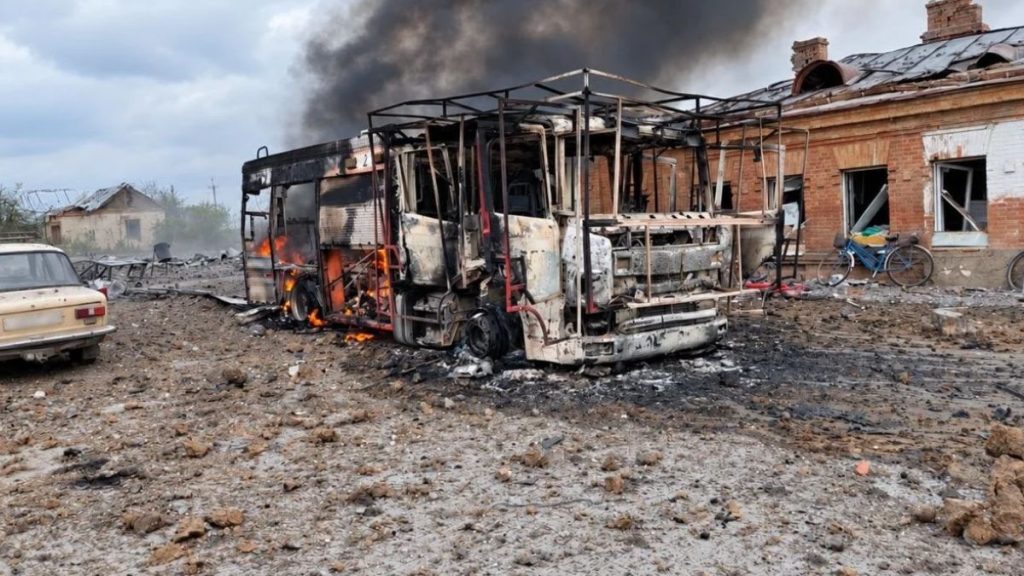
New Delhi: At least 26 people were reportedly killed when aerial bombs struck a school being used for humanitarian aid in Ukraine’s southeastern Zaporizhzhia region on Monday. Five others were injured in Komyshuvakha, where rescuers searched the wreckage amid threats of further strikes.
Ukraine’s state emergency service reported that two rescue workers and four police officers were among those killed. Five people were treated in hospital, including two emergency responders, as the death toll rose from earlier reports of 18 and then 24.
The president, Volodymyr Zelensky, said the school was no longer holding classes because the village was close to the front line. Its building and shelter were being used to distribute humanitarian assistance every Monday to residents who remained in the area.
In his evening address, Zelensky said several aerial bombs struck as people arrived for aid. He accused Russian forces of launching a second attack against the shelter where residents had sought cover, describing it as a “vile, terrorist strike”.
In an earlier post on X, Zelensky said the second wave involved nine more aerial bombs. Mykhailo Semikin, acting head of the Zaporizhzhia regional military administration, separately reported at least nine FAB-3000 guided bombs, each weighing approximately 3,000 kilograms, in attacks on the village. The numbers and weapon specifications are Ukrainian claims and have not been independently established.
Zelensky shared footage showing a large crater and rescuers searching through rubble. His initial X post reported 18 deaths; Ukrainian emergency services later revised the toll upwards before he confirmed 26 fatalities in his evening address.
Semikin initially reported 27 people missing. The Associated Press subsequently cited local officials saying about 20 people were still unaccounted for, but the differing figures could not immediately be reconciled as rescue operations continued.
Regional authorities said drones and warnings of further strikes repeatedly disrupted rescue work. Photographs released by officials showed emergency teams searching damaged buildings after nightfall, while Tuesday, was declared a day of mourning across Zaporizhzhia.
In his X post, Zelensky wrote: “With these killings, Russia is sending an entirely opposite signal: Russia is counting on more killings.” He accused Russia of knowing that aid was distributed there weekly, an allegation that has not been independently verified.
The attack followed a temporary ceasefire brokered with the involvement of US first lady, Melania Trump, which enabled a joint Russian-Ukrainian operation to deliver humanitarian aid and evacuate civilians from Russian-occupied Oleshky in neighbouring Kherson region. Zelensky said the operation had offered hope for further humanitarian measures, but described the latest bombing as evidence that Russia did not want de-escalation.
Meanwhile, US special envoy, Steve Witkoff, announced that representatives from Ukraine, Russia and the United States would resume peace talks in Abu Dhabi on November 10-11. The discussions will focus on “post-war security arrangements, de-escalation, humanitarian efforts, and next steps toward peace”. US negotiators are also expected to meet European and Nato officials in Brussels to discuss security guarantees and reconstruction.
Frontline communities in Zaporizhzhia have faced repeated attacks, disrupting public services and forcing some buildings to serve as shelters or aid points. Zelensky also warned that Ukraine expected fresh Russian strikes against energy and logistics infrastructure.
The Russian military had not publicly commented on the Komyshuvakha attack at the time of reporting. Claims about the precise sequence of strikes, the bombs used and the alleged deliberate targeting remain unverified independently.