


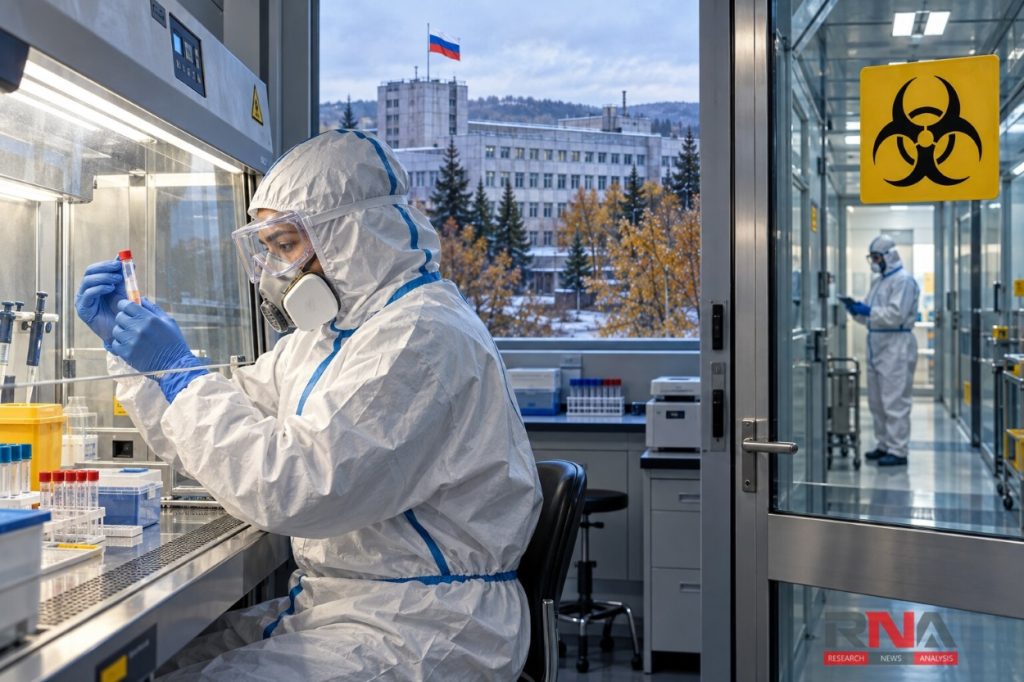
New Delhi: A 28-year-old employee of an anti-plague research institute in Russia’s Siberian region of Irkutsk has died after developing severe pneumonia, prompting the monitoring of nearly 200 contacts and international concern over a possible laboratory exposure. Russian media have linked the death to a reportedly broken test tube containing plague bacteria, but health authorities have denied that a laboratory accident occurred and have not confirmed plague as the cause.
The woman, identified in media reports as Daria Shipilova, worked at the Irkutsk Anti-Plague Research Institute of Siberia and the Far East. She was admitted to hospital in nearby Shelekhov on September 29 with severe pneumonia, required ventilation and reportedly died overnight between October 1 and 2.
According to an account published by the independent Siberian outlet People of Baikal and subsequently cited by Radio Free Europe/Radio Liberty, Shipilova accidentally broke a test tube containing the plague pathogen on September 25. That account remains unverified, and the available reporting has not established where or how she acquired the illness.
Russian authorities responded by tracing people who might have encountered her, placing contacts under medical observation or isolation and introducing precautions at medical facilities. Early reports put the number being monitored at 197, including more than 100 people in hospital wards, while the Shelekhov district hospital was placed under quarantine pending a commission’s assessment.
The head of Russia’s public-health watchdog, Rospotrebnadzor, Anna Popova, travelled to Irkutsk for an emergency meeting with regional authorities on October 2. The governor of the Irkutsk region, Igor Kobzev, urged residents to remain calm and said identified contacts were being monitored, with no signs of the suspected infection and negative laboratory results at that stage.
Public events were cancelled, and a mask requirement was introduced at the Irkutsk aluminium plant in Shelekhov on October 3. Independent reporting subsequently described restrictions at several hospitals, including limits on visits and patients’ movements, although the extent of those restrictions has become disputed.
In an important update on Monday, Moscow Times reported that Kobzev had said quarantined family members and close relatives could be discharged the following week. The same report cited local coverage saying hospitals were continuing their normal schedules apart from localized precautions, qualifying earlier accounts of wider closures.
Russia’s most detailed public explanation came in a Rospotrebnadzor statement carried by Interfax on October 4. The agency said Shipilova had been diagnosed with “pneumonia of unknown aetiology” and that expanded testing of samples from her had not detected microorganisms associated with her professional work.
The watchdog also said a biosafety commission had found no accident involving pathogenic microorganisms at the institute, with its conclusions supported by an expert commission dispatched on Popova’s instructions. It added that no other institute employee had sought medical attention for an infectious illness during the preceding 10 days.
Authorities said they had identified a broad circle of contacts and arranged hospital observation with daily laboratory testing because of the woman’s occupation. Those tests detected two cases of Covid-19 and two rhinovirus infections, but no other infectious agents, according to the agency, which described conditions in Irkutsk and Shelekhov as stable.
However, inconsistent public messages and the removal of warnings have raised questions about how the incident has been communicated. The head of neighbouring Buryatia, Alexey Tsydenov, initially referred to a woman who had died of plague before revising his statement to say she might have died of the disease.
The administration in Baikalsk also briefly advised residents against travelling to Shelekhov, citing unofficial information about a possible plague case, before deleting the notice. Meduza reported that the Russian broadcaster REN TV removed five social-media posts concerning the alleged spread of plague in the town.
These changes have fuelled allegations of secrecy, but they do not establish that officials are concealing a confirmed plague outbreak. The central questions remain unresolved: what caused Shipilova’s fatal pneumonia, whether an occupational exposure occurred and why early accounts differed so sharply from the watchdog’s subsequent findings.
The incident has meanwhile drawn a response from Washington, with the US state department confirming that it was monitoring reports of a suspected fatal pneumonic plague case alongside the Centers for Disease Control and Prevention (CDC). In a statement to RFE/RL, it urged Russian authorities to provide accurate information promptly and openly, while emphasizing that early antibiotic treatment can be effective.
Some American political figures have demanded restrictions on travel involving Russia, but Washington had announced no additional measures over the suspected case in the reporting available on Monday. There was also no publicly confirmed evidence of wider transmission among Irkutsk residents.
The concern centres on pneumonic plague, the lung infection caused by Yersinia pestis, the bacterium responsible for plague. Unlike the more familiar bubonic form, which commonly follows an infected flea bite and causes swollen lymph nodes, pneumonic plague can pass between people through infectious respiratory droplets during close contact.
The World Health Organization’s guidance warns that untreated pneumonic plague can progress rapidly and become fatal, while prompt diagnosis and antibiotics substantially improve the prospects of recovery. Plague persists naturally in animal populations, meaning a suspected human infection requires investigation of both possible environmental exposure and contact with infectious material.
This urgency explains why health authorities may isolate contacts and introduce precautions before a diagnosis is confirmed. The CDC advises clinicians to begin appropriate treatment when plague is suspected rather than wait for laboratory confirmation and recommends preventive antibiotics for people with qualifying exposures.
For now, the Irkutsk incident remains a fatal illness under investigation, accompanied by a disputed laboratory-exposure account and extensive precautionary measures. Establishing the cause of death and publishing a clear account of the investigation will be essential to assessing whether those measures contained a dangerous infection or responded to a suspicion that testing ultimately excludes.