


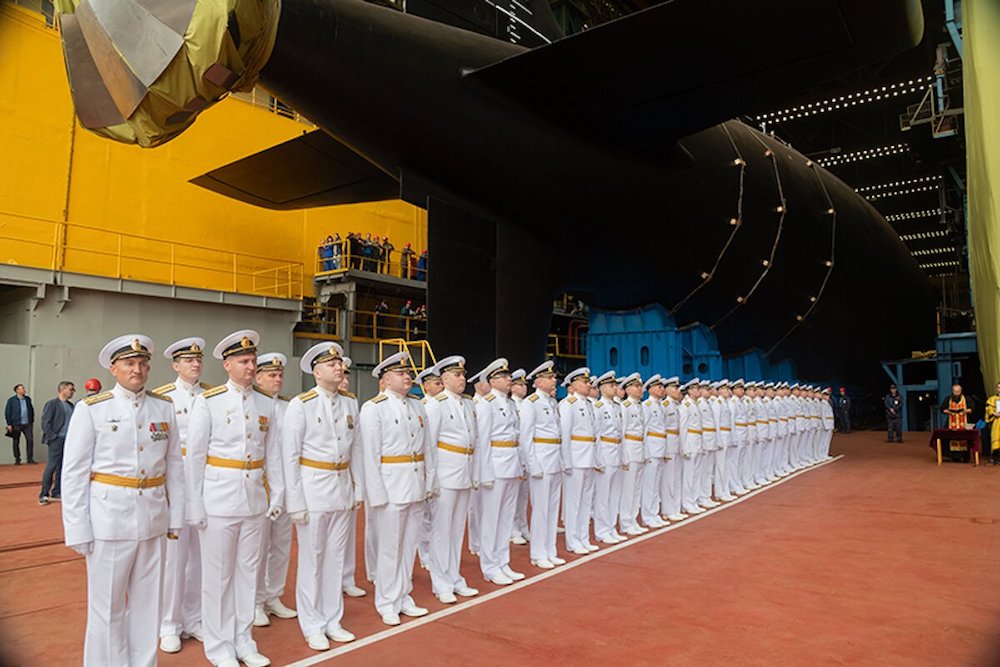
New Delhi: Russia’s Sevmash Shipyard, the country’s sole builder of nuclear-powered submarines, floated out the Yasen-M-class nuclear-powered submarine Ulyanovsk on Wednesday. The new submarine marks another step in Moscow’s decadelong effort to replace its ageing Soviet-era attack submarine fleet.
The ceremony, held at the Sevmash yard in Severodvinsk on Russia’s White Sea coast, was overseen by the Russian navy’s commander in chief, Admiral Alexander Moiseyev, and attended by the deputy prime minister, Yury Trutnev, along with the governor of the Arkhangelsk region, Alexander Tsybulsky. Ulyanovsk now moves to a fitting-out berth, where construction will continue afloat ahead of an extended sea trials programme.
Slow but steady production line
Ulyanovsk is the sixth Project 885M Yasen-M-class cruiser to leave the Sevmash slipway and, counting the original Project 885 boat Severodvinsk, the seventh vessel in the wider Yasen family. Moiseyev told the gathering that the rollout, coming barely six weeks after the keel-laying of a further boat, Murmansk, in June, reflected what he called systemic work to renew the fleet.
Sevmash’s chief executive, Mikhail Budnichenko, said the submarine is contracted for delivery to the navy in December 2027, after roughly a year of trials covering navigation, deep-diving performance and weapons systems in the Barents and Norwegian seas. Trutnev, addressing the ceremony, invoked a line attributed to the 19th-century tsar Alexander III – that Russia’s only reliable allies are its army and its navy – underlining the political weight Moscow continues to attach to the programme even as its economy strains under wartime spending and sanctions.
Once commissioned, Ulyanovsk will join the Red Banner Northern Fleet, alongside two Yasen-M boats already in service there, Kazan and Arkhangelsk. The class’s lead vessel, Severodvinsk, is currently undergoing a mid-life overhaul. Two further hulls, Voronezh and Vladivostok, remain under construction at Sevmash, while a fifth boat, Perm, has been undergoing sea trials since August 2025 and is expected to join the Pacific Fleet by the end of this year armed with the Zircon hypersonic cruise missile as standard equipment – the first Yasen-M boat so fitted.
Independent naval trackers put the eventual size of the programme at 12 boats by 2035, split roughly evenly between the Russian navy’s Northern Fleet and Pacific Fleet. However, the pace of construction – averaging one launch every twelve to eighteen months – has been slowed by sanctions on precision electronics and specialist steels since 2022.
Western navies watching an evolving threat
The Yasen and Yasen-M classes have drawn sustained attention from western navies, given their quieter acoustic signature compared with older Soviet designs and their ability to fire long-range precision missiles against land, sea or underwater targets from a single hull. The first sea lord of the Royal Navy, Admiral Gwyn Jenkins, warned in December 2025 that the Western Bloc risked losing its longstanding edge in the North Atlantic, citing the steady strengthening of Russia’s submarine fleet as a central factor. Analysts at London’s Royal United Services Institute have separately assessed that the class poses a substantial risk to western naval forces because of its combination of stealth and reach.
Moscow, for its part, frames the programme in purely defensive terms. Moiseyev said nuclear submarines now form the backbone of Russia’s underwater fleet and would continue to do so, crediting Sevmash’s accumulated expertise for enabling annual keel-layings and launches despite the broader pressures on the defence-industrial base.
A watching brief for India
For New Delhi, the steady expansion of Russia’s Yasen-M fleet is worth tracking beyond its immediate North Atlantic and Pacific implications. New Delhi’s own attack submarine ambitions – built around the long-delayed Project 75I programme and the indigenous nuclear submarine effort under the classified ATV (advanced technology vessel) project – draw on decades of technical collaboration with Russian design bureaus, including Sevmash’s sister design house, Malakhit.
Continued Russian investment in submarine modernization, even amid the costs of the war in Ukraine, signals that Moscow still regards Sevmash’s output as central to its bargaining position with both Washington and Beijing at sea – a factor New Delhi will weigh as it balances its own submarine-building partnerships with France, Russia and domestic yards.