


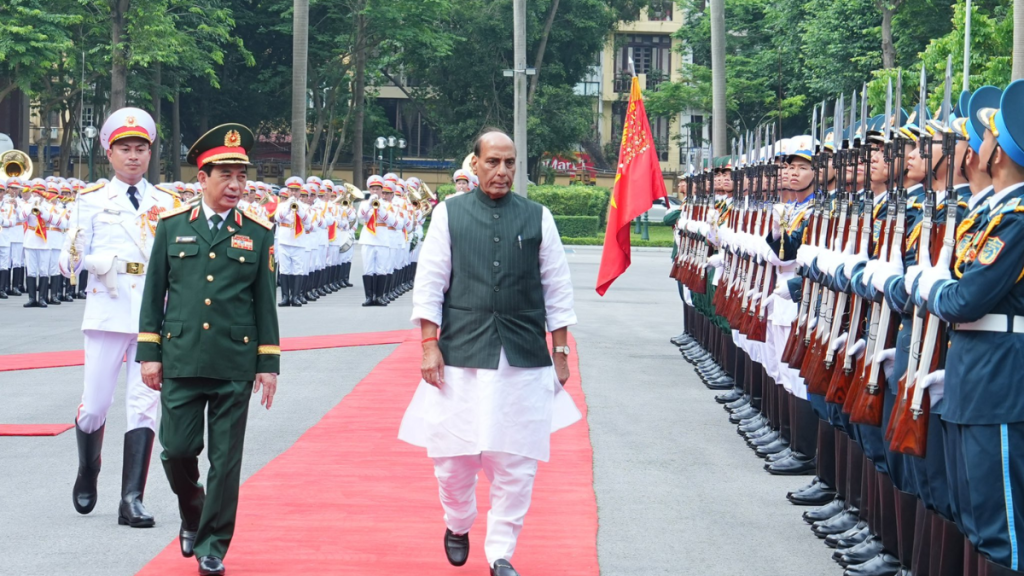
India’s Defence Minister Rajnath Singh is on a two-day tour of Vietnam, as both nations are in advanced talks for the sale of BrahMos supersonic cruise missile to Hanoi. India has previously supplied the BrahMos to Vietnam’s Pacific Ocean neighbour, the Philippines.
While in Hanoi, Rajnath Singh hailed May 2025 Operation Sindoor on terror infrastructure inside Pakistan as “a testimony to India’s transformation into a strong, confident, and capable nation.”
In Vietnam, Rajnath Singh held a bilateral meeting with the Deputy Prime Minister and Minister of National Defence of Vietnam, General Phan Van Giang, on Tuesday (May 19, 2026).
Both Ministers reviewed the growing defence partnership between the two countries and discussed ways to further deepen cooperation in maritime security, defence industry, training, and regional stability, according to a statement from the Indian Ministry of Defence (MoD).
The two sides exchanged views on regional and global security developments of mutual interest and emphasised the importance of maintaining peace, stability, security, safety, and freedom of navigation in the Indo-Pacific region, all euphemisms signalling China’s aggressive military posturing in the South China Sea.
The two ministers discussed avenues to expand cooperation in areas including military training, defence industry collaboration, maritime security, capacity building, United Nations peacekeeping, cyber security, and high-level exchanges.
They also agreed to enhance cooperation between the defence forces of the two countries through regular dialogues, joint exercises, and exchange programmes.
Rajnath Singh reaffirmed the commitment to strengthening India’s ‘Enhanced Comprehensive Strategic Partnership’ with Vietnam and reiterated India’s resolve in supporting Vietnam’s defence modernisation and capacity enhancement initiatives under the framework of bilateral defence cooperation.
The BrahMos missile deal, which is at an advanced stage of negotiations, is to meet these goals that both India and Vietnam have set for themselves.
General Phan Van Giang appreciated India’s continued support and underscored the long-standing friendship and growing strategic partnership between the two nations.
The two Defence Ministers virtually inaugurated the ‘Language Lab’ at the Air Force Officers’ College of Vietnam. This lab was established with Indian assistance. The Indian Defence Minister also announced the setting up of an ‘Artificial Intelligence Lab’ at the Telecommunications University at Nha Trang.
On the occasion, India’s Military College of Telecommunications Engineering and Vietnam’s Telecommunications University exchanged an MoU in the field of Artificial Intelligence and Quantum Technology, marking another important chapter in the Enhanced Comprehensive Strategic Partnership between the two nations.
After the bilateral meeting, Rajnath Singh called the General Secretary and President of Vietnam To Lam and conveyed warm greetings from the President & Prime Minister of India and reiterated India’s commitment to further deepening bilateral cooperation across diverse sectors, including defence and security, trade and investment, maritime cooperation, connectivity, digital transformation, and people-to-people exchanges.
“The two leaders reaffirmed the strong and enduring friendship between India and Vietnam, rooted in shared civilisational links, mutual trust, and common strategic interests. They expressed satisfaction at the continued growth of the India–Vietnam Comprehensive Strategic Partnership,” the statement said.
Warmly recalling his visit to India, the President of Vietnam appreciated the growing bilateral engagement and acknowledged India’s role as a key partner in Vietnam’s development and strategic priorities.
He welcomed the expanding defence cooperation as a key pillar of the ‘Enhanced Comprehensive Partnership’ between the two countries and expressed confidence that bilateral ties would continue to strengthen in the years ahead.
Later, addressing the Indian diaspora in Hanoi, Rajnath Singh said, “While India remains committed to the ‘no first use’ (nuclear weapons) policy, it will not succumb to nuclear blackmail and stands ready to respond firmly to any enemy misadventure.”
India’s neighbours, Pakistan and China, are nuclear-weapon states, and New Delhi has been wary of their collusion and has prepared itself for a two-front war with the two arch-rivals.
Rajnath Singh wrote on X that India was rapidly advancing in the semiconductor domain, and this was not just a story of technological progress, but also a story of building a new India.