


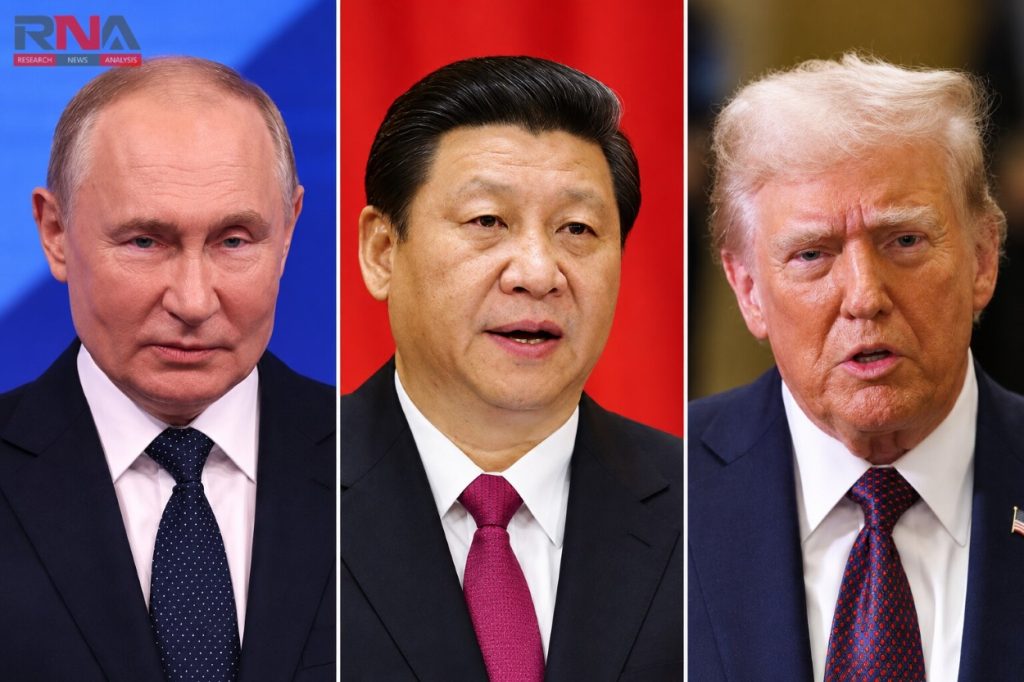
New Delhi: The Russian president, Vladimir Putin, has proposed a summit with his US and Chinese counterparts, Donald Trump and Xi Jinping, to discuss ending the war in Ukraine, the Wall Street Journal reported. The report said it would exclude Ukraine’s president, Volodymyr Zelenskyy, raising questions about Kyiv’s role in negotiations over its future.
Putin reportedly raised the proposal during a telephone conversation with Trump on October 9, which also produced an agreement on US purchases of Russian diesel. Moscow has suggested meeting alongside the Asia-Pacific Economic Cooperation (APEC) summit, although Trump has not agreed to participate.
The Kremlin spokesman, Dmitry Peskov, acknowledged discussions but said neither the meeting nor its agenda had been settled. The Journal described the initiative as an attempt by Moscow to secure a settlement favourable to Russia, rather than evidence that an agreement was approaching.
The APEC leaders’ meeting is scheduled for November 18–19 in Shenzhen, China. The gathering offers a potential setting for separate diplomatic talks, but its confirmed schedule should not be confused with confirmation of the proposed Ukraine summit.
The US secretary of state, Marco Rubio, subsequently acknowledged that a possible meeting had been discussed, while indicating that no final decision had been reached. Speaking during a visit to Uzbekistan on October 19, he urged Russia and Ukraine to concentrate on ending the war and warned about the danger of the conflict spreading.
The proposal comes as Washington’s recent overtures to Moscow have sharpened differences with Kyiv over how to pursue peace. Trump has defended easing pressure on Russia as a means of sustaining negotiations, while Zelenskyy argues that the diesel agreement and sanctions relief weaken efforts to constrain Putin.
Rubio said on Sunday that Trump would take up to 60 days to assess the sanctions waiver. The US energy secretary, Chris Wright, presented the diesel arrangement as an incentive for Russia to end the war, while Zelenskyy warned that suspending sanctions would prolong it.
Energy infrastructure has become central to this disagreement, linking battlefield operations with fuel prices and domestic politics in the United States. Ahead of November’s congressional midterm elections, Trump has blamed Ukrainian attacks on Russian refineries for higher energy costs, while Kyiv maintains that Russia continues striking its own energy facilities.
The fighting has continued despite the diplomatic manoeuvring, underlining the distance between discussing negotiations and establishing a ceasefire. As RNA Media had reported on Sunday, Ukraine launched more than 1,000 drones against Russia, with oil infrastructure among the targets, while Russian attacks caused further casualties in Ukraine.
China’s established position provides another important backdrop to the proposed talks. Its February 24, 2023, position paper called for respect for sovereignty and territorial integrity, a cessation of hostilities and renewed negotiations, while also opposing unilateral sanctions.
Those principles do not themselves resolve the questions a settlement would face, including territory, security arrangements and enforcement. The proposed format therefore leaves a fundamental issue unanswered: how discussions among Washington, Moscow and Beijing would translate into terms acceptable to Ukraine and capable of stopping the fighting.