


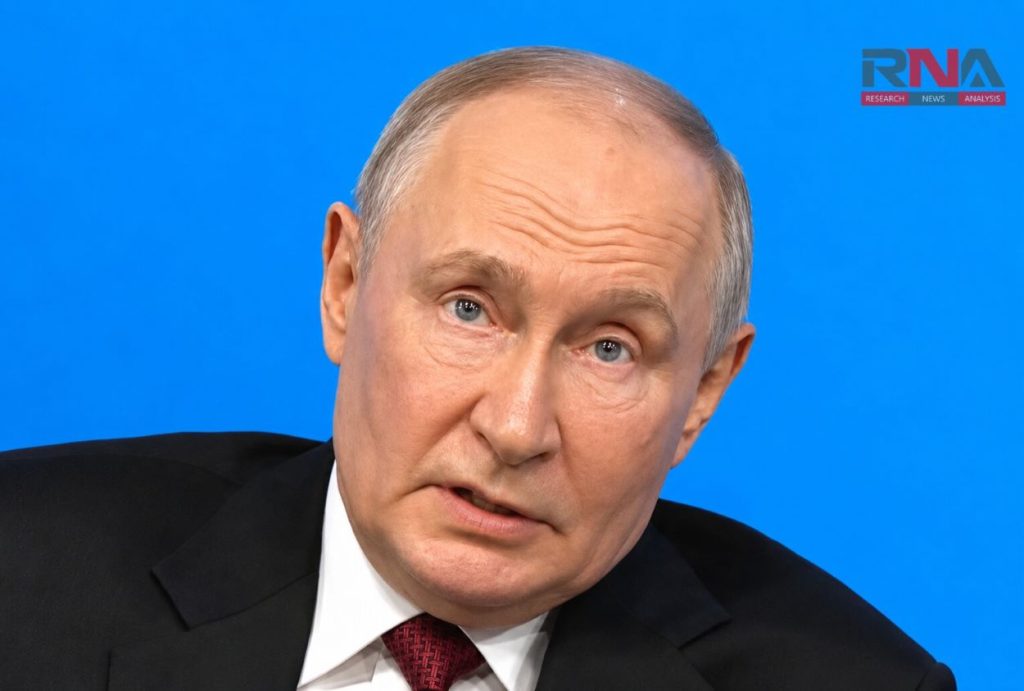
New Delhi: The Russian president, Vladimir Putin, has backed renewed engagement with European countries while warning that a wider military confrontation would leave no winners. His remarks on Thursday followed direct talks with the leaders of Finland and Norway, as preparations for fresh Ukraine negotiations raised questions about Europe’s place at the negotiating table.
Speaking to reporters after a Russia-Africa summit in Moscow, Putin said his country was prepared for a conflict with Europe but did not seek one. He also challenged European discussions about military readiness by 2030, claiming that Western attempts to inflict a strategic defeat on Russia had failed and were unlikely to succeed by that date.
“First of all, we are ready, but we want no war with Europe,” Putin said, according to Reuters. His warning combined support for restoring relations with an assertion that further escalation could have consequences for all sides.
Putin defended the decision of the president of Finland, Alexander Stubb, and the prime minister of Norway, Jonas Gahr Store, to telephone him on Wednesday, despite criticism within Europe. The Nordic leaders’ official account of the conversation said it was conducted in consultation with Ukraine and followed discussions in Oslo a week earlier.
Stubb and Store said their purpose was to convey messages about ending Russia’s war against Ukraine and preparing for future negotiations. They explicitly stated that they represented their respective countries, rather than Europe collectively, and reaffirmed their continuing support for Kyiv.
Putin also warned against obstructing shipping in the Baltic Sea, drawing a comparison with disruption around the Strait of Hormuz during the US-Iran conflict. He said Moscow wanted navigation to remain unhindered but would respond to challenges.
The diplomatic opening comes ahead of proposed negotiations involving Russia, Ukraine and the United States in Abu Dhabi. However, the Kremlin’s foreign policy aide, Yuri Ushakov, said on Wednesday that the timing depended on developments in the Middle East and other factors, leaving the arrangements uncertain.
What we know about the outreach
The clearest confirmed development is the reopening of direct communication between Putin and two European leaders whose countries share borders with Russia. Finland and Norway said the discussion covered both the Ukraine war and their interest in stability in the Baltic Sea region and the High North.
That contact has not produced a publicly announced political breakthrough. In an address to the Nordic Council after the call, Stubb said Putin’s positions contained no surprises and that the Nordic leaders had urged him to negotiate seriously.
Stubb also stressed that continued fighting would not exhaust Nordic support for Ukraine. His account indicates that the conversation provided a channel for communicating established positions, without demonstrating that the differences over ending the war had narrowed.
Moscow’s account similarly offered little evidence of a change in its negotiating conditions. According to the Kremlin readout, Putin insisted that a lasting settlement must fully accommodate what Russia describes as its legitimate interests.
The Kremlin said the leaders welcomed an agreement to resume Russian-Ukrainian-US talks in Abu Dhabi during the first half of November. It also said they agreed to maintain direct telephone contact, giving the Nordic initiative a potential continuing role even without a European seat in the proposed negotiations.
The precise timetable remains unsettled: the president of Ukraine, Volodymyr Zelenskyy, said on Wednesday, that he hoped a meeting would take place between November 6 and November 10. Ushakov, however, described an agreement to resume three-way consultations rather than a finalized schedule, and said European participation had not been discussed during the Nordic call.
Europe’s concern is that negotiations could shape its security without giving its governments a direct role in the decisions. The Financial Times reported on Thursday that European capitals remained divided over how to secure influence as Washington renewed its engagement with Moscow.
There is also a separate regional security context to Putin’s Baltic warning. Nato launched its Baltic Sentry activity in January 2025 following incidents involving critical undersea infrastructure, strengthening its presence and surveillance in waters shared by Russia and several alliance members.
Finland’s accession to Nato in 2023 and Sweden’s entry in 2024 changed the region’s military geography following Russia’s full-scale invasion of Ukraine in 2022. The Nordic governments’ emphasis on predictable relations and maritime security therefore addresses their own immediate security concerns as well as the wider war.
Putin’s latest remarks should consequently be read as an offer of engagement accompanied by a warning about escalation. They establish Moscow’s stated willingness to restore contacts, but the public accounts so far provide no evidence of agreement on the terms of a wider ceasefire or a settlement of the war.