


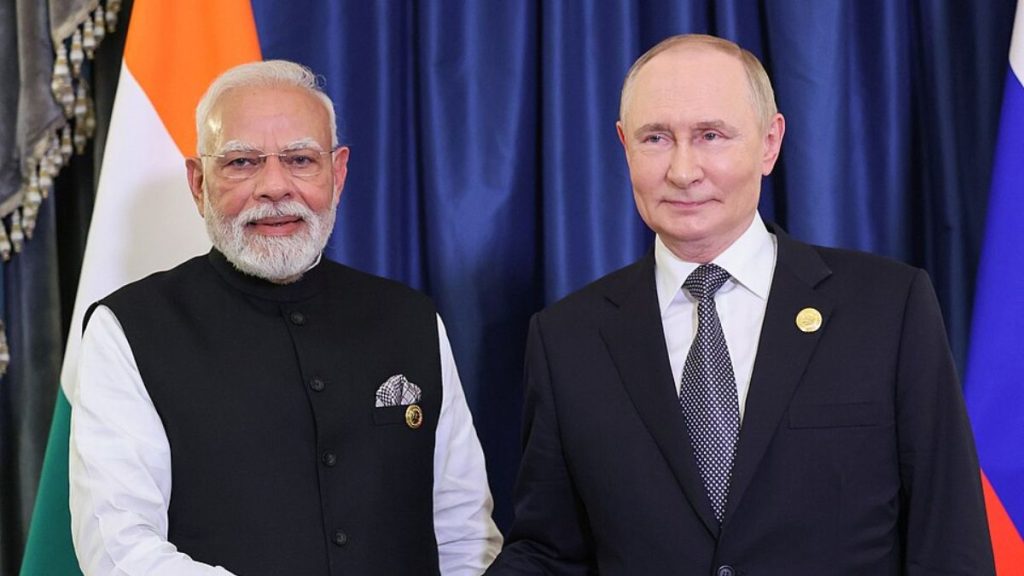
New Delhi: The Russian president, Vladimir Putin, on Monday credited the prime minister, Narendra Modi, with helping drive India- Russia economic ties as the external affairs minister, S Jaishankar, met him at the Kremlin during a two-day visit focused on trade, energy and long-term economic cooperation. The meeting comes at a particularly active diplomatic moment for New Delhi, with India simultaneously managing US concerns over Russian energy and a cautious improvement in ties with China.
Putin said bilateral trade had returned to growth this year after a decline earlier and attributed much of the momentum to Modi, who, he said, “pays close personal attention” to developing India-Russia relations. Jaishankar, who carried a personal communication from Modi for Putin, said economic cooperation between the two countries had grown “very significantly”, identifying trade, energy, fertilisers and nuclear cooperation among the areas discussed.
Jaishankar also told Putin that Modi looked forward to meeting him at the Shanghai Cooperation Organization summit and welcoming him to India for the BRICS summit on September 12−13. He said the annual India-Russia summit would follow at a mutually convenient time.
Trade has grown, but so has imbalance
Earlier in the day, Jaishankar co-chaired the 27th India-Russia Inter-Governmental Commission on Trade, Economic, Scientific, Technological and Cultural Cooperation with Russian first deputy prime minister Denis Manturov.
The mechanism covers some of the most consequential areas of the relationship: energy, fertilisers, pharmaceuticals, industrial cooperation, mining, information technology and trade. India and Russia have set a target of taking bilateral trade to $100 billion by 2030.
India-Russia trade reached a record $68.7 billion in 2024-25, according to the Indian embassy in Moscow. But the numbers also underline a structural imbalance. Indian exports accounted for only $4.9 billion, compared with $63.8 billion in imports from Russia.
Oil and petroleum products, fertilisers, coking coal and precious metals were among the principal Russian supplies, while India exported pharmaceuticals, chemicals, iron and steel and marine products.
New Delhi has therefore been pushing not only for higher trade but also for greater access for Indian exports, smoother payment arrangements, stronger transport connectivity and solutions to insurance and logistics problems that have complicated commerce with Russia since western sanctions intensified following the Ukraine war.
That economic agenda helps explain why Jaishankar’s visit matters. Russia remains an important energy supplier, a longstanding defence partner and a major source of fertilisers and nuclear cooperation, even as India has spent the past decade building much closer strategic, technological and economic ties with the United States.
Russian oil remains a test for US ties
That balancing act has become more difficult because Russian oil has emerged as a recurring point of friction between India and the US. The Trump administration imposed an additional 25 per cent tariff on Indian goods in August 2025 over India’s purchases of Russian oil. The White House removed the additional levy in February this year after saying India had taken significant steps to address US concerns and had committed to stop directly or indirectly importing Russian oil.
Energy flows have since been affected by disruptions in the Middle East. Reuters reported that Russia accounted for a record 50.83 per cent of India’s crude imports in July, as Indian refiners increased Russian purchases amid reduced availability from some Middle Eastern suppliers.
A US Senate bill passed this month would also give the president authority to impose tariffs of up to 100 per cent on countries heavily dependent on Russian energy, including India. The legislation still requires action by the House of Representatives.
At the same time, the Russia issue has not halted wider India-US economic engagement. US ambassador to India Sergio Gor said over the weekend that the broader bilateral trade agreement was close to completion, with most substantive issues agreed in principle. India and the US had already announced a framework for an interim trade agreement earlier this year.
The two tracks illustrate New Delhi’s approach. India is trying to preserve its relationship with Moscow while continuing to deepen economic and strategic cooperation with Washington, rather than treating the two partnerships as mutually exclusive.
Moscow engagement as Doval arrives in Beijing
The China dimension adds another layer to the timing. As Jaishankar held talks in Moscow, the national security advisor, Ajit Doval, arrived in Beijing ahead of the 25th round of Special Representatives’ talks with Chinese foreign minister Wang Yi on August 25. The discussions are part of the mechanism dealing with the boundary question and come as India and China cautiously rebuild engagement after years of tension along the line of actual control (LAC)
India and China have gradually restored some channels disrupted after the 2020 border crisis. Border trade through Nathu-la and Shipki-la resumed on August 1 after a six-year suspension, while diplomatic and military talks have continued on maintaining peace along the frontier.
At the latest diplomatic-level discussions on August 6, both sides stressed the importance of peace and tranquillity along the border for the wider bilateral relationship and agreed to continue using diplomatic and military channels to address outstanding issues.
The diplomatic calendar is becoming even more crowded. Reuters reported on Monday, citing three sources, that Chinese president Xi Jinping was likely to attend the BRICS summit in New Delhi on September 12-13, although Beijing had not formally confirmed the visit.
Three relationships, three challenges
The three relationships pose very different diplomatic challenges for New Delhi. With Russia, India has a longstanding strategic partnership built around defence, energy, nuclear cooperation and growing trade, with relatively limited political friction between the two governments.
With the US, strategic convergence has expanded considerably, particularly in defence, technology and the Indo-Pacific, but disagreements over trade and Russian energy continue to test the relationship.
China presents the most complex equation. Bilateral trade remains substantial, but an unresolved boundary dispute and wider strategic competition continue to limit how far the relationship can normalize.