


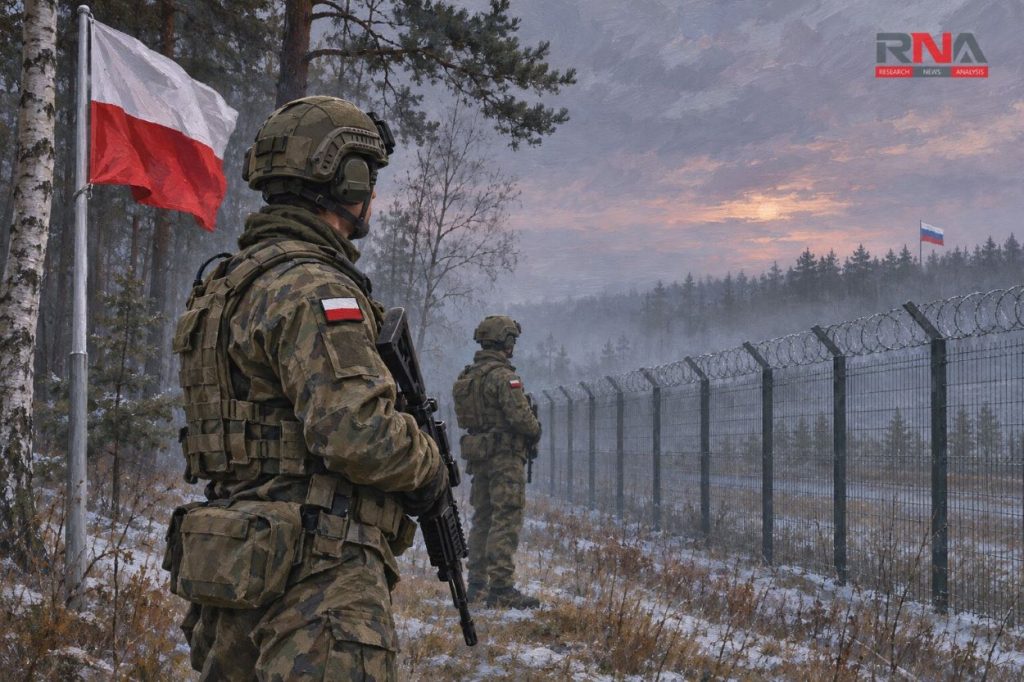
New Delhi: Poland has reinforced security along its border with Russia’s Kaliningrad exclave after intelligence warnings of possible sabotage and incursions by armed groups, the prime minister, Donald Tusk, said on Tuesday. GROM special forces personnel are also present in the region, although the military has described their activities as training alongside police and other troops.
The security operation gained urgency after border guards detected suspicious movements overnight, prompting the rapid deployment of additional personnel. Tusk said the response might have prevented a provocation but acknowledged that the intentions of those observed could not be established with certainty.
Speaking before a cabinet meeting, Tusk said Polish and allied intelligence agencies had warned of potential sabotage or serious provocations, including the possibility of armed people entering Polish territory during the first half of November. The warnings led the government to strengthen police, border guard and counterterrorism deployments in the country’s northeast.
Suspicious movements trigger overnight response
According to an AP report on Tusk’s remarks, the prime minister was informed shortly after midnight that people carrying torches had been spotted near the Polish-Russian border. Security forces were sent to the area, and no incident followed.
Tusk qualified his assessment that a provocation had been thwarted, saying officials could not conclusively determine whether that had been the purpose of the activity. His account did not establish that an armed group had crossed into Poland or identify the people seen near the frontier.
The intelligence warnings, he said, were consistent with concerns raised by Nato’s supreme allied commander Europe, General Alexus Grynkewich, during an October visit to Poland. Tusk cautioned that the heightened tensions could persist and said security agencies would need to remain prepared for further incidents.
Police lead operation; military clarifies GROM’s role
The national police chief, Marek Boroń, had confirmed the preventive security operation in an interview with RMF FM on Monday. He said reinforcements from several other provinces, including counterterrorism officers, were working with the military, border guards and intelligence services.
The operation covers the north-eastern provinces of Warmia-Masuria and Podlaskie, with a coordination headquarters established at national police headquarters in Warsaw. Regional police commands in Olsztyn and Białystok are also involved, with the stated objective of protecting residents and facilities against potential sabotage.
Wirtualna Polska reported, citing its sources, that GROM personnel had been sent to the border region in anticipation of possible sabotage and reconnaissance groups. That report placed the special forces deployment within the wider response to intelligence warnings about threats from Kaliningrad.
However, a subsequent statement from Poland’s special operations component command, reported by Defence24, described GROM’s presence in Warmia-Masuria as a training deployment. The command said its personnel would exercise with police and other military units, using vehicles, helicopters and additional equipment.
The command also appealed to the public to avoid exercise areas and refrain from publishing photographs, videos or information about the soldiers and their movements. Its statement confirmed the unit’s presence but gave a different public explanation for its role from the operational assignment described in media reports.
Intelligence claims remain unverified publicly
RMF reported that Poland’s military intelligence service and allied agencies had issued warnings in late October about possible sabotage near the Russian border, including crossings by armed groups. The underlying intelligence has not been made public, while police have withheld further operational details on confidentiality grounds.
According to the Tass report, the Russian embassy in Warsaw had previously rejected reports of potential sabotage as false and accused Poland’s information environment of increasingly militaristic rhetoric. That earlier response did not specifically address Tusk’s November 3 account of suspicious overnight activity.
Polish police have separately linked an order for heightened readiness from November 2 to November 8 to sabotage threats. They denied speculation that the order was connected to the domestic confrontation surrounding Poland’s constitutional tribunal.
Kaliningrad is a Russian Baltic Sea exclave bordered by Poland and Lithuania, both Nato members, making security developments there significant beyond the immediate frontier. Nearby lies the Suwałki Gap, the stretch of territory between Kaliningrad and Belarus that provides the Baltic states’ land connection with other Nato allies.
For now, Polish authorities describe the additional security measures as preventive, intended to protect border communities and deter possible incidents. The reinforced deployment is confirmed, but the alleged sabotage plans and the purpose of the overnight movements remain unverified in the publicly available accounts.