


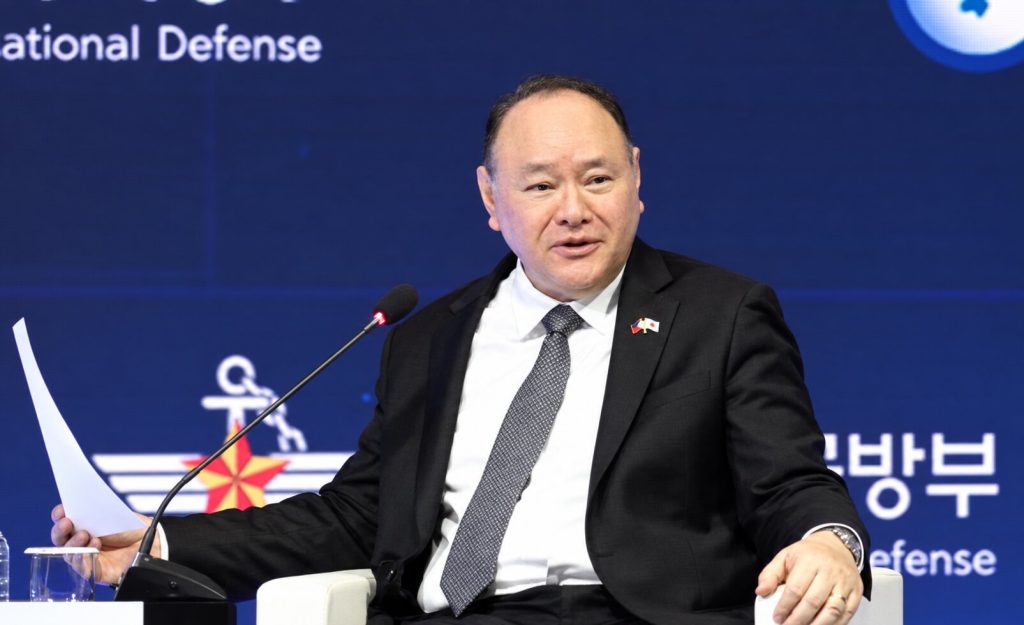
New Delhi: A handwritten note restating China’s position on the South China Sea became the centre of an unusually sharp public exchange in Seoul after the Philippine defence secretary, Gilberto Teodoro Jr, read it aloud and challenged its assertions during a maritime-security discussion.
The exchange took place at the Seoul defense dialogue on Tuesday while Teodoro was speaking about maritime security and the United Nations Convention on the Law of the Sea (Unclos). Forum organizers said a Chinese military attaché from the embassy in Seoul handed the note to a staff member, who then passed it to Teodoro during the session.
The note reiterated Beijing’s position that the 2016 South China Sea arbitral award was “illegal, null and void”, lacked binding force and would not be recognized by China. Teodoro responded from the stage, arguing that Beijing was rejecting obligations arising from Unclos. When he reached the assertion that China neither accepted nor recognized the award, he replied: “Of course, because you lost.”
He later described the intervention as “actual coercion, bullying and aggression”, drawing applause from the audience. The Philippine defence department subsequently circulated footage of the exchange.
What the 2016 ruling actually said
The case was initiated by Manila under Annex VII of Unclos. In July 2016, an arbitral tribunal administered by the permanent court of arbitration concluded that there was no legal basis for China to claim historic rights to resources within sea areas falling inside its expansive “nine-dash line” beyond the maritime rights permitted under Unclos.
The tribunal did not rule on sovereignty over disputed land features or delimit a maritime boundary between China and the Philippines.
China refused to participate in the proceedings and has consistently rejected the award. Beijing maintains that the tribunal lacked jurisdiction and that maritime disputes should be settled through negotiations between the states concerned.
The Chinese foreign ministry spokesperson, Mao Ning, reiterated that position on Wednesday. She said Beijing was not familiar with the specific circumstances of the Seoul incident but remained opposed to what China calls the “South China Sea arbitration”. She also urged relevant Philippine officials to stop “seeking attention and stirring up trouble”.
For Manila, the award remains a central legal basis for challenging Chinese maritime claims. The dispute has also become increasingly operational, with repeated confrontations involving Philippine vessels and Chinese coast guard or other maritime forces around contested features.
India-China border dialogue expands
The Seoul confrontation has no direct legal connection with the India-China boundary dispute. The 2016 arbitration dealt with maritime entitlements and conduct under Unclos, while India and China are seeking a negotiated settlement of an unresolved land boundary.
The two developments nevertheless come at a time when New Delhi and Beijing are cautiously expanding military and diplomatic engagement following years of tensions along the line of actual control (LAC).
India and China held their first corps commander-level meetings in the eastern sector on September 6 and 7, at Wacha on the Indian side in Arunachal Pradesh and Damai on the Chinese side. The Ministry of External Affairs said the mechanism followed understandings reached by the two countries’ special representatives and subsequent Working Mechanism for Consultation and Coordination talks.
The meetings came amid reported tensions in the Taksing area of Upper Subansiri district in Arunachal Pradesh and expanded senior military communication beyond the western sector, where 23 rounds of corps commander-level talks were held following the 2020 eastern Ladakh crisis.
Weeks earlier, the national security adviser, Ajit Doval, and the Chinese foreign minister, Wang Yi, held the 25th round of special representatives’ talks in Beijing on August 25. The two sides agreed to maintain peace and tranquillity along the border and continue negotiations towards a “fair, reasonable and mutually acceptable” settlement.
They also agreed to advance work on boundary delimitation, establish additional high-level military meeting points and strengthen communication through new military hotline channels.
The recent improvement in ties followed the October 2024 patrolling arrangement covering Depsang and Demchok, which led to disengagement from the remaining friction points associated with the 2020 standoff. The confrontation had culminated in the Galwan valley clash in June 2020, in which 20 Indian soldiers and four Chinese troops were killed.
For India, the latest military talks form part of an effort to maintain peace along the LAC while broader negotiations on the boundary continue. Both sides have repeatedly stated that peace and tranquillity in the border areas are necessary for the steady development of bilateral relations.