


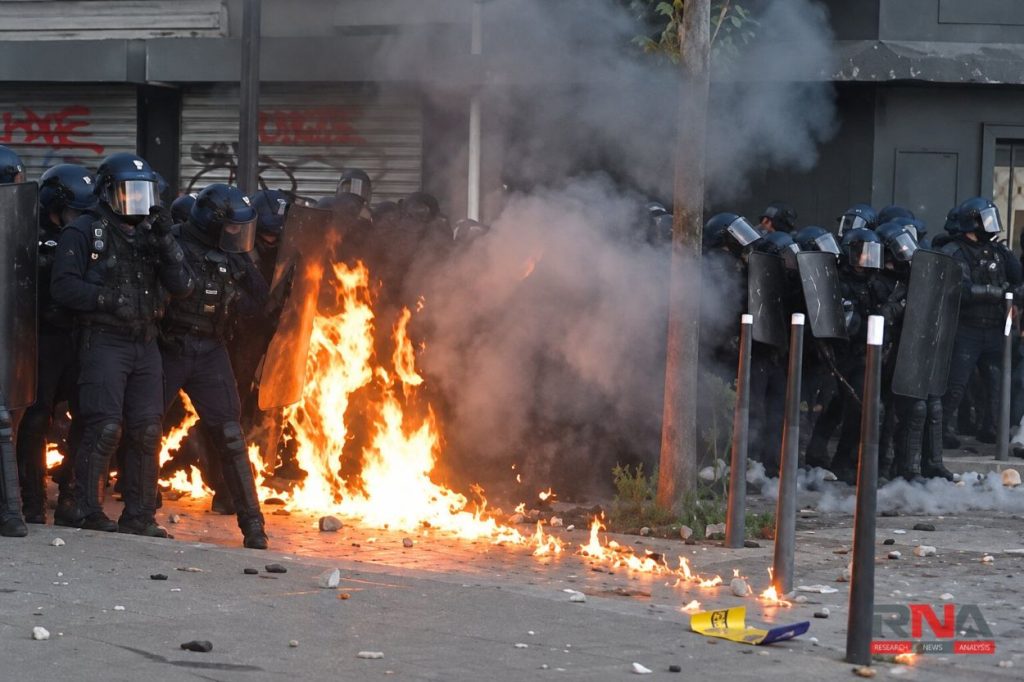
New Delhi: French prosecutors have opened an attempted murder investigation after a petrol-bomb attack set a gendarmerie officer’s protective equipment ablaze during protests in Paris on Saturday. Three suspects were being sought, according to a subsequent AFP report, as authorities investigated violence that followed a third consecutive weekend of demonstrations over living costs and public services.
The inquiry, announced on Sunday, concerns an attack at Porte de Charenton, where the capital’s march ended. Photographs and video showed an incendiary device exploding near security personnel and flames spreading around an officer’s legs.
Prosecutors said explosive devices had targeted about 15 gendarmes as well as police officers, with reported injuries including second-degree burns. Their initial statement said no suspects had been arrested in connection with the attack; the later AFP dispatch published by Mediapart reported that investigators were searching for three suspects.
The injured gendarme told RTL that his unit had faced bottles, stones and incendiary devices, and that parts of his protective equipment had melted. The broadcaster reported that 13 members of his unit were injured, although prosecutors were still assessing the overall injuries.
Footage also showed a man attempting to help extinguish the flames before another officer pushed him away and restrained him. The injured officer, identified as Captain Alexandre, subsequently told AFP that his colleagues had mistaken the man’s intentions during the confrontation and acknowledged that he had come to help.
France’s interior minister, Laurent Nunez, condemned the violence committed by some rioters as “extraordinary”. The Paris police prefecture said several hundred people had attacked security personnel with projectiles during the disturbances.
The interior ministry’s revised nationwide tally recorded 779 arrests during the demonstrations and Halloween night, replacing Saturday evening’s provisional figure of 565. That total covered incidents across France and was separate from the investigation into the petrol-bomb attack.
Paris prosecutors separately reported 105 arrests in the capital, comprising 88 linked to the demonstrations and 17 to Halloween night. They said 89 people remained in custody, including at least 22 minors.
The government estimated nationwide participation at 320,000, while unions put turnout at nearly 500,000. Despite the attack in Paris, the overall disorder was less extensive than during the earlier October protests.
The French protest movement began with school students challenging teacher shortages, neglected buildings and a university admissions system they considered unfair. Labour unions and other groups subsequently joined, broadening the demands to include wages, household costs and public services.
Most demonstrators marched peacefully, although clashes broke out near the end of the Paris procession, with bottles and fireworks thrown at police. Officers responded with tear gas and stun grenades, prompting peaceful participants to leave the area.
Authorities were preparing for further disruption as schools reopened on November 2 following the autumn break, with some student organizations calling for blockades. A broader strike affecting trains and public services, accompanied by student and union demonstrations, was planned for November 5.
In Germany, Frankfurt experienced some of the weekend’s worst violence, with authorities reporting more than 100 injured police officers and 54 arrests. The interior minister of Hesse, Roman Poseck, said 17 shops had been damaged, including five that were looted, and that those arrested were aged between 13 and 29.
The German rallies were organized by the youth campaign Gen Z regelt, which demanded better education and more affordable living. The organizers distanced themselves from the violence, while Germany’s interior minister, Alexander Dobrindt, promised that rioters and looters would be identified and held accountable.
In Portugal, police forcibly dismantled housing protest camps in Lisbon and Porto after demonstrators refused to remove their tents overnight. Euronews reported about 100 injuries, including 13 police officers, and said the president, António José Seguro, had sought explanations about the police operations.
Switzerland also saw clashes following unauthorized demonstrations in Zurich and Basel, with burning barricades and damage to property. In Zurich, police reported attacks with fireworks, bottles and stones, and used water cannon, tear gas and rubber bullets to disperse groups.