


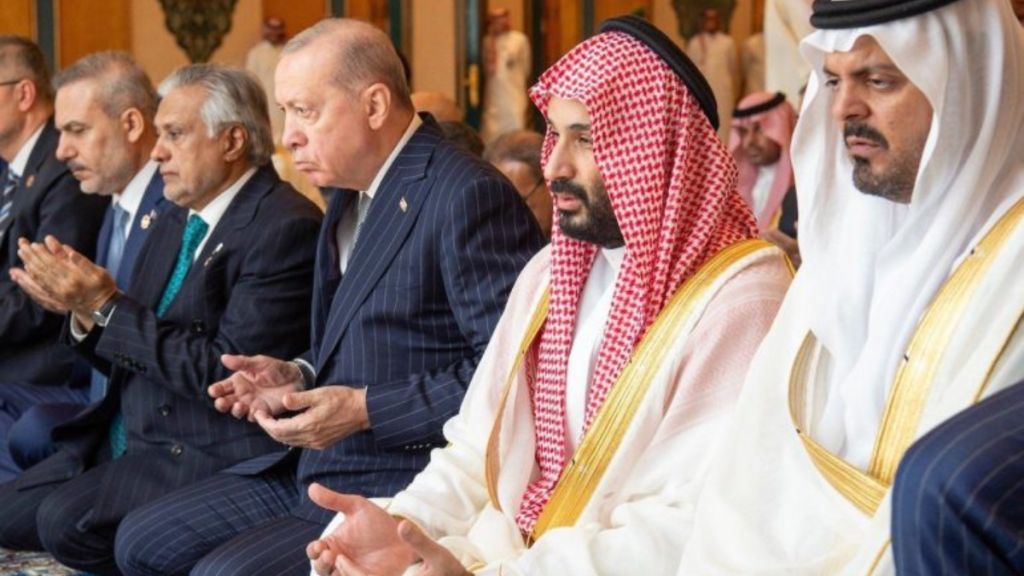
New Delhi: Four days after Pakistan, Saudi Arabia and Türkiye signed the Mecca Joint Defence Agreement on August 7, 2026, pledging to treat an attack on any one of them as an attack on all, missiles struck the cargo vessel Tihamah in the Bab el-Mandeb Strait. Four crew members — three Pakistanis and an Indonesian — were killed, according to Yemen’s transport ministry.
The vessel’s 11-member crew comprised Pakistani and Indonesian nationals. Two Yemeni rescue workers were killed in a follow-up strike as they attempted to reach the survivors, taking the overall toll to six and exposing the gulf between the pact’s political promise and its immediate operational value.
The Mecca pact was signed with considerable fanfare. The prime minister, Shehbaz Sharif, said he hoped the agreement would “remain a shield of peace for generations to come”, and the Turkish president, Recep Tayyip Erdoğan, said it would strengthen cooperation in security and defence.
Days earlier, Saudi Arabia, Pakistan, Türkiye and 11 other countries — including Bahrain, Egypt, Jordan, Qatar and Yemen — had formed a separate maritime coalition intended to protect the Bab el-Mandeb Strait, the Red Sea and the Gulf of Aden against Houthi counternarcotics attacks. The Saudi naval officer Rear Admiral Abdullah bin Salem al-Shehri was appointed its commander.
Neither arrangement changed the outcome for the three Pakistani sailors aboard the Tihamah. The Tanzanian-flagged vessel, owned by companies registered in Egypt and Yemen, was struck by three ballistic missiles on August 11 while carrying food supplies through the strait, according to Yemen’s transport ministry.
Early reports from Yemeni officials had incorrectly identified the ship as Saudi-owned. The attack caused a fire and extensive damage, particularly to its bridge, photographs of the vessel showed.
Pakistan’s foreign minister, Ishaq Dar, confirmed that at least three Pakistani nationals had been killed and another injured. Describing the Tihamah as a “non-combatant commercial vessel”, he said Pakistan’s foreign ministry was in contact with the authorities in Saudi Arabia and Yemen.
A Yemeni Coast Guard statement said two rescuers belonging to an anti-Houthi military group were killed in a second strike targeting the rescue operation. Yemen’s transport ministry said the follow-up attack endangered both those aboard the ship and those attempting to save them.
The contrast between political signalling and operational protection is not new to Pakistan’s maritime posture. Islamabad has maintained defence cooperation with Saudi Arabia for decades, including training and technical assistance for Saudi forces, and has periodically exchanged warships and training aircraft with Türkiye.
Pakistan Navy vessels have also operated under Combined Task Force 150 of the Combined Maritime Forces. In October 2025, a Pakistan Navy ship participating in a counternarcotics operation seized narcotics valued at about $972 million.
None of these arrangements, however, provided protection to the Pakistani nationals killed on August 11 in a waterway that the newly constituted 14-nation coalition was specifically intended to secure. The incident underscored the difference between establishing a security framework and deploying the surveillance, interception and rescue capabilities needed to enforce it.
The coalition itself was only days old when the Tihamah was attacked. According to Al Jazeera, its first planning meeting was held on August 12 and 13 — beginning a day after the strike — to finalize its institutional framework.
It therefore remains unclear whether a fully operational coalition, backed by agreed rules of engagement and assets positioned near the strait, could have intercepted the missiles or evacuated the crew more quickly. Its command structure and operating procedures were still being developed when the Pakistani sailors were killed.
Pakistan’s foreign ministry has not publicly explained what operational protection the Mecca agreement or the maritime coalition would provide to Pakistani nationals working aboard commercial vessels in the Bab el-Mandeb and Gulf of Aden corridor. Nor has it clarified how either arrangement would respond to attacks by non-state actors against civilian shipping.
According to Pakistan’s official announcement, the Mecca pact commits the three signatories to regard an armed attack on one of them as an attack on all. That collective-defence provision appears designed primarily for state-on-state conflict, leaving unanswered how it would apply when Pakistani citizens are killed aboard a foreign-flagged commercial vessel by missiles fired by a non-state armed group.