


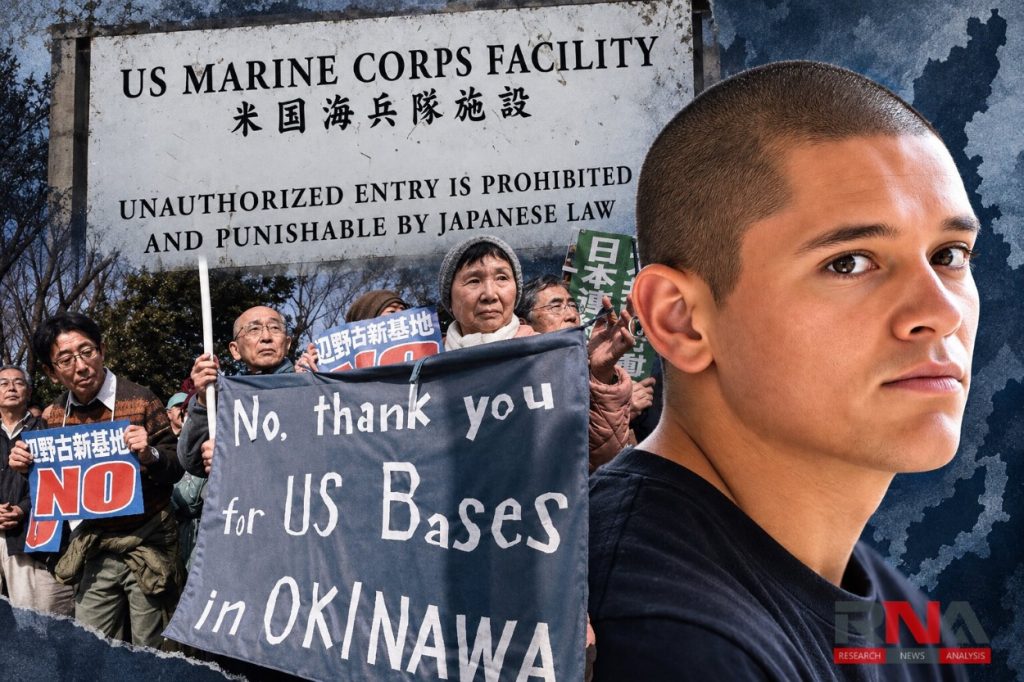
New Delhi: Okinawa’s prefectural assembly called on Friday for a fundamental revision of the agreement governing American military personnel in Japan, following the arrest of a US marine suspected of robbing and killing a local woman. The demand has renewed pressure on Tokyo and Washington to address longstanding concerns about military discipline and accountability in a prefecture central to their security alliance.
The resolution passed by 45 votes to two, according to local media, and will be submitted to the US embassy. Lawmakers also adopted an opinion statement for the Japanese government, seeking changes to the Japan-US Status of Forces Agreement (SOFA), including its provisions governing the transfer of criminal suspects.
The case concerns Lance Corporal Devin Jacob Ballard, 20, who was arrested on October 4 on suspicion of killing Anna Yagi, 39, at a hotel in Naha, Okinawa’s capital, the previous day. Police said he was also suspected of taking her wallet and backpack; Ballard has denied the allegations.
Ballard, a combat engineer serving with Marine Wing Support Squadron 172, remains in Japanese custody, and his case was forwarded to the Naha prosecutors’ office on October 5. Police said Yagi died from asphyxiation after pressure was allegedly applied to her neck, according to a Stars and Stripes report.
The killing has prompted protests in Okinawa and Tokyo, with dozens of demonstrators gathering outside Japan’s foreign ministry on Thursday carrying signs condemning crimes involving US service members. Reuters reported that the demonstrations were smaller than the mass protests following the rape of a 12-year-old Okinawan girl by three American servicemen in 1995, an incident that became a defining moment in opposition to the bases.
The prime minister of Japan, Sanae Takaichi, lodged a formal protest with the US after Ballard’s arrest and demanded full cooperation with the investigation and stronger preventive measures. The US embassy and Marine Corps expressed condolences and said they were cooperating with Japanese authorities.
At a meeting with Takaichi on October 7, the governor of Okinawa, Genta Koja, argued that repeated assurances about discipline and human rights education had failed to prevent further serious incidents. He welcomed the governments’ prompt response but sought Japanese involvement in making preventive measures effective, alongside further efforts to reduce Okinawa’s burden of hosting American bases.
The US military ordered a 48-hour suspension of normal operations and an alcohol ban, running from noon on October 7 until Friday noon, while personnel underwent training. Lieutenant General Benjamin Watson, commander of III Marine Expeditionary Force, also announced a subsequent 30-day period with a midnight-to-5am curfew and increased supervision at installation gates.
The assembly’s intervention goes beyond those immediate restrictions by seeking changes to the legal framework governing the American presence. It follows a similar resolution and opinion statement adopted in 2024 after a series of sexual assault cases involving US servicemen in Okinawa.
The forces agreement, concluded in 1960, allocates criminal jurisdiction between the two countries and regulates the use of military facilities and the status of American personnel. Japan generally has the primary right to prosecute offences against local residents outside official duties, while the United States has priority over offences arising from official duties and certain offences involving only American military interests or personnel.
One disputed provision allows a suspect already held by US authorities to remain in American custody until Japan formally brings charges, even when Japan has primary jurisdiction. A 1995 bilateral arrangement requires Washington to give sympathetic consideration to Japanese requests for earlier custody transfers in specific murder or rape cases, but does not make such transfers automatic.
These arrangements help explain why demands for reform persist even though Japanese authorities are holding Ballard in the current investigation. The wider dispute concerns the balance between Japan’s authority to enforce its laws and the procedural protections and operational privileges afforded to a foreign military stationed on its territory.
Okinawa’s disproportionate share of the military presence adds to that friction: the prefecture accounts for about 0.6 per cent of Japan’s land area but hosts roughly 70 per cent of the total area of facilities reserved exclusively for US forces, according to Japan’s Okinawa defence bureau. Residents have long raised concerns about aircraft noise, pollution and crimes associated with the bases, alongside demands for a more equitable distribution of their burden.
The prefecture remained under American administration after the Second World War until its return to Japan in 1972, and its island chain lies close to Taiwan and China. Tokyo and Washington regard that location as crucial to regional deterrence, leaving them under pressure to reconcile the alliance’s military requirements with residents’ demands for safety and accountability.