


New Delhi: Harald V, Norway’s king, died in Oslo on Friday, ending a 35-year reign during which he modernized the royal household and became a reassuring national figure in times of crisis. His son, Haakon, immediately succeeded him as King Haakon VIII, assuming the throne when Norway’s monarchy is facing unusually intense public scrutiny over controversies involving members of his family.
The Norwegian royal household said Harald died peacefully at Oslo University Hospital Rikshospitalet at 6.35am (10.05am IST). He had been admitted on August 17 with a bacterial infection in his blood and was also being treated for haemolytic anaemia, a condition in which red blood cells are destroyed faster than the body can replace them.
The palace had announced on Thursday that Harald’s condition had become “extremely serious”, prompting Haakon and other senior royals to cancel their engagements. Crowds began gathering outside the Royal Palace in Oslo after news of the death emerged, laying flowers as flags were lowered to half-mast and church bells rang across the country.
Under Norway’s Constitution, the throne passes automatically to the next person in the line of succession, ensuring that the country is never formally without a monarch. The Norwegian government’s explanation of the transition says no proclamation or coronation is required for the accession itself.
Haakon formally informed ministers of his father’s death during an extraordinary council of state and confirmed that he would reign as Haakon VIII. He retained the traditional royal motto, “Everything for Norway”, and is expected to take the constitutionally mandated oath of allegiance before the Storting, Norway’s parliament.
Norway abolished coronations more than a century ago, reflecting the restrained character of its constitutional monarchy, although the new king may later choose a religious consecration. A period of national mourning will continue until Harald’s funeral, the date of which had not been announced immediately.
The kingdom’s prime minister, Jonas Gahr Store, said the news had been received with profound sadness and described Harald’s life as one devoted to the country. “King Harald loved Norway. And Norway loved its king,” Store said as political leaders and royal houses across Europe offered condolences.
Britain’s king, Charles III, remembered Harald as a “dear cousin” who had guided Norway with warmth and humility, while the president of the European Commission, Ursula von der Leyen, said he had brought Norwegians together. The international tributes repeatedly emphasized his personal modesty, steady leadership and ability to represent a wealthy but strongly egalitarian society.
Harald became king on January 17, 1991, after the death of his father, Olav V, and gradually made the royal household more accessible and responsive to social change. Although the monarch’s role was largely ceremonial, Harald remained an important symbol of continuity in a parliamentary democracy where the crown is expected to stand above partisan politics.
His standing was reinforced by his response to the July 22, 2011, terrorist attacks in Oslo and on Utoya island, in which far-right extremist Anders Behring Breivik killed 77 people. Addressing a traumatized country, Harald declared that “freedom is stronger than fear”, helping establish his reputation as a national consoler rather than merely a ceremonial head of state.
In a widely discussed speech in 2016, Harald presented Norwegian identity as inclusive of immigrants, different religions, atheists and people of diverse sexual orientations. The intervention was considered unusually direct for a monarch but closely reflected the socially liberal values that had increasingly shaped modern Norway.
Born on February 21, 1937, Harald was the first royal heir to be born in Norway in nearly 570 years and was three when Nazi Germany invaded the country. He spent much of the Second World War in exile in the United States, returned in 1945, later studied at Balliol College, Oxford, and represented Norway in sailing at three Olympic Games.
His marriage to Sonja Haraldsen, a commoner, in 1968 challenged the conventions of European royalty and eventually became central to the monarchy’s modern image. Despite bladder-cancer surgery in 2003, repeated infections and the fitting of a permanent pacemaker in 2024, Harald consistently rejected abdication because he regarded his parliamentary oath as a lifelong commitment.
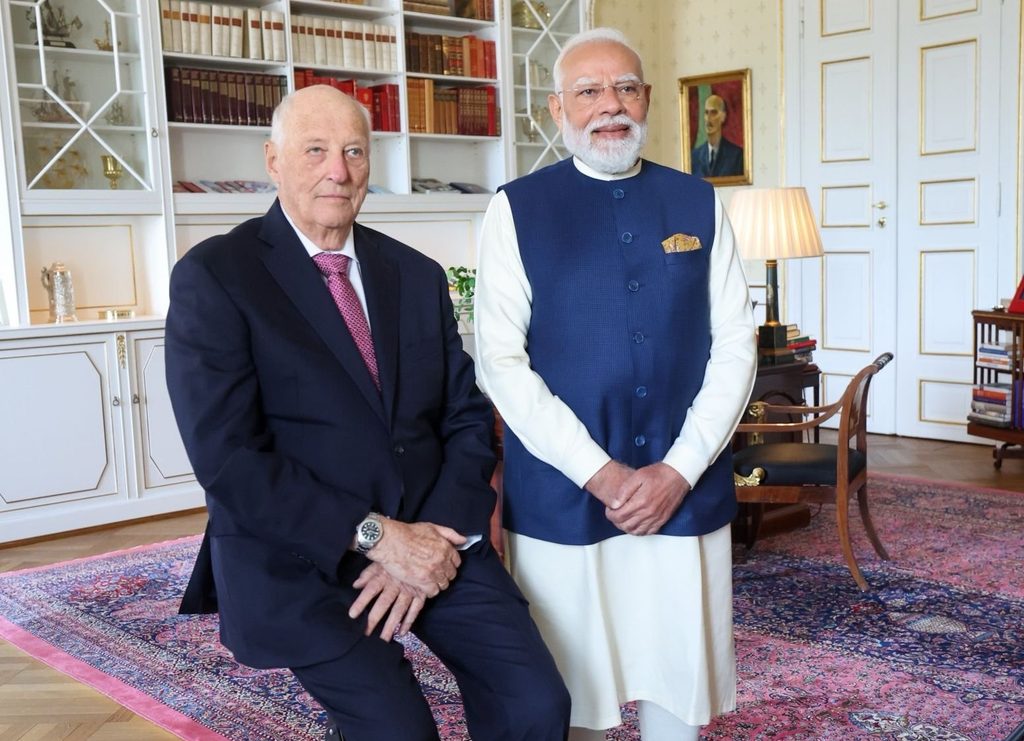
For India, his death comes little more than three months after the prime minister, Narendra Modi, met him at the Royal Palace during an official visit to Oslo on May 18. According to the Prime Minister’s Office, they discussed expanding bilateral cooperation in technology, innovation and business, as well as the long-standing relationship between India and Norway.
Modi expressed his condolences on Harald V’s demise. In a post on X, he said: “I fondly recall meeting His Majesty during my visit to Norway earlier this year and was deeply touched by his warmth and profound sense of service to his nation,” and expressed his condolences to the people of Norway.

Haakon, 53, enters the role with substantial experience, having repeatedly served as regent during his father’s illnesses and undertaken diplomatic and ceremonial assignments abroad. Educated at the University of California, Berkeley, and the London School of Economics, he has generally promoted development, environmental protection and international cooperation.
However, his wife, Mette-Marit, who has become queen consort, is facing criticism over her past friendship and correspondence with Jeffrey Epstein after the American financier’s 2008 conviction for sex offences involving a minor. Documents released by the US justice department showed extensive contact between them between 2011 and 2014, prompting Mette-Marit to apologize for her poor judgement and for the damage caused to the royal family.
The controversy concerns her association with Epstein and the judgement involved in maintaining that relationship; she has not been accused of participating in his crimes. Nevertheless, the disclosures became politically significant after Store publicly said she had shown poor judgement, an unusual rebuke of a senior royal by a serving Norwegian prime minister.
The family has also been shaken by the prosecution of Marius Borg Hoiby, Mette-Marit’s son from an earlier relationship and Haakon’s stepson. Hoiby was sentenced in June to four years in prison after being convicted of two counts of rape, domestic violence and other offences, although both he and prosecutors have appealed the sentence.
The cases have damaged confidence in the royal household, with a Norstat survey for public broadcaster NRK recording support for the monarchy at 60 per cent in February before a partial recovery to 64 per cent in May. Institutional backing remains strong, however, as the Storting voted by 141 members to 26 in February against replacing the monarchy with a republic, according to Reuters.
Haakon’s 22-year-old daughter, Ingrid Alexandra, is now the crown princess and heir apparent, placing Norway on course eventually to have its first reigning queen in more than six centuries. The immediate test for Haakon will be whether he can preserve the credibility and unifying character associated with his father while establishing clearer boundaries between the constitutional institution and the private conduct of its extended family.