


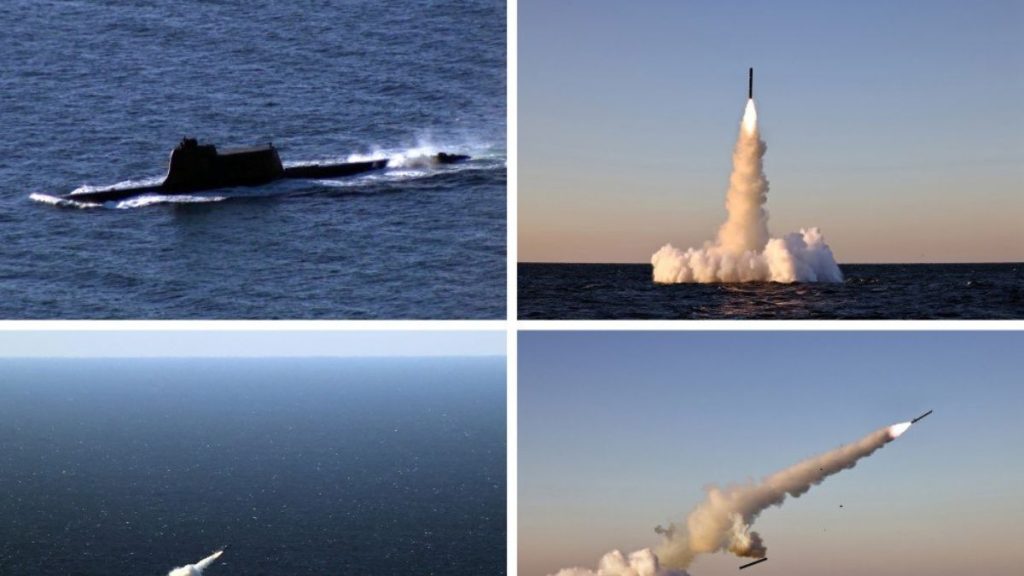
New Delhi: North Korea test-fired two types of submarine-launched strategic cruise missiles off its eastern coast on Wednesday, its first publicly reported underwater missile launches since January 2024. The tests, announced the following day, have renewed scrutiny of Pyongyang’s pursuit of a sea-based strike capability, although the submarine involved and its operational readiness remain unconfirmed.
The launches examined the readiness of underwater combat systems and the navy’s ability to perform strategic missions, according to the state-run Korean Central News Agency (KCNA). Senior military officials observed the tests, which Pyongyang said posed no threat to neighbouring countries. KCNA named neither the missiles nor their ranges.
South Korea’s joint chiefs of staff said it tracked the launches from before firing through the end of flight. Its spokesman, captain Jang Do-young, said one missile type was launched vertically and the other from a torpedo tube, but did not identify the submarine.
Uncertainty over launch platform
Photographs released by North Korea suggested the possible involvement of the Hero Kim Kun Ok, a roughly 3,000-tonne diesel powered submarine unveiled in September 2023. Pyongyang claims it can launch tactical nuclear weapons. Analysts at 38 North identified ten missile-tube hatches in photographs of the vessel, including four larger and six smaller openings, but questioned aspects of its converted Romeo-class design.
North Korea said its January 2024 Pulhwasal 3-31 missile tests involved the smaller, 2,000-tonne 8.24 Yongung submarine, regarded by experts primarily as a testing platform. If the latest missiles came from the Hero Kim Kun Ok, they would represent its first publicly reported weapons tests since its unveiling.
Shin Jong-woo of the Korea defence and security forum said the launches suggested progress towards testing combat systems for deployment after a prolonged period without reported trials. He also suggested that submarine-launched ballistic missile tests could follow.
However, Hong Min of the Korea institute for national unification cautioned that the vessel appeared to have only “limited operational capability”, with prolonged patrols and fully submerged launches yet to be demonstrated.
Why underwater launches matter
Submarine-launched cruise missiles can fly low and approach targets from unexpected directions, potentially complicating detection for South Korea, Japan and American forces. Unlike ballistic missiles, which rise before following a largely ballistic trajectory, cruise missiles remain powered during flight.
The latest tests follow North Korean ballistic launches on September 20, including a weapon analysts said might carry a hypersonic glide vehicle, an October 3 missile drill described by Pyongyang as hypersonic and further ballistic launches on October 12. Separately, North Korea unveiled a nuclear-powered submarine under construction in March 2025, with no confirmed completion date.
Kim Jong Un has made naval modernization a priority. North Korea dismissed Washington’s reduction of a joint military exercise with South Korea in August as insufficient to change its hostile character and has insisted that the US abandon denuclearization demands as a precondition for talks.
Moon Keun-sik, a submarine specialist at Hanyang University, interpreted the latest launches as an effort to strengthen Pyongyang’s negotiating position by demonstrating its determination to extend its nuclear deterrent to the maritime domain.
For now, the identity of the launching vessel, the readiness of its weapons systems and any deployment timetable remain unconfirmed.