


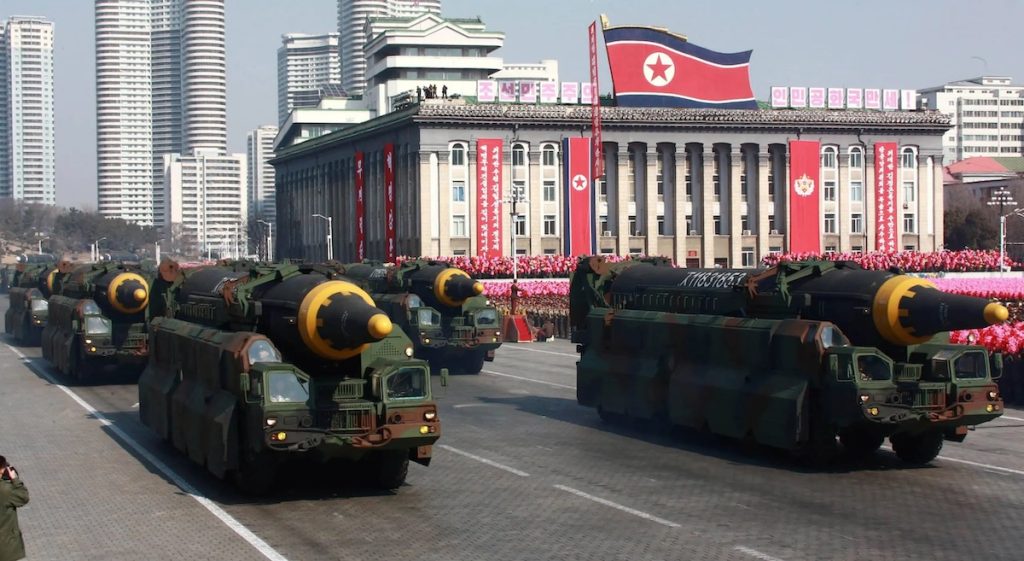
New Delhi: North Korea fired a barrage of short-range ballistic missiles into the sea on Thursday, as a dispute over landmines that wounded three South Korean soldiers in September intensified tensions along the peninsula’s heavily fortified border. The launches came six days after Seoul proposed military talks to clarify the location of the dividing line and reduce the risk of accidental clashes.
South Korea’s joint chiefs of staff (JCS) said the missiles were launched from the Wonsan area on North Korea’s eastern coast at about 12.30pm local time and travelled approximately 250km. Reports citing the military put the number at about 10 to a dozen, while South Korean and US authorities continued analysing their specifications.
Japan’s defence ministry said the projectiles appeared to have fallen outside its exclusive economic zone, while the Japan Coast Guard advised vessels to remain alert and avoid any fallen objects. South Korea’s presidential national security office convened an emergency meeting, and Seoul condemned the launches as violations of United Nations Security Council resolutions.
The South Korean military increased surveillance for further launches and said it was sharing information with Washington and Tokyo. Although the barrage followed Seoul’s dialogue offer, the available reporting did not establish whether Pyongyang intended it specifically as a response to that proposal.
Landmine findings deepen the dispute
The immediate source of friction is a September 21 explosion in the demilitarized zone (DMZ), which injured three South Korean soldiers. A joint investigation involving South Korean authorities and the United Nations Command, whose findings were announced on October 5, concluded that North Korean anti-personnel mines had been deliberately planted south of the military demarcation line.
Investigators said GPS measurements placed the blast sites and another mine discovered nearby approximately 10 metres south of the line. They cited forensic analysis of fragments, explosive residue and the way the devices were buried as evidence that the mines were North Korean and had been laid intentionally, rather than carried into the area by floodwater.
According to the South Korean military, the United Nations Command assessed that the mines had been emplaced more than a year earlier. Seoul demanded an apology and their removal and began a clearance operation around the explosion site in coordination with the command.
Pyongyang has denied responsibility and accused Seoul of manufacturing the dispute to portray North Korean border construction as an incursion. The disagreement has also reached the United Nations Security Council, with both governments submitting letters setting out their competing accounts.
Talks offer meets threats and artillery displays
South Korea’s October 23 proposal for military talks sought to resolve differences over the precise location of the military demarcation line and prevent unintended confrontations. Seoul also proposed discussing the restoration of communication channels, but no North Korean acceptance had been reported in the coverage available on Thursday.
Instead, North Korea has threatened additional weapons deployments and a resumption of anti-South propaganda broadcasts along the frontier. Kim Yo-jong, the influential sister of the North Korean leader, Kim Jong-un, has rejected Seoul’s demands for an apology over the mine incident.
The confrontation has been accompanied by unusually visible military activity near the border. Reuters reported on Monday that three North Korean armoured vehicles, identified by South Korean reporting as 122mm self-propelled howitzers, were positioned with their barrels pointing south, while soldiers carried out fencing work inside the DMZ.
South Korea’s military subsequently assessed that the artillery was an older system and that its conspicuous positioning was primarily intended as a display. North Korean troops have been constructing roads and fences and laying mines near the dividing line, while Seoul says it has used warning broadcasts and warning shots when personnel cross into the South’s side.
Weapons tests continue
The barrage followed North Korea’s previous ballistic missile launches on October 12, which Pyongyang described as tests intended to improve a key weapons component. The latest missiles’ precise type remained under assessment, making it premature to identify the weapon system solely from its reported flight distance.
The tests also come as the US president, Donald Trump, continues to signal interest in renewed engagement with Kim. However, Trump has recently played down expectations of an imminent summit, leaving uncertain the prospects for negotiations and Seoul’s role in any future nuclear diplomacy.
The Korean War ended in 1953 with an armistice rather than a peace treaty, leaving the two Koreas technically at war. Despite its name, the DMZ remains one of the world’s most heavily fortified frontiers, where disputes over mines, construction activity and troop movements can quickly acquire wider military significance.
There is a precedent for a mine incident escalating into a broader confrontation: in 2015, injuries to South Korean soldiers prompted Seoul to restart propaganda broadcasts, triggering a military standoff. That crisis ended through a high-level inter-Korean agreement after Pyongyang expressed regret, whereas the present dispute remains unresolved.