


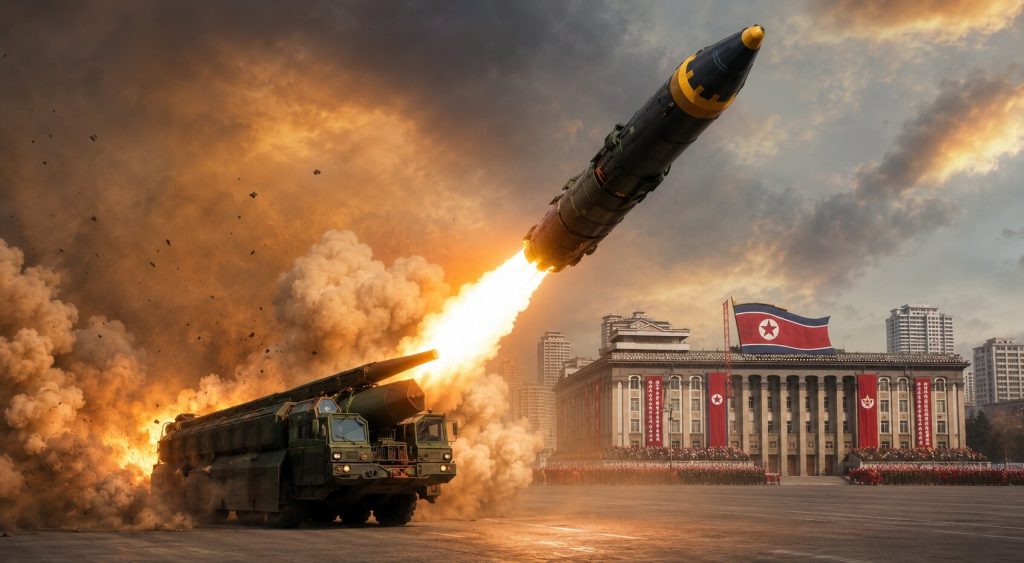
New Delhi: North Korea launched at least one short-range ballistic missile into the East Sea on Thursday, ending a pause of just over six weeks in its weapons-testing programme. South Korea’s joint chiefs of staff (JCS) confirmed the launch from the Wonsan area on the North’s eastern coast, though it did not immediately specify how many missiles were fired or the distance they covered.
The missile was detected shortly after 5pm local time, or 9am GMT (2.30pm IST), according to a JCS statement. Seoul said it had strengthened surveillance against possible further launches and was maintaining a full readiness posture while sharing information closely with Washington and Tokyo.
Japan’s defence ministry separately said it had detected what it believed was a ballistic missile launch from North Korea, adding that there was no impact on Japanese territory or its exclusive economic zone. The two allied assessments – from Seoul and Tokyo – broadly matched, though neither government offered further technical detail on the projectile’s type or trajectory.
First test since June
Thursday’s launch was North Korea’s first since June 25, when the North Korean leader, Kim Jong-un, oversaw tests of a tactical ballistic missile alongside new multiple rocket launchers and other weapons. It also followed a pointed warning from Kim’s sister, Kim Yo-jong, who said on Wednesday, that Pyongyang would not remain a “passive onlooker” to what she called Japan’s accelerating transformation into a military power.
State media in Pyongyang quoted Kim Yo-jong describing Japan’s pursuit of pre-emptive strike capabilities as a “war criminal state” threat to regional peace. The remarks came as Japan marked the 81st anniversary of the Hiroshima atomic bombing, lending a symbolic edge to both the statement and the launch that followed it.
Pyongyang has steadily built up its nuclear and missile capabilities since denuclearisation diplomacy between Kim Jong-un and the-then US president, Donald Trump, collapsed in 2019. Analysts believe Kim’s underlying objective is international recognition as a nuclear-armed state, a status that would strengthen his hand in any future negotiation over the lifting of sanctions.
Only last month, Kim supervised the test of a nuclear-capable cruise missile and other weapons aboard a newly commissioned 5,000-tonne destroyer, underlining a shift in emphasis from land-based ballistic systems towards naval power. North Korea is also reported to be constructing a nuclear-powered submarine, part of a broader push to diversify its strike capability across sea, land and air.
That naval build-up has coincided with deepening military ties with Russia, to which Pyongyang has supplied both conventional weapons and troops in support of Moscow’s war in Ukraine.
For India and other Indo-Pacific stakeholders, the episode is a reminder that trilateral coordination between Seoul, Tokyo and Washington remains the primary mechanism for managing North Korean brinkmanship, even as Pyongyang’s growing partnership with Moscow, as RNA Media reported, complicates the picture. Each fresh launch adds to a testing tempo that has become almost routine through 2026, yet the pattern continues to shape deterrence planning well beyond the Korean peninsula.