


New Delhi: A former Ukrainian military officer went on trial in Hamburg on Wednesday accused of helping organize the explosions that damaged the Nord Stream gas pipelines linking Russia and Germany. The proceedings mark the first trial over the September 2022 sabotage, bringing a politically sensitive investigation into public court hearings four years after the attack.
The defendant, identified under German privacy rules as Serhii K, denies involvement, while the Ukrainian government has also denied responsibility. Prosecutors allege that he worked with other Ukrainian military personnel on behalf of unidentified Ukrainian state entities to destroy the pipelines and prevent Russia from financing its war through gas revenues.
According to the prosecution’s account, the operation involved professional divers, a boat captain and an explosives specialist using a chartered yacht. Explosions near the Danish island of Bornholm on September 26, 2022, damaged three of the network’s four undersea pipes, leaving a major route for Russian gas exports unusable.
Serhii K was arrested in Italy in August 2025 and extradited to Germany that November after contesting his transfer. Another Ukrainian suspect, previously released by a Polish court that refused Germany’s extradition request, was arrested in Croatia in August 2026 and has been challenging his extradition.
The charges include causing explosions, damaging property, disrupting public services and complicity in war crimes, based on the alleged targeting of civilian infrastructure. Those accusations remain to be tested in court, including the defendant’s role and the prosecution’s characterization of the attack.
The case presents a diplomatic difficulty for Berlin, which remains a major supporter of Ukraine against Russia’s invasion. Its outcome could clarify responsibility for the sabotage, while also intensifying debate about the pipelines’ strategic role and the limits of wartime attacks on energy infrastructure.
What happened to Nord Stream – and how did it affect Europe?
Nord Stream comprised two projects, each containing two parallel pipes running beneath the Baltic Sea from Russia to Germany. Nord Stream 1 entered service in stages in 2011 and 2012, while Nord Stream 2 was completed in 2021; together, they had a designed annual capacity of 110 billion cubic metres of gas.
The direct route allowed Russia to supply Germany without crossing Ukraine or Poland, reducing its dependence on those transit countries. Supporters presented the projects as reliable commercial infrastructure, while opponents warned that they deepened Europe’s reliance on Moscow and weakened Ukraine’s strategic position.
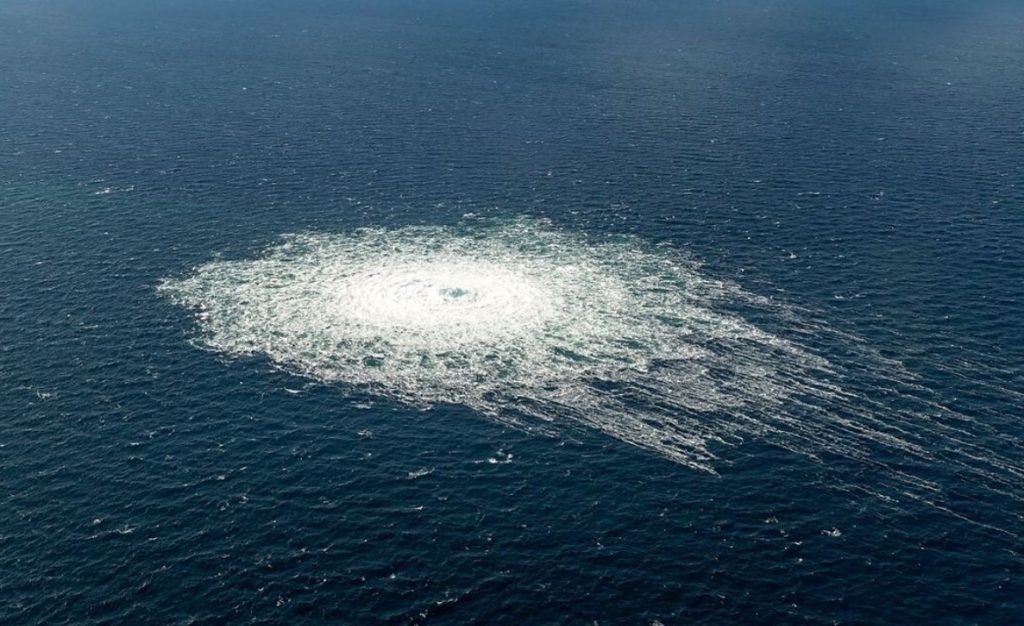
On September 26, 2022, underwater explosions ruptured both Nord Stream 1 pipes and one Nord Stream 2 pipe near Bornholm. Although gas deliveries were inactive, the pipes remained pressurized, producing enormous methane leaks when their walls were breached.
Crucially, the explosions did not initiate Europe’s energy crisis: Russia had already stopped Nord Stream 1 deliveries, and Germany had suspended Nord Stream 2’s certification before the invasion. The sabotage instead disabled infrastructure that might otherwise have offered a route for restoring supplies, adding physical destruction to an existing political and commercial rupture.
The wider supply shock was severe because European heating, electricity generation and manufacturing depended heavily on gas. The International Energy Agency’s assessment shows that Russian pipeline exports to OECD Europe fell by approximately 50%, or 83 billion cubic metres, in 2022, as multiple supply routes were curtailed.
Europe responded by buying more liquefied natural gas, expanding import terminals and filling storage facilities ahead of winter. European LNG imports increased by more than 60% in 2022 but limited additional global supply meant cargoes were diverted from other markets, spreading the pressure to Asian buyers.
The adjustment carried substantial economic costs: households faced higher bills, while energy-intensive factories reduced production or substituted imported goods. According to the IEA’s analysis of gas demand, EU consumption fell by 13% in 2022, yet its gas import bill approached €400 billion – more than three times the previous year’s level.
The explosions also caused a major environmental disaster, separate from their economic consequences. A UN Environment Programme-coordinated study estimated that 445,000–485,000 tonnes of methane escaped, identifying the incident as the largest human-caused methane release recorded.
Europe’s lasting response has combined supplier diversification, lower consumption and stronger storage arrangements, although greater reliance on LNG exposes buyers to global competition. On January 26, the EU adopted a phased ban on Russian gas imports, with full prohibitions scheduled for LNG from the beginning of 2027 and pipeline gas from autumn 2027, subject to transition and emergency provisions.