


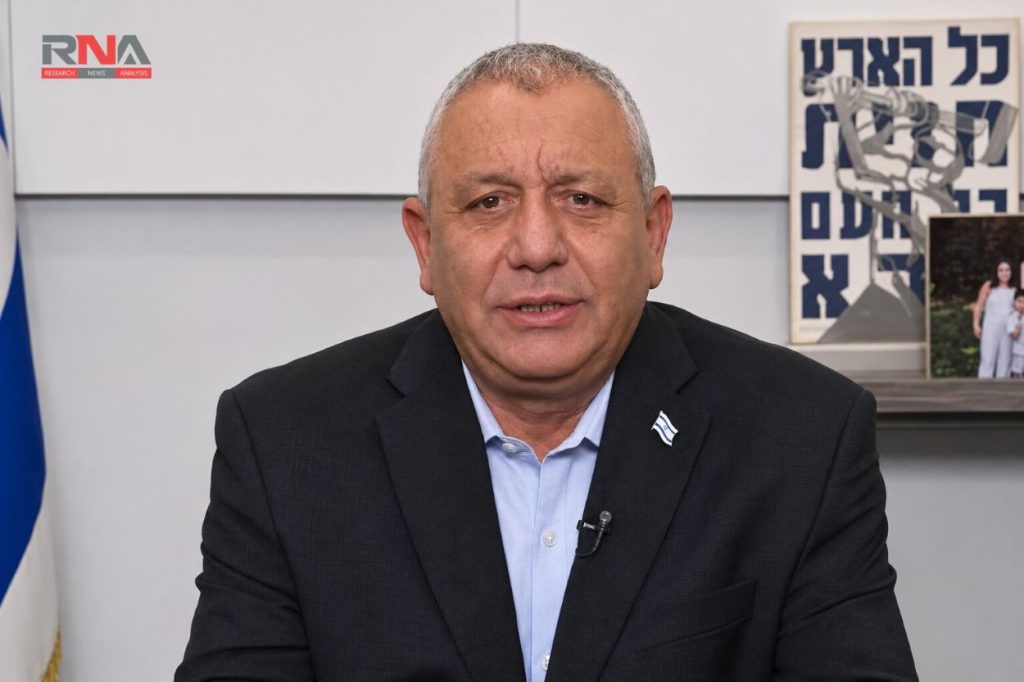
New Delhi: Israel’s opposition parties have reached their first significant agreement on sharing powerful parliamentary positions, marking a coordinated attempt to challenge the prime minister, Benjamin Netanyahu, as the country struggles to form a government following an inconclusive general election. The arrangement, negotiated by former military chief Gadi Eisenkot and four opposition leaders, could give Netanyahu’s opponents control over key legislative institutions even before they secure the majority needed to replace his administration.
The breakthrough came as Israel’s newly elected parliament, the Knesset, was sworn in on Tuesday, nearly two weeks after the October 27 election produced another fragmented political verdict. Eisenkot, who has been entrusted with forming the next government, announced that the opposition leaders had agreed on candidates for the parliamentary speakership and three influential committee positions, potentially strengthening their negotiating position against Netanyahu’s right-wing alliance.
According to the agreement announced by Eisenkot, the understanding involves former prime minister Naftali Bennett, former deputy military chief Yair Golan, former defence minister Avigdor Lieberman and former prime minister Yair Lapid. Although their parties differ considerably on security, economic and domestic issues, they share the immediate objective of establishing an alternative government and ending Netanyahu’s premiership.
The most consequential nomination is that of former minister Matan Kahana, a member of Eisenkot’s Yashar party, for speaker of the Knesset, a position currently held by Netanyahu ally Amir Ohana. The speaker exercises considerable influence over parliamentary proceedings and the legislative agenda, making control of the office particularly important when rival political blocs are competing to assemble a governing majority.
The agreement also proposes Roy Folkman, another Yashar politician, to lead the committee responsible for parliamentary procedures, with Lieberman nominated to chair the Foreign Affairs and Defence Committee. Liran Avisar Ben-Horin, associated with Bennett’s political camp, has been selected to head the Finance Committee, which oversees important aspects of government spending and budgetary legislation.
These nominations remain subject to parliamentary approval, and the proposed committee arrangements will require further negotiations before they can take effect. However, the understanding demonstrates that Eisenkot’s prospective partners can cooperate on distributing institutional responsibilities, even though they have not resolved the considerably more difficult question of governing together.
Parliamentary arithmetic remains the biggest obstacle
The president, Isaac Herzog, formally gave Eisenkot the mandate to form a government on November 8, after consultations showed that lawmakers representing 67 parliamentary seats favoured giving him the first opportunity. Netanyahu received recommendations from lawmakers representing 46 seats, but these presidential consultations do not necessarily translate into firm commitments to participate in a governing coalition.
Eisenkot’s immediate political alliance controls 48 seats in the 120-member Knesset, considerably short of the 61 required for a parliamentary majority. Netanyahu’s Likud remains the largest individual party with 27 seats, and his broader religious-nationalist bloc commands 53, leaving neither side capable of forming a government without additional support.
The balance of power rests partly with Arab-led parties, which collectively secured 19 seats and could help Eisenkot reach the required majority. However, Lieberman has rejected participation in a government dependent on Arab political support, exposing a fundamental disagreement within the opposition over the composition of any future administration.
An alternative would involve attracting ultra-Orthodox parties or individual lawmakers from Netanyahu’s parliamentary camp, although that strategy presents its own complications. Disagreements over military conscription exemptions for ultra-Orthodox Jewish men have become particularly contentious, making cooperation between secular nationalist politicians and religious parties difficult.
Eisenkot nevertheless insisted on Tuesday that he intended to establish a national emergency government as quickly as possible, arguing that the prevailing political circumstances demanded compromise. The former chief of staff, whose son was killed during the Gaza war, has positioned himself as an alternative to Netanyahu’s leadership and called for an investigation into the security failures surrounding the Hamas attacks of October 7, 2023.
His challenge extends beyond assembling parliamentary numbers, as the prospective coalition includes politicians with sharply contrasting views on religion, security and the relationship between Jewish and Arab citizens. Nevertheless, significant elements of the opposition broadly favour a tough security posture towards Iran, suggesting that a change of government would not necessarily produce an immediate transformation in Israel’s regional policies.
Netanyahu could remain in office despite electoral setback
Under Israel’s government formation procedures, Eisenkot has until December 6 to secure an agreement, with a possible extension until December 20. Should he fail, Herzog could offer another candidate, potentially Netanyahu, an opportunity to assemble a majority, prolonging the political uncertainty.
Netanyahu, meanwhile, continues as caretaker prime minister and retains considerable political influence despite his alliance falling short of a majority. He has alleged electoral irregularities involving Arab voters, although Israeli officials have indicated that no identified misconduct would have been sufficient to change the election result.
Addressing the newly elected parliament, Herzog urged political leaders to overcome their differences and avoid pushing Israel towards another election. The new Knesset includes 47 first-time lawmakers, reflecting substantial changes in the country’s political representation after years of divisive coalition politics.
For Eisenkot, the agreement over parliamentary appointments represents a tangible opening rather than a decisive political victory, since the nominated officials must still secure the necessary legislative backing. Whether this initial cooperation develops into a functioning government will determine if Netanyahu’s opponents can translate their combined parliamentary strength into a change of leadership or whether Israel faces another prolonged political impasse.