


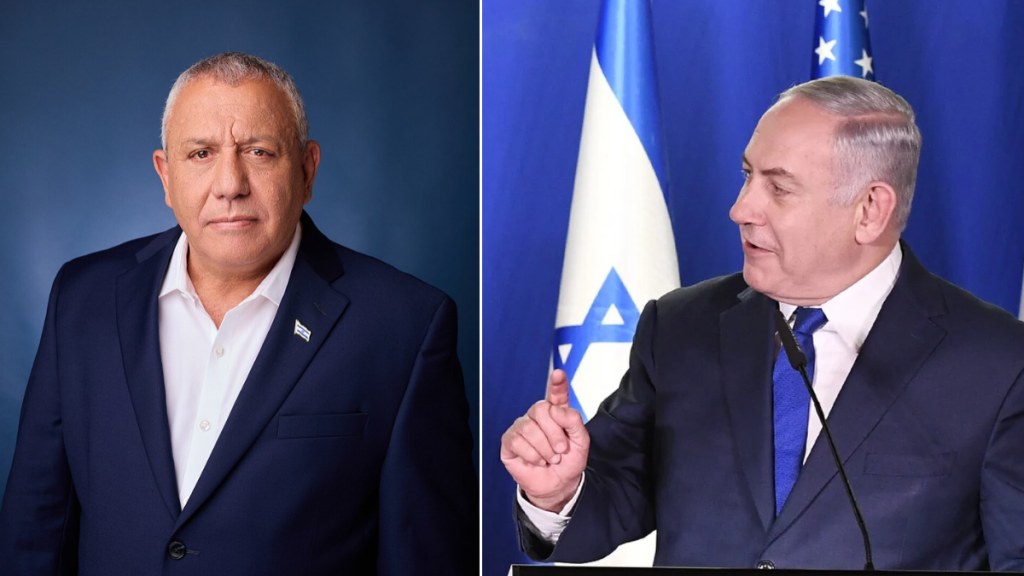
New Delhi: Israel’s caretaker prime minister, Benjamin Netanyahu, met his rival Gadi Eisenkot in Tel Aviv on Sunday and discussed a national unity government that could end a month of political deadlock. The two-hour meeting came hours after Netanyahu made an offer he had long refused: that Eisenkot serve first as prime minister under a rotation deal.
Eisenkot, leader of the centrist Yashar party, now has one week left to form a government. The mandate, which President Isaac Herzog gave him on November 8, runs out on December 6.
Netanyahu announced the offer on Saturday night in a social media post. He argued that Likud, as the largest party, would normally lead any coalition.
“My responsibility as a leader requires me to set everything aside, including the principle of the largest party,” he wrote, asking for “genuine, sincere and accelerated negotiations” in return.
The offer marks a shift from his earlier stance. Two weeks ago, Likud negotiators reportedly demanded that Netanyahu serve as the sole prime minister for a full four-year term.
Netanyahu has presented unity as a security necessity for weeks. Earlier this month, he warned that the alternative was a “shaky and dangerous government”.
Eisenkot answered within hours with a test of his own. “If Likud is genuinely committed to unity, I am prepared to assess its seriousness over the next 24 hours,” he said.
He insisted that the talks should rest on his team’s policy paper rather than on Netanyahu’s public announcement. He also accused Likud of stalling and ignoring a detailed proposal his team sent last week.
The two camps have clashed over the same handful of issues for weeks. Each side has set out terms that the other rejects.
Likud’s reported opening demands included a place for Itamar Ben-Gvir’s far-right Otzma Yehudit party. They also sought a political inquiry into the October 7, 2023 attack instead of an independent state commission.
Other reported terms kept the judicial overhaul laws in place until both sides reach a consensus. They also backed the outgoing government’s ultra-Orthodox military draft bill and a pledge against a Palestinian state.
Likud dismissed three of those reported claims as false. It disputed the accounts of its position on the inquiry, the judicial reforms and military conscription.
Eisenkot said Likud had tabled no concrete proposal on a state inquiry or a universal conscription law, while his bloc had offered “real and substantive” compromises, including on the judicial overhaul.
Eisenkot will consider partners from Netanyahu’s outgoing coalition, but not Ben-Gvir’s party. Likud, in turn, insists on bringing in its entire bloc, including Ben-Gvir.
Negotiating teams found some common ground last week. They agreed to draft a mandate for an inquiry into the October 7 attack if unity talks moved forward.
The October 27 elections left no clear winner. Netanyahu’s bloc of right-wing and ultra-Orthodox parties won 53 seats, short of the 61 needed for a majority.
Eisenkot’s likely partners hold 48 seats, led by Yashar with 21. He has already signed coalition deals with Avigdor Liberman’s Yisrael Beytenu and Yair Golan’s Democrats.
Those deals left him well short of a majority. Yashar, Yisrael Beytenu and the Democrats together control 36 seats.
The two rivals share one red line: neither wants to depend on the Arab-led parties. Those parties hold 19 seats in the 120-member Knesset.
The former prime minister Naftali Bennett and his B’Yachad party, with 12 seats, now hold a pivotal position. Bennett is the only member of Eisenkot’s bloc who backs a unity deal under which Netanyahu would serve second.
Bennett reportedly warned Netanyahu that B’Yachad would sign with Yashar if no rotation offer came.
Bennett’s terms include a state inquiry into the October 7 attack and an eight-year limit on prime ministers. He also wants agreed judicial legislation and new laws benefiting soldiers.
Other partners in Eisenkot’s bloc dismissed the offer. Liberman called the rotation idea “merely a ploy” and warned that Netanyahu might try to sabotage the process.
Ron Dermer, a former strategic affairs minister, joined Sunday’s meeting at the Kirya military headquarters, mainly as a mediator between the two camps.
Outside, demonstrators called on both leaders to form a national unity government.
Eisenkot is also pursuing a possible draft deal with the ultra-Orthodox United Torah Judaism party. He can ask for a 14-day extension if talks drag on, and he has accused Likud of stalling to force a fresh election.
For now, neither side has closed the door. Eisenkot has said his door remains open if Likud makes “courageous leadership decisions”.