


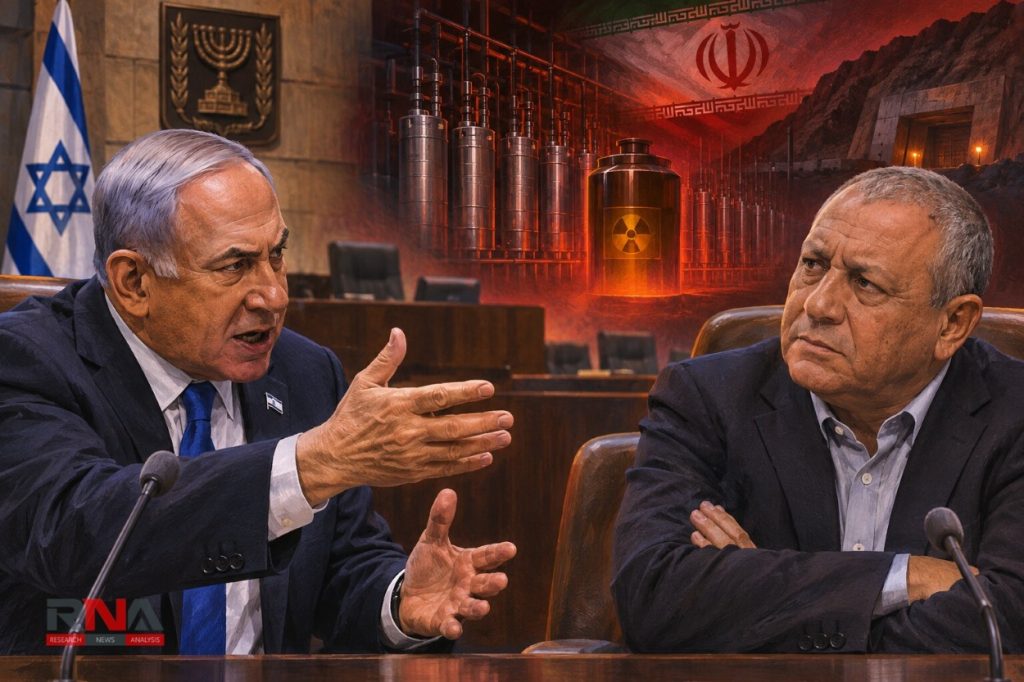
New Delhi: A sharp disagreement over the urgency of renewed military action against Iran has intensified Israel’s political uncertainty, with the caretaker prime minister, Benjamin Netanyahu, accusing his opponents of underestimating serious security threats. His principal rival, Gadi Eisenkot, who has been tasked with forming the next government, has challenged the need for an immediate military operation, arguing that Israel should instead prioritize the unresolved question of Iran’s highly enriched uranium stockpile.
This comes even as Eisenkot opened coalition talks with Netanyahu’s Likud as Israel’s election deadlock continued, with major disputes over leadership, Arab-party participation and national security policy.
The confrontation unfolded on Monday during separate parliamentary faction meetings, exposing differences over whether Iran presents an imminent danger requiring military intervention before a new Israeli government takes office. Netanyahu warned that Israel faced immediate and severe threats, while Eisenkot maintained that the available security assessment did not justify rushing into another confrontation with Tehran.
Netanyahu, addressing lawmakers from his Likud party, suggested that political considerations were behind attempts to downplay the seriousness of the threats confronting Israel. He also renewed his demand for a national unity government, arguing that a broad political consensus was essential for addressing the country’s security challenges and ensuring its survival.
Eisenkot, a former chief of staff of the Israel Defense Forces (IDF) and leader of the Yashar party, offered a substantially different assessment at his own faction meeting. He said he saw no direct and immediate Iranian threat that would require military action before the formation of a new government, effectively questioning the urgency of Netanyahu’s position.
The disagreement was not over whether Iran remained a strategic adversary but over the timing, justification and political authority for another military campaign. Eisenkot identified the approximately 440 kilograms of highly enriched uranium whose fate remains unverified as the more pressing security concern, urging Israel to concentrate on eliminating that danger rather than initiating another round of hostilities.
Iran’s missing uranium remains key concern
The nuclear issue has acquired particular significance because international inspectors have been unable to establish the whereabouts and condition of substantial quantities of Iranian nuclear material following earlier Israeli and American attacks. According to the International Atomic Energy Agency (IAEA), Iran possessed approximately 440.9 kilograms of uranium enriched to 60 per cent purity before the June 2025 strikes, considerably above the enrichment level normally required for civilian nuclear power generation.
Although uranium enriched to 60 per cent is not itself weapons-grade material, it is technically much closer to the roughly 90 per cent enrichment associated with nuclear weapons. The crucial uncertainty concerns whether Iran retains the material, where it is stored and whether its nuclear infrastructure could support further enrichment, questions that have become difficult to resolve because of interrupted international verification.
The dispute has also revived questions about the effectiveness of previous military operations against Iranian nuclear facilities and the limits of air power in eliminating a dispersed nuclear programme. Destroying enrichment plants can set back production, but it does not necessarily eliminate already enriched material, technical expertise or the ability to reconstruct damaged installations.
That distinction helps explain why Eisenkot’s emphasis on the uranium stockpile carries considerable strategic weight despite his rejection of immediate military action. It also highlights the difficulty facing Israeli decision-makers: determining whether another strike would materially reduce Iran’s nuclear capabilities or merely trigger further retaliation without resolving the underlying problem.
Military assessments complicate Netanyahu’s position
The disagreement follows reports that senior Israeli defence officials have expressed reservations about launching another major operation against Iran without evidence of an urgent military necessity. According to Israeli television reports, the IDF assessment presented during a security briefing attended by both Netanyahu and Eisenkot earlier this month did not identify developments requiring an immediate Israeli strike.
The briefing reportedly took place against the backdrop of Netanyahu’s efforts to prepare Israel for possible renewed military action, despite concerns within the security establishment about the consequences of escalation. As RNA Media reported, Israeli military intelligence has warned that another offensive could develop into a prolonged regional conflict involving several theatres of confrontation.
The political sensitivity of these assessments has increased following Israel’s inconclusive parliamentary election on October 27, which deprived Netanyahu’s bloc of a governing majority. The president, Isaac Herzog, subsequently entrusted Eisenkot with forming a government, leaving Netanyahu in charge of a caretaker administration as negotiations over a new coalition continue.
Eisenkot has previously warned against using Israel’s security forces for operations that could reasonably await the formation of a new government, unless an immediate threat makes intervention unavoidable. Netanyahu’s opponents have accused him of seeking to prolong his political survival through military escalation, although such allegations remain contested and do not establish his motives.
Coalition deadlock deepens divisions
The security confrontation has become intertwined with negotiations over Israel’s next government, particularly Netanyahu’s proposal for a broad coalition that would include his Likud party. Eisenkot has indicated that he remains open to meaningful national unity but insists that any agreement must address institutional accountability, including an independent state commission of inquiry into the October 7, 2023, Hamas attacks and the contentious question of military conscription.
The former prime minister, Naftali Bennett, has advocated a unity arrangement involving Likud but with Eisenkot serving first as prime minister under a rotational agreement. However, the Democrats party leader, Yair Golan, has opposed cooperation with Netanyahu, arguing that retaining him in a position of influence could undermine the opposition’s electoral mandate.
As RNA Media previously explained, the election produced a fragmented Knesset, with Netanyahu’s bloc securing 53 seats, Eisenkot’s alliance winning 48 and Arab-led parties holding 19. These numbers have complicated coalition-building because any arrangement involving Likud, religious parties or support from Arab lawmakers faces resistance from sections of Eisenkot’s political alliance.
Regional stakes extend beyond Israel
The prospect of another Israeli strike against Iran has also raised concerns in Washington and across West Asia, where governments fear a renewed campaign could further destabilize an already volatile region. Associated Press reported that regional governments have intensified diplomatic efforts to discourage renewed large-scale attacks, fearing Iranian retaliation against military installations, energy infrastructure and shipping routes.
For India, another escalation would carry significant implications for energy supplies, maritime commerce and the security of Indian nationals across the Gulf. Continued instability around the Strait of Hormuz and Bab al-Mandab could further complicate shipping and energy logistics, making the consequences of Israeli military decisions relevant far beyond the immediate conflict.
Ultimately, the Netanyahu-Eisenkot confrontation reflects two different assessments of how Israel should address a persistent Iranian threat during an unsettled political transition. Whether the dispute remains confined to parliamentary negotiations or influences the timing of another military operation could depend on fresh intelligence, the outcome of coalition talks and Washington’s willingness to support renewed action.