


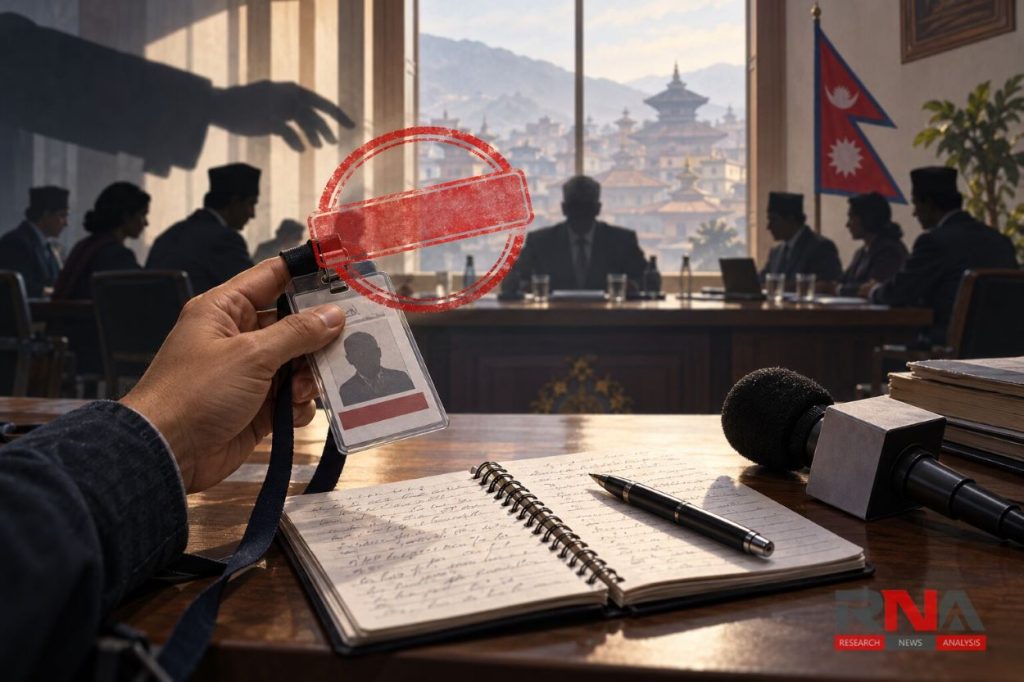
New Delhi: Nepal has proposed a three-tier system for dealing with breaches of journalistic standards, with measures ranging from corrections and apologies to recommendations that a journalist’s press pass be suspended for up to a year. The draft media council bill, released for public feedback, has also reopened a dispute over how independent the body enforcing those standards would be.
The proposal separates mistakes made in reporting from professional negligence and more serious violations of ethics. That distinction would determine the council’s response, while allowing people who say a report damaged their reputation, dignity or property to seek compensation through a district court.
Errors in names, job titles, dates or figures, along with typographical mistakes, would fall into the first category. The draft also places the unintended mixing of opinion with news reporting among journalistic errors, for which the council could direct a correction or require an apology.
The second category, professional negligence, covers failures that go beyond an ordinary mistake: inadequate fact-checking, the use of unverified sources, a failure to give an accused party a fair chance to respond, or misleading headlines and photographs. In such cases, the council could seek an explanation, order a public retraction and record the violation publicly.
At the most serious level, the draft lists conduct such as identifying child victims or survivors of sexual violence, inciting communal or religious hatred, character assassination, contempt of court and compromising national security. The council could recommend withholding government advertising and other state benefits, as well as suspension of press credentials for up to one year; the draft describes these as recommendations, rather than giving the council direct power to withdraw a pass.
A person affected by published material could bring a compensation claim before a district court under the proposal, while a party dissatisfied with a council decision could appeal to the High Court within 35 days. Those routes would put some decisions before judges, although they would not resolve the separate question of whether the council itself could act independently of the government.
That question centres on appointments. The proposed three-member council would have a chairperson and two members selected through a recommendation process led by the speaker of the House of Representatives, with the communications minister and a government-nominated media expert also involved; the head of the country’s information & broadcasting department would serve as an ex officio member.
The draft also provides for a 15-member directive committee bringing together journalists, academics, human rights and technology specialists, media representatives and audience delegates. Critics say the broader membership offers limited reassurance because the ministry would nominate seven media representatives to that committee, leaving substantial influence over the proposed regulator with the executive.
The former president of the Federation of Nepali Journalists, Shiva Gaunle, has warned that the appointment and removal provisions could make the council vulnerable to government pressure, particularly when it handles complaints against critical outlets. The federation’s vice-president, Nitu Pandit, has called for its involvement in drawing up the code of conduct and for the council to have greater authority over its own rules.
The government has presented the reform as a way to support responsible journalism while addressing changes in the information environment, including misinformation and AI-generated content. During stakeholder discussions in August, media representatives urged it to favour self-regulation, clarify how a media council would deal with online platforms and protect the proposed body from political influence.
Nepal has been through this debate before. A 2019 media council proposal drew protests over fines for ethical breaches, while a later bill ceased to progress after the dissolution of the country’s parliament in 2025; the press freedom group Freedom Forum had also challenged the earlier bill’s safeguards for council independence.
Some of the proposed remedies have precedents under Nepal’s existing press council arrangements. In an August examination of those rules, the council’s chair said it could recommend press pass suspension after repeated non-compliance but could not suspend a pass itself, and that the relevant department had not acted on such recommendations because of a legal obstacle.
The draft therefore puts two linked decisions before Nepal: how firmly to distinguish a correctable error from harmful misconduct, and who should be trusted to make that judgement. Its provisions remain proposals open to feedback, with the independence of the proposed council likely to remain the central issue as the legislation moves forward.