


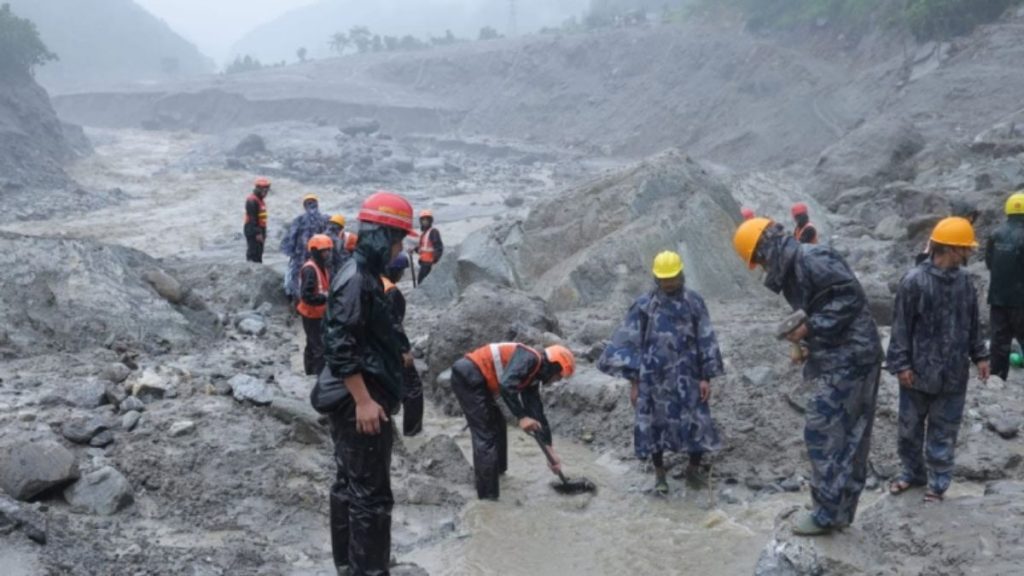
New Delhi: Nepal observed a national day of mourning on Monday as the confirmed death toll from the August 26 Bhote Koshi floods rose to 1,355, with 4,996 people still missing and rescue teams continuing searches across hydropower tunnels, damaged settlements and river corridors. Nepalese authorities said 13,396 people have been rescued, while approximately 600 foreign nationals from 35 countries remain among those unaccounted for.
The mourning day fell on the 13th day after the disaster, an important period in Hindu mourning traditions. National flags were flown at half-mast, but search and recovery operations continued across the worst-hit areas as authorities warned that casualty and missing-person figures could still change.
Search missions continue
Nepal’s foreign ministry said the floods had caused extensive damage to homes, roads, bridges, hydropower facilities and other infrastructure across Rasuwa, Nuwakot, Dhading and downstream areas. The Nepali Army, Nepal Police, Armed Police Force, disaster management agencies and local authorities remained deployed in rescue and relief operations.
Families in several affected communities have begun mourning rites even where remains have yet to be recovered, Reuters reported. Identification remains difficult because of the scale of destruction and the condition in which some bodies have been found.
Hydropower tunnels remain focus of rescue
Hydropower projects remain among the most difficult search locations. Reuters reported that around 900 workers linked to hydropower projects remain missing, with army rescuers estimating that about 121 may have been inside tunnels when the floods struck.
Searches are continuing at sites including Upper Trishuli-1, Upper Trishuli-3A, Upper Trishuli-3B and Chilime in Rasuwa. Rescuers are clearing mud, water and debris from tunnel entrances and other underground sections, while examining spaces where workers may have taken shelter.
Four survivors were brought out on Friday and Saturday. Two Nepali workers were rescued from the Upper Trishuli-3A tunnel, a Chinese national was brought out from Upper Trishuli-1 and a Nepali woman was rescued from a house in Betrawati, according to Nepal’s foreign ministry.
Officials have said some tunnels contain rooms and possible air pockets, but authorities have not suggested that large numbers of those missing will necessarily be found alive.
India expands rescue, relief, forensic assistance
India has deployed specialist teams and humanitarian supplies as part of its assistance to Nepal. As of the Ministry of External Affairs’ September 5 update, 169 Indian nationals had been rescued in Nepal.
A day earlier, the MEA said 275 Indians remained missing, while India had delivered about 95 tonnes of relief material on seven aircraft and deployed 54 specialists, comprising 30 tunnel rescue personnel, 19 forensic experts and a five member medical team.
Indian tunnel rescue specialists have been working alongside the Nepali Army at hydropower sites, particularly Chilime. The team shifted its base to Syabrubesi to reduce travel time to the rescue area and had earlier advanced around 100 metres through deep slush and tunnel blockages as crews worked to reach inaccessible sections.
RNA Media earlier reported that Indian tunnel rescue and forensic teams had joined Nepal’s operation as rescuers began reaching workers trapped inside hydropower tunnels.
India’s 19 member forensic team is assisting Nepalese authorities with DNA analysis and identification of recovered remains. Indian facilities have also been made available for first-degree relatives of missing people to provide DNA samples that can be compared with profiles taken from unidentified victims.
International teams join search
Nepal said tunnel rescue teams from India, China and South Korea were working with the Nepali Army, while personnel and assistance from the United Arab Emirates and Malaysia had also joined the wider response.
Kathmandu has requested additional specialized equipment, including high capacity drones, LiDAR systems, Bailey bridges, DNA testing kits, high capacity pumps, laboratory freezers and specialized tunnel and mud rescue suits.
Forensic specialists from India, China, Japan, Singapore and South Korea are also assisting with identification. Nepal has temporarily buried some unidentified remains after completing required forensic procedures so that DNA based identification can continue later.
Relatives of missing people have been asked to provide DNA profiles through Nepal Police or through facilities in their countries of residence.
Roads, power and communications being restored
Recovery work is also underway on roads, electricity networks, telecommunications and bridges. The Nepali Army and engineers are working to restore the Galchhi-Trishuli Road, including construction of a temporary bridge over the Tadi River.
Power and mobile connectivity have been gradually restored in some affected areas, although access to several locations remains difficult because roads and bridges were washed away or buried under debris.
Tibet toll remains separate from Nepal figures
Recovery work is also underway on roads, electricity networks, telecommunications and bridges. The Nepali Army and engineers are working to restore the Galchhi-Trishuli Road, including construction of a temporary bridge over the Tadi River.
Power and mobile connectivity have been gradually restored in some affected areas, although access to several locations remains difficult because roads and bridges were washed away or buried under debris.