


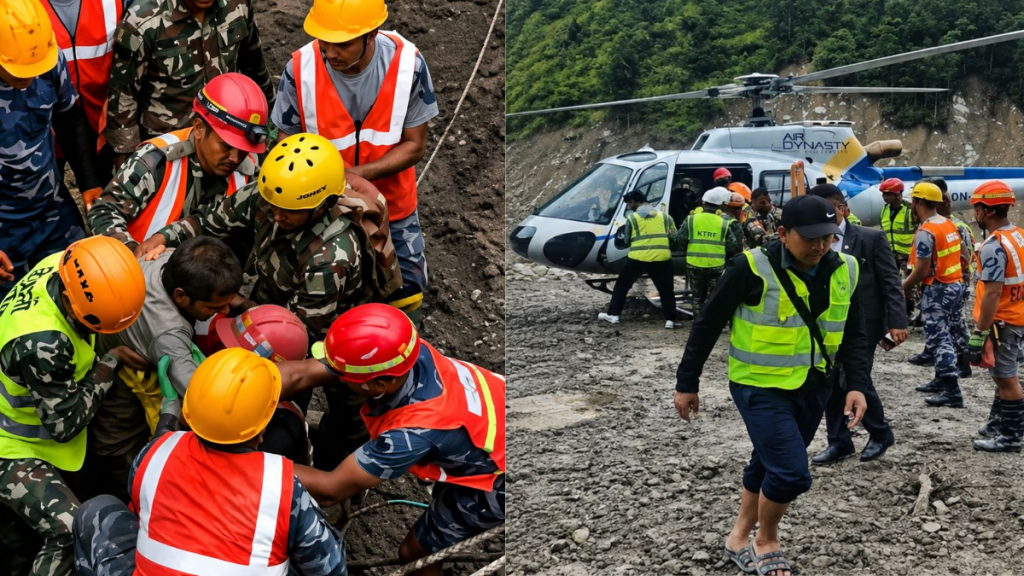
New Delhi: Two workers were rescued alive from Nepal’s upper Trishuli 3A hydropower station on Friday, hours after rescue teams heard voices from inside the blocked tunnel. The development came nine days after the August 26 flash floods and intensified efforts to reach others believed trapped inside hydropower tunnels across the Trishuli valley.
The Rastriya Swatantra Party lawmaker and engineer, Shri Ram Neupane, said rescuers heard responses from more than one person early on Friday. Nepali Army and Armed Police Force teams then stepped up the operation before mechanical foreman Sanjay Sah and mechanical supervisor Kabir Maharjan were brought out alive and flown to Kathmandu for treatment.
Associated Press reported that at least 557 workers from the Trishuli 3A project remain missing, with about 115 believed trapped in its main tunnel. Across 12 hydropower projects, around 900 workers are still unaccounted for and roughly 500 are believed to be inside tunnels.
The operation has been slowed by mud, rocks and debris blocking tunnel entrances. Rescuers have used excavators, controlled blasting, oxygen pipes and engineering drawings to clear access and identify underground sections where workers could have survived.
Nepal’s National Disaster Risk Reduction and Management Authority (NDRRMA) put the confirmed death toll at 1,259 in its latest consolidated update, with 5,083 people still missing. The authority said 12,038 people had been rescued overall, a figure separate from workers rescued from hydropower tunnels and nationality specific rescue counts.
Foreign nationals remain among those unaccounted for. The latest NDRRMA tally listed 583 foreign nationals as missing, while Nepal’s foreign ministry had said earlier on Thursday that more than 300 had been rescued. Authorities continue to revise the lists as people are traced and recovered remains are identified.
International assistance has expanded as Nepal seeks specialized support for tunnel rescue, forensic identification and access to isolated areas. China and South Korea have deployed specialist teams, Australia has dispatched a 15 member Disaster Assistance Response Team including drone operators, while the United States has announced more than $3.6 million in humanitarian assistance. United Nations agencies have also provided emergency funding and supplies.
On the Tibetan side of the border, Chinese authorities have reported 21 deaths and 541 people missing. The Gyirong border area was among the locations badly damaged when the flood swept across the Nepal-China frontier.
India’s rescue and relief effort
The Ministry of External Affairs has said 166 Indian nationals had been rescued in Nepal, while 410 Indians who had been visiting the Tibet Autonomous Region for pilgrimage or other purposes left China on Wednesday. Two more Indian Air Force C-130J aircraft reached Kathmandu on Thursday carrying a combined 21.5 tonnes of relief material, including forensic kits and medical equipment, following five earlier Indian relief flights.
RNA Media had earlier reported that India’s 19-member forensic team was assisting Nepal with DNA analysis and identification of victims, while Indian tunnel rescue personnel were working with Nepali teams at Chilime and Langtang. India has also sent specialist rescue personnel, medicines, generators, dewatering pumps, temporary shelters and other emergency supplies.
The latest move expands that forensic assistance. The Ministry of Home Affairs has made laboratories in India available for DNA profiling of first-degree biological relatives of people still missing in Nepal, allowing profiles prepared from parents, children or siblings to be compared with DNA obtained from unidentified remains recovered in Nepal.
Nepal’s new early warning plan
Meanwhile, Nepal has started preparations to rebuild an early warning system along part of its border with China. RNA Media had earlier reported that the disaster exposed gaps in cross border warning, including the loss of upper river monitoring stations and the absence of a formal mechanism for real time Nepal-China information sharing on glacial lakes, landslides and river blockages.
Reuters has since reported, citing two Nepali government sources, that authorities plan to install seismic sensors, cameras and a very small aperture terminal (VSAT) satellite link at Timure in Rasuwa district. Nepal has not formally announced the plan, but the proposed satellite connection is intended to keep monitoring stations transmitting when mobile networks fail.
Kathmandu also wants improved real time information from China on glacier movement and upstream water levels, alongside stronger monitoring of landslide and flood risks. The August 26 floods are believed to have been triggered by a glacier collapse near the Nepal-China border, sending water, ice, rock, mud and debris through the river system, although authorities continue to study the precise sequence of events.