


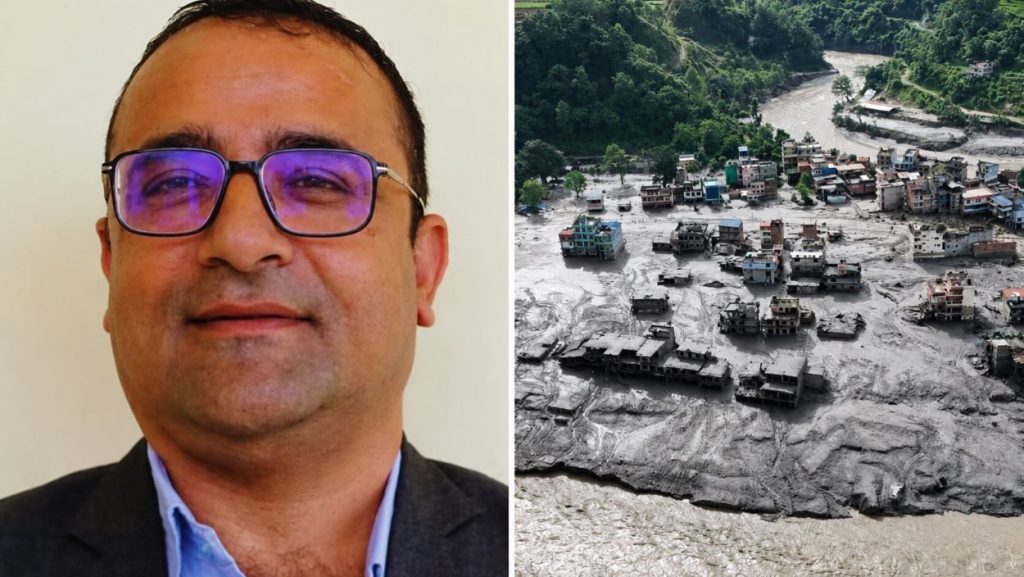
New Delhi: A warning from an upstream village and a rapid evacuation ordered by the principal, Rajendra Dawadi, prevented a potential mass-casualty event at Tribhuvan Trishuli Secondary School when catastrophic floods struck Nepal’s Nuwakot district on August 26. As many as 1,643 children who were either inside the three-storey school or travelling towards it were moved out of danger before the surge tore through the campus.
At about 9.20am, nearly 900 pupils were attending the morning shift while around 700 others were approaching the school on foot or in buses. Dawadi, a 47-year-old English teacher, then received an urgent telephone call from a friend at Betrawati, about eight kilometres upstream, warning that the settlement had been overwhelmed by the river.
The principal initially believed the school could withstand the approaching flood because its concrete buildings stood about 60 metres above the normal river level. His assessment changed when a parent arrived and reported that the water was rising with alarming speed.
Dawadi immediately sounded the school bell and instructed teachers to clear the classrooms and lead the pupils uphill. He also telephoned the school-bus drivers and ordered them to turn back, although one bus he could not contact had already begun crossing a bridge over the swollen river.
As the scale of the danger became apparent, one girl suffered a panic attack and was taken uphill on a motorcycle. The other pupils climbed towards higher ground on foot and eventually gathered beneath a bodhi tree, from where they watched floodwater, mud and debris engulf the school below.
The evacuation saved the children and most of the school’s staff, but two employees lost their lives. Santos Pariyar, a 32-year-old social-history teacher, was reportedly swept away after returning to his riverside accommodation to prepare breakfast, while the school’s caretaker, Sultan Lama, died after going back to secure the premises.
Residents subsequently described Dawadi as a hero, but the principal played down his role as he surveyed the remains of the campus. “What else could I do?” he told the British newspaper, framing his decision as an unavoidable responsibility rather than an exceptional act.
The episode demonstrates how a warning delivered through an informal local network can become decisive when official systems are damaged, delayed or unable to reach people directly. Dawadi’s decision to evacuate without waiting for further confirmation was particularly significant because the school’s elevation had previously appeared to offer adequate protection.
There are, however, discrepancies in the accounts that have circulated internationally. The school’s official website identifies the principal as Rajendra Dawadi, rather than “Dadabi” as his surname appeared in the original British report, while Kathmandu Post placed the school’s enrolment at 1,400 rather than 1,643.
The Nepalese newspaper reported that 40 students and teachers stranded around the school were airlifted on August 28 after bridges and roads were destroyed, with several others still awaiting evacuation. That operation appeared to concern people isolated by the loss of transport links after the initial escape rather than children left behind during the flood.
The school faces an uncertain future because the river has cut through its grounds and severed connections with neighbouring areas. Classes cannot resume until authorities establish temporary learning facilities or find a safer location for pupils whose classrooms, books and other materials have been lost.
The school’s ordeal formed one part of a much larger disaster caused by the collapse of glacial ice and rock near the Nepal–China border, which released a torrent of water, mud and debris into the Himalayan river system. By Sunday, Nepal’s disaster-management authority had recorded 781 deaths and 2,500 missing people, while the combined toll in Nepal and Tibet had reached at least 750 dead and more than 3,000 unaccounted for.
Children have been particularly affected across Rasuwa, Nuwakot and Dhading districts, where homes, healthcare centres and communications networks have been destroyed or damaged. Unicef said at least 17,000 children required urgent humanitarian assistance, with 18 schools destroyed, another 20 damaged and about 10,000 school-age children needing help to continue their education.
The disaster has also exposed the growing vulnerability of Himalayan communities to collapsing glaciers, landslides and sudden floods in a warming climate. While scientists will need time to determine the complete chain of causes, the survival of Dawadi’s pupils offers a compelling lesson in the value of trusted local warnings, decisive leadership and rehearsed routes to higher ground.