


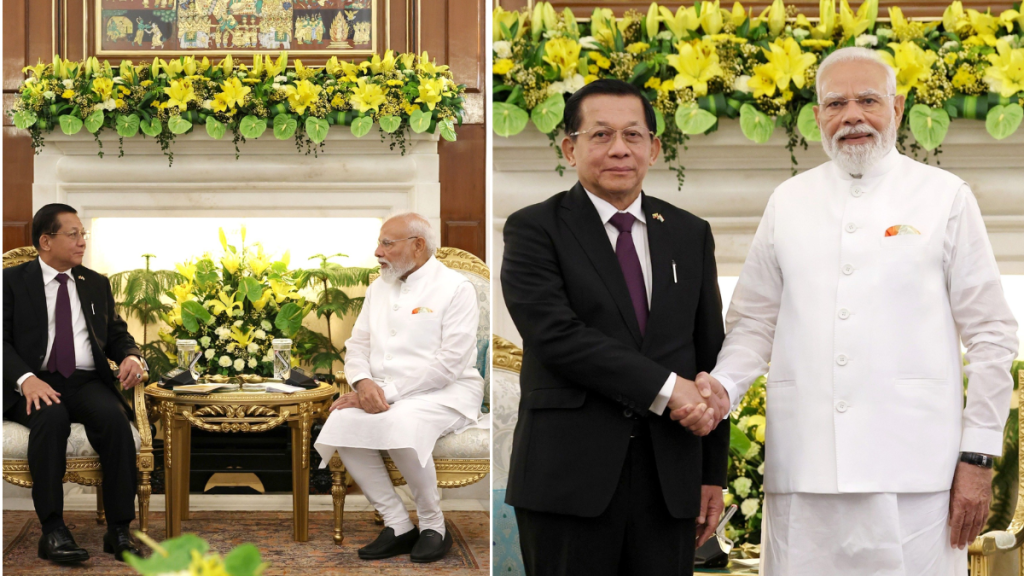
New Delhi: Myanmar has renewed its assurance to India that it will not allow Indian insurgent groups to operate from its territory, as the leaders of the two countries agreed to deepen security cooperation at a summit in New Delhi on Monday. The prime minister, Narendra Modi, also raised the continued detention of Myanmar’s democracy leader Aung San Suu Kyi with the visiting Myanmar president, U Min Aung Hlaing, what New Delhi described as part of a broader push for an inclusive peace process.
A joint statement issued after the talks at Hyderabad House said the president “reiterated Myanmar’s assurance that its territory would not be permitted to be used against India’s security interests.” Modi, in turn, reaffirmed India’s support for Myanmar’s sovereignty and territorial integrity and pledged to deepen security ties.
The foreign secretary, Vikram Misri, told reporters the insurgent presence near the border – a longstanding and sensitive concern for New Delhi – was raised directly by Modi during the discussions. “The president once again reiterated his assurance that Myanmar was sensitive to these concerns and would do everything necessary to ensure there was action against these groups and that they did not become a cause of threat against the security of India,” Misri said.
The assurance matters considerably for India, given the porous 1,643-kilometre border shared with Myanmar across several northeastern states, including militancy-affected Nagaland and Manipur. Separatist outfits with a history of cross-border movement have long been a security headache for Indian authorities.
Civil war and peace process
Misri also addressed Myanmar’s ongoing civil conflict, which has seen the military government – now formally under Min Aung Hlaing as a nominally civilian president – battling a constellation of ethnic armed organizations and resistance forces that emerged after the February 2021 coup. He said the Myanmar government was working to bring these groups to a common platform as part of a broader national dialogue aimed at building consensus on the country’s future governance.
“This is essentially an effort to see how the current structure of governance in Myanmar might need to change so that something can be crafted around which there is broad national consensus,” Misri said.
He underscored that instability in Myanmar carried consequences well beyond India’s border security, affecting connectivity to Southeast Asia and the coherence of Asean, of which Myanmar is the only member sharing a land border with India.
Suu Kyi and democracy
Modi’s raising of Suu Kyi’s imprisonment was framed by Misri as part of a wider conversation about Myanmar finding a path back to representative governance. “The prime minister was making a point on the need for Myanmar to find its way back towards democracy, the need for an enduring peace in the country, the need for inclusion, the need to have all stakeholders at the table,” Misri said.
Suu Kyi remains detained after being arrested in the February 2021 coup that her own elected government was swept aside by the military. Western nations have sought to isolate Myanmar’s military rulers since they ousted Suu Kyi, which triggered a crackdown on opponents and a brutal civil war. India has taken a markedly different approach, maintaining engagement even as it presses its concerns.
Misri defended that policy directly. “History has shown that disengagement doesn’t give us any results that are better than engagement, and it certainly doesn’t produce democratic change,” he said, adding that pulling back only created a vacuum that other powers – with no interest in democracy – would move to fill. The implicit reference to China, which has backed the Myanmar military and retained deep influence through infrastructure projects under the Belt and Road Initiative, was unmistakable, even if Misri did not name Beijing.
Cybercrime, trafficking, and broader
The talks ranged across a wide agenda. The leaders discussed cooperation against cybercrime and human trafficking, issues that have affected thousands of Indians lured to scam centres in the region. India and Myanmar have worked together to rescue more than 2,400 Indian nationals over the past 18 months. Around 150 Indian nationals are still believed to be trapped in such facilities, and discussions are underway with Myanmar authorities to facilitate their return.
The two sides agreed to increase bilateral trade from the current $2 billion, including through a rupee-kyat settlement mechanism, and to strengthen defence and security ties. They also discussed cooperation in critical minerals and mining. India has a strategic interest in Myanmar’s rare earth deposits, which could help reduce its dependence on China-dominated supply chains for materials essential to defence and high technology industries.
Modi and Min Aung Hlaing did not address the media after their meeting, unlike the usual practice at bilateral summits in New Delhi. During the visit, Min Aung Hlaing also met the president, Droupadi Murmu; the foreign minister, Subrahmanyam Jaishankar; and the national security advisor, Ajit Doval.
The visit, which runs from May 30 to Tuesday, marks Min Aung Hlaing’s first trip abroad since becoming president following Myanmar’s parliamentary elections, results of which were declared in April this year. Analysts had widely expected his first foreign visit to be to China, Myanmar’s biggest external backer, making the choice of India as his first destination a diplomatically significant signal.
Min Aung Hlaing is due to travel to Mumbai on Tuesday for business meetings before the visit concludes.