


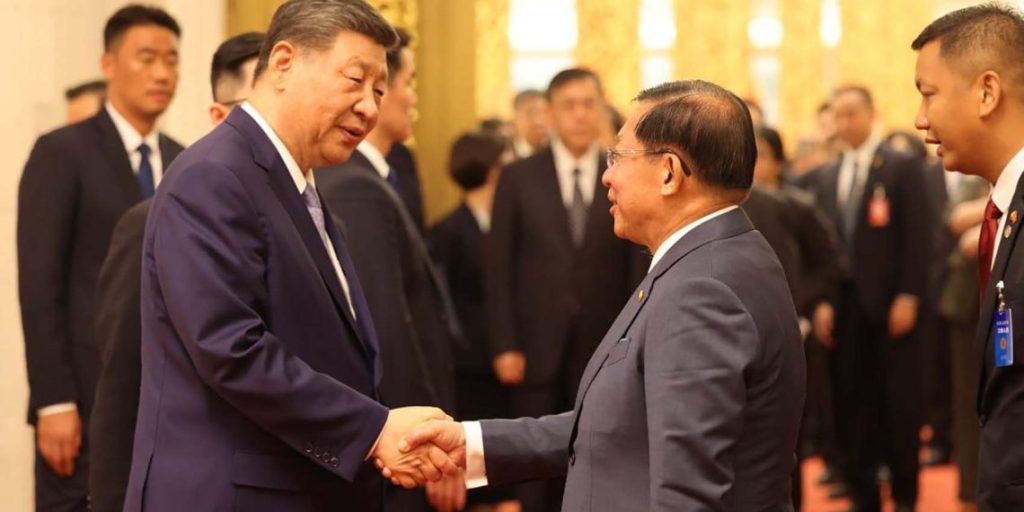
New Delhi: Myanmar’s military-backed government has moved closer to China by becoming the first known country to formally endorse all four flagship global initiatives of the Chinese president, Xi Jinping. This is seen as a step that analysts say underlines Naypyidaw’s growing dependence on Beijing for diplomatic, economic and security support as it seeks to consolidate its position after years of civil conflict.
The MoUs (memorandums of understanding) were signed during the visit of the Burmese president, Min Aung Hlaing, to China in June, where he held talks with Xi. The agreements cover the Global Security Initiative (GSI), Global Development Initiative (GDI), Global Civilization Initiative (GCI), and Global Governance Initiative (GGI), pillars of Beijing’s expanding foreign policy framework aimed at increasing China’s influence across the developing world.
Myanmar’s government has described the decision as unprecedented, noting that while several countries have supported one or two of the initiatives, Myanmar is the first to sign cooperation agreements covering all four.
The move marks another milestone in the steady strengthening of ties between Beijing and Naypyitaw since the military seized power in 2021. International sanctions and diplomatic isolation pushed Myanmar’s rulers to rely increasingly on China, which has emerged as the country’s principal strategic partner, providing political backing, economic engagement and security cooperation.
China presents the four initiatives as frameworks for promoting development, security, cultural exchanges and improvements in global governance through greater cooperation among developing countries. However, many western governments and independent analysts argue that the initiatives also serve Beijing’s broader geopolitical objective of reshaping international institutions and expanding its strategic influence while emphasizing state sovereignty and non-interference over liberal democratic norms.
Regional security analyst Jason Tower said the agreements demonstrate Myanmar’s comprehensive strategic alignment with China and reflect the military leadership’s reliance on Beijing to secure its political future.
According to Tower, China’s support has become indispensable for the military-led government as it attempts to strengthen its authority after years of armed resistance across large parts of the country. Beijing has increased its engagement since 2025, including encouraging ceasefires involving several ethnic armed organizations operating near the China-Myanmar border.
Among the four initiatives, the Global Security Initiative is widely regarded as the most consequential for bilateral ties.
The joint statement issued after the summit committed both countries to strengthening security cooperation for Chinese infrastructure projects under the Belt and Road Initiative (BRI), many of which pass through conflict-affected regions of Myanmar. Those projects include oil and natural gas pipelines linking the Bay of Bengal to China’s Yunnan province, as well as the China-Myanmar Economic Corridor and the strategically significant Kyaukpyu deep-sea port on Myanmar’s western coast.
The two sides also agreed to enhance cooperation in border management and the protection of Chinese personnel and investments operating inside Myanmar.
Observers believe these commitments could pave the way for a greater role for Chinese private security companies in protecting Beijing’s commercial interests. Myanmar had already enacted legislation allowing private security firms to operate in the country and earlier established a joint security venture with Chinese participation.
Veteran Myanmar analyst Bertil Lintner said the latest agreements could accelerate the presence of Chinese security contractors, particularly around major Belt and Road projects.
For Beijing, stability in Myanmar is closely linked to the security of its southwestern frontier and the uninterrupted operation of critical energy and transport infrastructure. China also has significant investments in mining, hydropower and industrial projects across the country, making political stability a strategic priority.
For the military-led administration, closer engagement with China offers diplomatic legitimacy, economic investment and continued access to a powerful international partner at a time when many Western countries continue to maintain sanctions and limit official engagement following the 2021 military takeover.
The agreements also reinforce China’s broader effort to position its global initiatives as alternatives to western-led political and security frameworks, particularly across Asia, Africa and the Global South. Xi has increasingly promoted the initiatives as central pillars of China’s vision for a multipolar international order, with Beijing seeking wider acceptance through bilateral partnerships and development cooperation.
The latest developments come as several regional countries cautiously re-engage with Myanmar’s military-backed government following the country’s controversial elections earlier this year, although many Western governments continue to question the legitimacy of the political process. Asean foreign ministers are also preparing for renewed engagement with Myanmar in an effort to encourage dialogue and address the country’s prolonged internal conflict.