


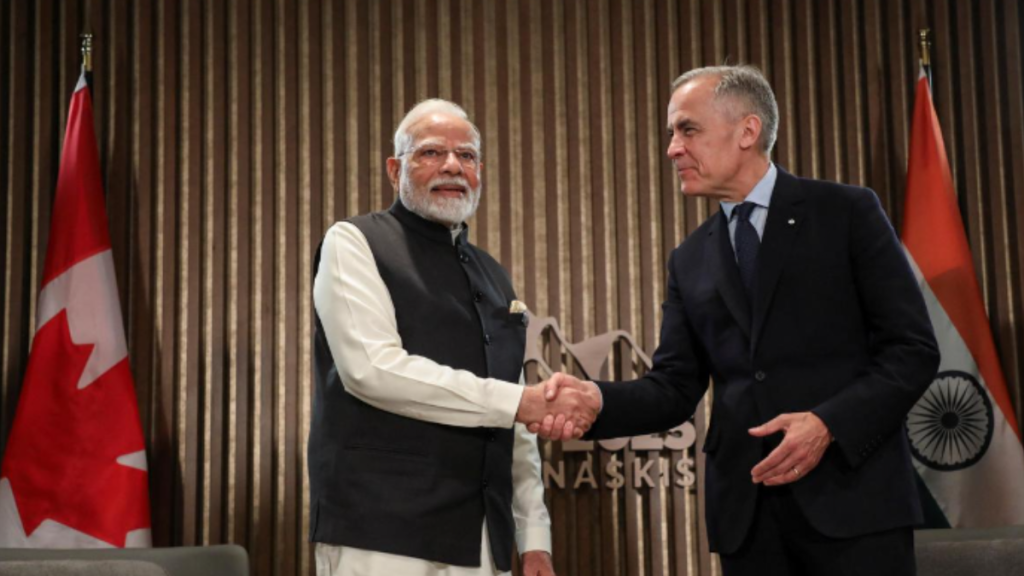
New Delhi: The prime minister, Narendra Modi, will likely visit Canada in December, the Canadian prime minister, Mark Carney, announced, saying the two countries aim to conclude the ongoing trade talks by the G20 summit, which will be held in the United States on December 14–15 this year.
Carney added that the two prime ministers had together decided to conclude the trade negotiations by then.
India and Canada have come a long way since 2023, when the bilateral ties between the two countries nearly broke down after Ottawa accused the Indian government of orchestrating the killing of Sikh separatist Hardeep Singh Nijjar in British Columbia.
New Delhi’s relations with Ottawa improved this year, with Carney visiting India between February 27 and March 2 to meet Modi, followed by further talks at the G20 summit in Johannesburg, where both sides agreed to restart a long-stalled free trade agreement called the India-Canada Comprehensive Economic Partnership. Modi last visited Canada during the G7 Summit held in June last year at the invitation of the Canadian prime minister.
“We are making good progress in our trade negotiations with India,” Associated Press reported Carney as saying at a news conference on the sidelines of the ongoing UN General Assembly.
Canada and India formally launched trade negotiations on a comprehensive trade agreement in March this year.
Only a day ahead of Carney’s announcement, the Canadian minister of international trade, Maninder Sidhu, met India’s minister of commerce and industry, Piyush Goyal, in Mumbai.
In a statement, the Canadian government said, “The ministers met alongside Canada and India’s chief trade negotiators to discuss opportunities for strengthened trade and investment ties and advance discussions on a Canada-India Comprehensive Economic Partnership Agreement (CEPA).”
As of now, four rounds of negotiations for the CEPA have taken place between the two countries. Officials plan to keep working together to sustain momentum and close remaining differences, with a joint goal of wrapping up negotiations before 2026 ends.
Canada aims to double its exports to markets outside the United States over the coming decade, which includes growing two-way trade with India to $70 billion a year by 2030.
India recently concluded and trade negotiations with New Zealand with the Free Trade Agreement set to come into effect on October 20. A similar exercise was completed last year with the UK, which came into effect on July 15 this year.
Such agreements help by cutting tariffs and easing regulatory barriers, which lowers costs, opens new markets for exporters, and boosts overall bilateral trade and investment flows.
US-Canada tensions
The trade talks come at a time when Carney intends to double Canada’s non-US trade over the next decade. India is part of the same effort to reduce the country’s dependence on the United States, as relations between the US and Canada have taken a hit under President Donald Trump.
To this effect, Carney looks to becoming the European Union’s first associate member to ensure that Canada’s markets and are not controlled by external powers. Furthermore, Canada let in a limited number of Chinese EVs at a much lower tariff, in exchange for China cutting tariffs on Canadian canola.
Trade talks between the US and Canada collapsed after mutual tariff escalations, leaving relations sharply strained.