


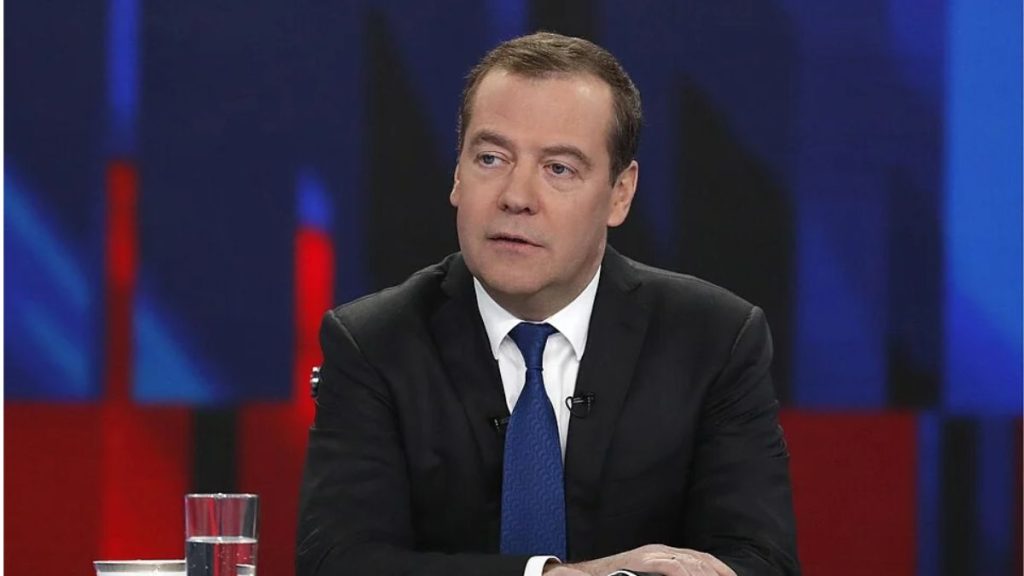
New Delhi: The Russian security council deputy chairman, Dmitry Medvedev, has warned that Moscow could consider a nuclear strike on Ukraine under certain circumstances, accusing Kyiv and its western supporters of creating situations that raise the prospect of nuclear escalation. He nevertheless said the war had not so far produced a direct necessity for Russia to use nuclear weapons.
The former Russian president made the remarks in an article titled state sovereignty and nuclear weapons: international legal aspects of ensuring national security, published in the Moscow journal of international law. According to TASS, Medvedev alleged that Ukraine, Nato countries and other western states had already created circumstances in which Russia considered the “possibility of launching a nuclear strike”.
Medvedev qualified his warning by saying that events in Ukraine had not reached the threshold requiring nuclear action. He said Putin would ultimately decide whether to authorize such a strike, based on an assessment of the circumstances, the damage sustained and whether a response would be proportionate.
Conditions for possible nuclear use
Medvedev argued that Russia could invoke its nuclear capabilities to defend national security if its survival were threatened or it suffered unacceptable damage. He claimed that large-scale attacks involving conventional weapons, particularly air- and space-based systems capable of causing severe industrial, environmental or social disasters, could bring a pre-emptive nuclear response into consideration.
At the same time, he acknowledged that Russia’s nuclear doctrine does not expressly authorize preventive nuclear use. His argument about when a pre-emptive strike might be justified therefore reflects his interpretation, not a declaration that Moscow has decided to undertake such an attack.
Russia’s nuclear deterrence policy, revised in November 2024, identifies circumstances in which Moscow could consider nuclear weapons, including attacks involving weapons of mass destruction and conventional aggression posing a critical threat to Russian or Belarusian sovereignty or territorial integrity. The doctrine also covers reliable warnings of ballistic missile attacks, large-scale aerial and space-based attacks crossing Russia’s borders, and attacks on critical government or military facilities that could undermine Russia’s ability to retaliate with nuclear weapons.
Legal argument and Ukraine’s position
Medvedev cited the international court of justice’s 1996 advisory opinion to support his argument that nuclear weapons could be used when a state’s survival was threatened. The court found that nuclear use would generally conflict with international humanitarian law but could not reach a definitive conclusion on its legality in an extreme circumstance of self-defence involving a state’s survival. The opinion did not provide blanket legal authorization for a preventive nuclear strike.
Separately, Ukrainian president, Volodymyr Zelenskyy, called on Monday for early negotiations involving Ukraine, Europe, the United States and Russia, while reiterating his demand for Nato membership as a lasting security guarantee. Addressing the Nato parliamentary assembly in Berlin by video link, he said Kyiv was prepared to participate in four-party talks at short notice, underlining Ukraine’s pursuit of diplomatic negotiations alongside stronger long-term security arrangements.
Medvedev’s latest remarks add to repeated nuclear warnings from senior Russian officials during the conflict, even as Moscow describes such weapons as instruments of deterrence. His acknowledgement that no immediate need has arisen stops short of signalling an impending strike but underscores the risks of miscalculation surrounding any confrontation involving Russia and Nato.