


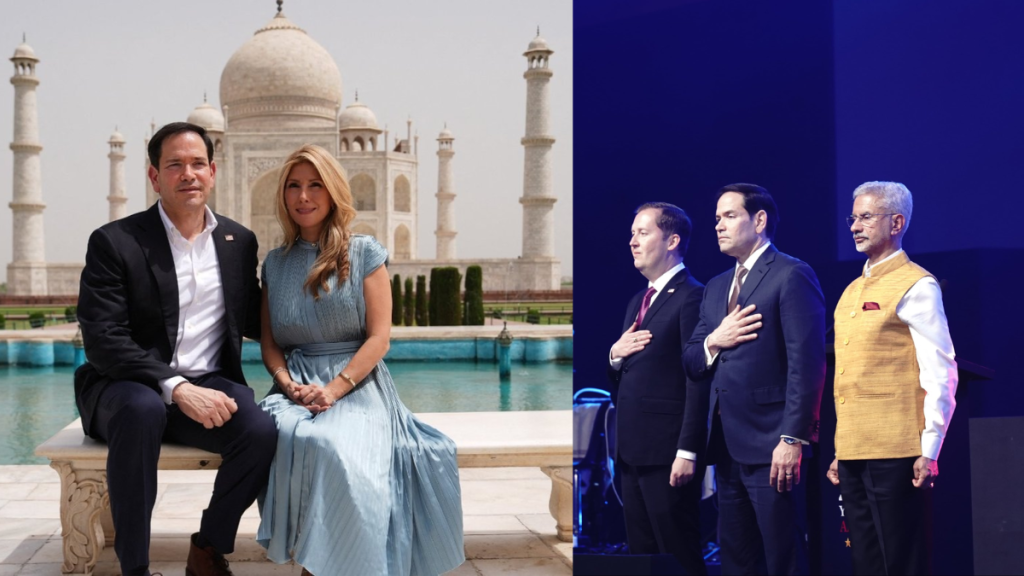
US Secretary of State Marco Rubio met External Affairs Minister S. Jaishankar on Sunday (May 24) as part of his four-day India visit. The two sides discussed the ongoing interim trade agreement between New Delhi and Washington, with indications that a conclusion may be near.
Talks centred on the India–US partnership, reaffirming steady bilateral ties despite recent tariff-related tensions. Both sides expressed commitment to deepening cooperation going forward.
During the media briefing, Rubio was asked about US engagement with Pakistan and China. He said Washington continues to engage with countries across different issues at a “tactical level,” but stressed that such engagements do not dilute long-term strategic relationships.
“I don’t view our relations with any country in the world as coming at the expense of our strategic alliance with India,” Rubio said, describing India as a major democratic partner of the United States. He expressed confidence that the partnership would grow even stronger by the end of the current US administration.
Rubio Invites PM Modi to the White House
A day earlier, on Saturday (May 23), Rubio met Prime Minister Narendra Modi. Discussions covered security, trade, and critical technologies — areas both sides identified as central to a free and open Indo-Pacific. Rubio extended a formal invitation from President Donald Trump for PM Modi to visit the White House in the near future.
PM Modi, sharing details of the meeting on social media, said: “We discussed progress in the India–US Comprehensive Global Strategic Partnership and issues related to regional and global peace and security. India and the United States will continue to work closely for the global good.”
Rubio Visits Taj Mahal, Jaipur on Cultural Tour
On Monday (May 25), Rubio visited the Taj Mahal in Agra with his wife before travelling to Jaipur for cultural engagements.
He is scheduled to return to New Delhi on Tuesday (May 26) for the Quad Foreign Ministers’ Meeting, where discussions are expected to focus on Indo-Pacific security, regional cooperation, and strategic coordination among the four member nations.