


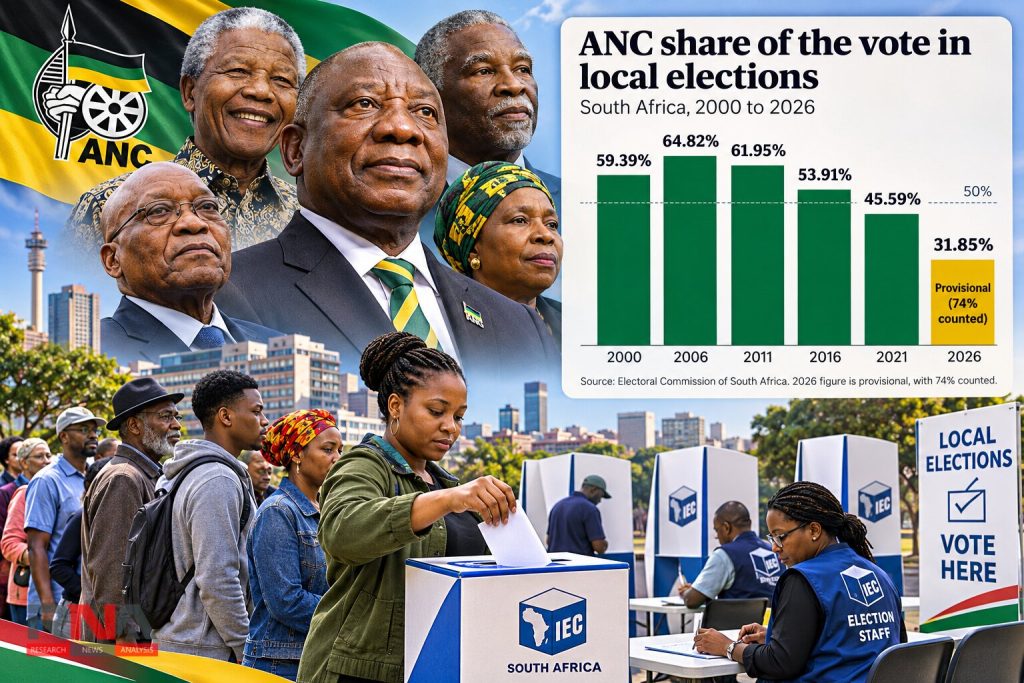
New Delhi: South Africa’s African National Congress (ANC), the liberation movement that dismantled apartheid and subsequently dominated the country’s politics for more than three decades, is heading towards its worst electoral performance since the arrival of democracy in 1994. Provisional results from the Wednesday municipal elections show the party losing substantial ground to opposition rivals, particularly in major cities, as public frustration over unemployment, corruption and deteriorating essential services reshapes the country’s political landscape.
With approximately 84 per cent of voting districts counted by Friday afternoon, the ANC had secured 31.9 per cent of the national vote, followed by the Democratic Alliance (DA) with 24.1 per cent and the uMkhonto weSizwe (MK) party with 9.3 per cent. The figures, drawn from provisional Electoral Commission data, represent a sharp decline from the ANC’s approximately 45.6 per cent share in the 2021 municipal elections, although the final outcome remains subject to counting in outstanding districts.
The results suggest that South Africa is entering a more fragmented phase of democratic politics, with no single organization capable of exercising the authority once enjoyed by the ANC. Although the governing party remains ahead nationally in the combined municipal vote, it is facing the prospect of surrendering its position as the largest political force in Gauteng and KwaZulu-Natal, the country’s two most populous provinces.
The Electoral Commission of South Africa is expected to announce the final results on Sunday, after which the battle for control of municipal councils will move into formal coalition negotiations. The outcome could influence the political fortunes of the president, Cyril Ramaphosa, and his party before the next national elections scheduled for 2029.
Johannesburg becomes biggest battleground
The most politically consequential contest is unfolding in Johannesburg, South Africa’s commercial capital, where the ANC faces the possibility of losing its remaining influence over a municipality that has experienced years of administrative instability. The DA, campaigning on promises of restoring basic services and improving municipal management, has established a substantial lead over the governing party.
According to provisional figures published on Friday afternoon, the DA was leading with approximately 39.5 per cent of the vote in Johannesburg, compared with the ANC’s roughly 17 per cent, with counting still incomplete. The contest has been dominated by Helen Zille, the 75-year-old former mayor of Cape Town, whose campaign has focused on the city’s neglected infrastructure, unreliable water supply and deteriorating public spaces.
Johannesburg has become an illustration of the difficulties associated with unstable coalition administrations, having experienced 10 changes of mayor over the past decade. The municipality has acknowledged an infrastructure investment backlog of approximately 220 billion rand, reflecting the scale of the challenge facing whichever political grouping eventually assumes power.
Residents have repeatedly complained about interrupted water and electricity supplies, damaged roads, overflowing rubbish and inadequate maintenance of public facilities. These problems have made municipal administration, rather than the ANC’s historical role in defeating apartheid, a decisive issue in the election.
The DA is also leading in Gauteng’s other two metropolitan municipalities, Tshwane, which includes the administrative capital Pretoria, and Ekurhuleni, an important industrial and manufacturing centre. However, leading the vote count does not guarantee control of a municipality because parties must secure sufficient council seats to elect a mayor and sustain an administration.
The Council for Scientific and Industrial Research has projected that the DA could finish with approximately 34 per cent in Johannesburg, ahead of the ANC on 20 per cent and ActionSA on 16.8 per cent. Such an outcome would require negotiations with smaller parties, some of which have already indicated that personal and ideological differences could complicate coalition formation.
Zuma’s MK party challenges ANC in KwaZulu-Natal
The ANC’s difficulties extend beyond Gauteng to KwaZulu-Natal, where the MK party, associated with the former president, Jacob Zuma, is emerging as the principal beneficiary of disillusionment with the governing establishment. The party, established in 2023, combines appeals to Zulu political identity with demands for economic redistribution and has challenged the ANC’s traditional electoral base.
In eThekwini, the metropolitan municipality incorporating Durban, the MK party was leading with approximately 41 per cent of the vote in Friday’s incomplete count. The DA was running second, and the possibility remained that several competing parties could combine their council seats to prevent MK from taking power despite its lead.
Zuma’s political resurgence has added another dimension to the ANC’s decline, demonstrating the extent to which divisions within the former liberation movement have weakened its electoral strength. His departure from the ANC and subsequent association with MK have helped divide a constituency that once formed a substantial part of the party’s support in KwaZulu-Natal.
The MK party also secured a significant foothold during the 2024 parliamentary elections, confirming that it was more than a temporary protest movement. Its performance in the latest municipal contests suggests that the competition for political influence in KwaZulu-Natal could increasingly revolve around former ANC constituencies rather than a straightforward contest between the ANC and the DA.
Why ANC is losing its traditional support
The municipal election results are the latest stage in a political decline that became unmistakable during the 2024 general election, when the ANC won just 40.18 per cent of the national vote. That result ended its parliamentary majority for the first time since 1994 and forced Ramaphosa to establish a coalition government involving the DA and several smaller parties.
The arrangement, described as a government of national unity, has allowed the ANC to retain the presidency but has also exposed the political difficulties of sharing power with longstanding opponents. Its national partnership with the DA has not eliminated their rivalry in municipalities, where competing political ambitions and local alliances continue to shape electoral contests.
Economic hardship remains central to the governing party’s difficulties, with South Africa struggling to create sufficient employment for its expanding workforce. According to Statistics South Africa, the official unemployment rate reached 33.6 per cent in the second quarter of 2026, with approximately 8.5 million people unemployed and the jobless rate among young people aged 15–34 reaching 47.4 per cent.
Persistent inequality, inadequate public infrastructure and allegations of corruption have further weakened confidence in established political institutions. For younger voters, many of whom have no personal memory of apartheid, the ANC’s liberation credentials appear increasingly insufficient to compensate for failures in employment generation and public administration.
Nevertheless, the opposition’s gains do not necessarily represent a uniform endorsement of one alternative political programme. The DA’s performance in metropolitan centres, MK’s strength in KwaZulu-Natal and the emergence of smaller parties point instead to an electorate increasingly willing to distribute its support among competing organizations.
Coalition politics to determine South Africa’s next chapter
The increase in voter participation adds significance to the political shift, with the election commission estimating turnout at 54.5 per cent of registered voters, compared with approximately 46 per cent in 2021. Rather than withdrawing from electoral politics, a larger proportion of eligible voters appears to have used the municipal elections to register dissatisfaction with existing administrations.
The immediate challenge will be forming functioning governments in municipalities where no party commands an outright majority, particularly in Gauteng’s economically important metropolitan centres. Parties have two weeks after the formal declaration of results to constitute their councils, elect mayors and begin establishing administrations capable of surviving political disagreements.
ActionSA, led by Herman Mashaba, could become an important negotiating partner in several councils, although its relationship with the DA leadership is complicated by longstanding disagreements. Mashaba has publicly ruled out working with Zille, making Johannesburg’s coalition arithmetic particularly difficult despite the DA’s substantial electoral lead.
The ANC and DA could also consider local partnerships despite their political competition, although such arrangements carry the risk of alienating supporters who voted for a change of administration. Opposition leaders have indicated that negotiations will depend on commitments to improving services, stabilizing councils and addressing corruption rather than simply distributing political offices.
For Ramaphosa, the wider implications extend beyond municipal administration because another electoral setback could sharpen internal criticism of his leadership and intensify debate over the ANC’s future direction. The party must now reconcile its historical identity as the principal force behind South Africa’s democratic transition with the increasingly demanding expectations of an electorate prepared to withdraw its support.
The final municipal results will determine the distribution of council seats, but the political message emerging from the incomplete count is already substantial. South Africa’s governing party can no longer assume that its liberation legacy guarantees electoral loyalty, and its opponents must now demonstrate whether they can deliver the improvements in everyday life that voters have demanded.